TOEFL Primary Step 2 Test #12 - Reading
5/20/2020 8:29:00 PM- Pancake
- Omelet
- Grilled sausage
- Hill
- Bank
- Field
- West
- South
- East
It's a place in an airport or on a ship that sells alcohol, cigarettes, etc. without the tax that you have to pay if you buy them in a country. What is it?
- Immigration
- A duty-free shop
- A travel agency
- Insects
- Mammals
- Carnivores
This happens when you are not sure about and try to guess what is true, what will happen. What are you doing?
- Wondering
- Thinking
- Trembling
- A printer
- A shredder
- A binder
- A coward
- A hero
- A traitor
When two people do this against each other, they hit and kick the other person in order to hurt them. What are they doing?
- Discussing
- Yelling
- Fighting
Read the letter. Then answer questions.
Dear Susan,
I'm going to stay in Miami during the summer vacation. I found a lovely beach house near Miami Beach. It has three bedrooms, four bathrooms, a dining room, a kitchen, and a garage.
I rented it for two months. So if you haven't set up any plans yet, you are more than welcome to stay with me. Talk to you later.
Sincerely,
Jennifer
Where is the beach house?
- Near Jennifer's house
- Near Miami Beach
- Near Susan's house
How long can Jennifer stay at the beach house?
- For two weeks
- For two years
- For two months
Read the letter. Then answer the questions.
Dear Alex,
How are you doing? Do you like your new home? How's your new school? lt has been a month since you moved to your new city. Did you make many friends? We all miss you a lot. We talk about our best player (That's you!) when we play basketball after school. We had a tournament last week, and we came in second. If you were here, we could have won the whole thing.
Write to tell us how you are doing and what your new school is like. Let's keep in touch. Take care.
Your best friend,
Michael
What is true about Alex?
- He likes soccer.
- He moved to a new city.
- He doesn't know how to play basketball.
Why did Michael write a letter to Alex?
- To blame him for the game
- To ask how he is doing
- To tell him that he is moving, too
Read Lucy's bank record. Then answer questions.
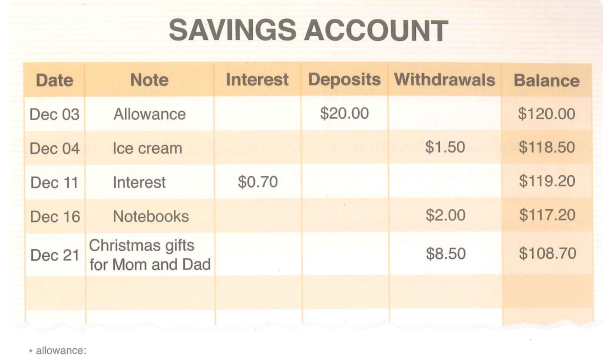
What type of money did Lucy get on December 3rd?
- Money her parents gave her.
- Money she earned before.
- Money she was awarded.
What did Lucy do on December 4th?
- She got her allowance.
- She bought some ice cream.
- She went to school.
How much money did Lucy earn on December 11th?
- Seventy cents
- Seventeen cents
- Seven cents
What is true about Lucy's last balance?
- She has less than one hundred dollars.
- She has more than one hundred dollars.
- She has exactly one hundred dollars.
Read the instruction. Then answer the questions.
The library provides the materials and the quiet environment needed for scholarly work. Please respect the library by following these rules:
1. Students mustn't bring food into the library.
2. Drinks (hot or cold) can be brought in to the library but only if they are in a container such as a sports bottle, travel mug or keep cup.
3. Mobile phones must be turned to "silent" mode.
4. Conversations on mobile phones must be held outside of the library.
5. The rule of silence must be respected and antisocial behaviour will not be accepted.
6. All books and magazines must be returned to the shelves after use.
Students who do not follow these rules will be required to leave, and repeat ones will not allowed to use the library until they leave the school.
What mustn't students do in the library?
- Bring mobile phones
- Read books and magazines on the shelves
- Bring drinks without containing in bottles
What does the rule 4 mean?
- Students cannot chat on phones.
- Students have to go outside to answer the phone.
- Students cannot chat about the library.
What will happen if students break the rules more than once?
- They cannot use the library any more.
- They have to pay money.
- They have to leave outside the library.
Read the story. Then answer the questions.
Last weekend, a little girl named Emily found herself lost and scared in a busy shopping mall. Amidst the hustle and bustle of the crowd, people hurriedly passed by, paying little attention to her.
Then, a kind man named Jack noticed Emily's fear and approached her. With a gentle smile, he asked, "Hey there, what's your name? Are you lost?"
Emily looked up at him with teary eyes but remained silent. Jack sensed her anxiety and suspected she might be too scared to speak.
Thinking quickly, Jack gestured towards the mall's help desk and said, "Let's find your parents together. We'll go to the help desk."
Emily seemed to understand, and she nodded. She followed Jack to the help desk. Jack explained the situation to the staff, and they quickly made an announcement over the mall's speaker system, describing Emily's appearance and asking for her parents to come to the help desk.
After an anxious 15-minute wait, a worried woman rushed in. She looked so worried. She hugged Emily tightly and turned to Jack, saying, "Thank you so much! I searched everywhere to find her. She has some hearing problems, and she accidentally left her aids at home."
Jack smiled and replied, "You're welcome. I'm glad she's safe."
What did most people do when they saw Emily at the mall?
- They had no money to give her.
- They didn't care about her.
- They stopped to chat with her.
How did Jack help Emily find her mother?
- He led her around the shopping mall.
- He took her to the mall's help desk.
- He asked for her mother's number and called her.
Why didn't Emily answer Jack when he approached her?
- She was too scared to say a word.
- She was told not to speak to strangers.
- She had a hearing impairment.
What can be the best title of the passage?
- The Busy Shopping Mall
- A Shopping Mall Rescue
- Emily's Silent Encounter
Read the passage and answer the questions.
Out West
Eliza stared out of the back of the covered wagon. Fields of grass stretched for miles and miles behind them. Eliza thought she had felt every single bump of the wagon along the way.
Riding in the back of the wagon was definitely not comfortable. She and her sister Martha were squeezed in among all of the family’s belongings. Wooden chests held clothes and blankets. Crates held her mother’s iron pots and pans. A barrel held bread and dried meat for the long journey.
Eliza sighed. She had been happy at their home in Ohio. But her father was eager to settle out west. There was rich farmland for the taking out there. He dreamed of a cabin and fields of corn. But Eliza missed her little house in Ohio. She missed her friends. She knew life on a farm was hard work. Would there even be a school out there?
Her father didn’t seem to care about these things. “The Civil War is over,” he said. “It’s time for a fresh start for all of us.” So they had packed up their belongings and joined the next wagon train out west.
Eliza was relieved when the wagon came to a stop. The wagons in the train formed a circle. It was time to get out, stretch, and cook the evening meal. The men had killed some wild pheasants the day before, so dinner would be tasty, at least.
Eliza hopped out of the wagon. They were in the middle of a prairie. Colorful flowers grew among the tall grasses. They made Eliza smile. She still wasn’t happy about the move out west. But at least the flowers were pretty.
(Adapted from readworks.org)
- the beauty of nature.
- the importance of family.
- a new beginning.
What did Eliza think about the new place she would move to?
- Whether she could make friends
- Whether she could go to school
- What she could do on the farm
We know that Eliza has arrived at the prairie because
- there were colorful flowers.
- the grasses were tall.
- all of the above.
Which of the following does not tell the date of this story?
- Eliza is moving away from her home in Ohio.
- The family is traveling in a covered wagon.
- The father mentions that Civil War just ended.
Read the story. Then answer the questions.
Starting at a new school
By Anna Gray, age 11
I’ve just finished my first week at a new school and I’d like to tell you about it. Like other children in my country, I went to primary school until I was eleven and then I had to go to a different school for older children. I loved my primary school but I was excited to move to a new school.
It was very strange on our first day. There were some kids from my primary school there, but most of the children in my year group were from different schools. But I soon started talking to the girl who was sitting beside me in maths. She lives near me so we walked home together. We're best friends now.
When I saw our timetable there were lots of subjects, some were quite new to me! Lessons are harder now. They're longer and the subjects are more difficult, but the teachers help us a lot.
At primary school, we had all our lessons in one classroom. Now each subject is taught in a different room. It was difficult to find the classrooms at first because the school is so big. But the teachers gave us each a map of the school, so it's getting easier now.
The worst thing is that I have lots more homework to do now. Some of it is fun but I need to get better at remembering when I have to give different pieces of work to the teachers!
How did Anna feel about moving to a new school?
- Worried about being with lots of older children
- Happy about the idea of doing something different
- Pleased because she was bored at her primary school
What does Anna say about the timetable at her new school?
- It includes subjects she didn't do at primary school.
- She has shorter lessons than she had at her old school.
- It is quite difficult to understand.
Why couldn't Anna find her classrooms?
- She couldn't read a map.
- There was little time between lessons.
- The school building was very large.
What does Anna say about the homework she has now?
- She gets more help from some teachers than others.
- She thinks it is the hardest part of school life.
- She remembers everything she's told to do.
Read the passage. Then answer the questions.
Paper folding
People have been making things out of paper since the Chinese invented it, over 2,000 years ago. In China, when someone died, they made houses, tables and chairs, and all kinds of other things out of paper. Then they burned them so that the smoke from them could go to "the next world" where the dead person could use them.
Sometime in the 7th century, people in Japan started folding paper to make things. The Japanese called it "origami", and today they still make many beautiful things from folded paper. They make not only birds and ships, but insects and other kinds of animals.
Some very famous people have been very good at origami, for example, Leonardo da Vinci, the artist, and Lewis Carroll, the man who wrote “Alice in Wonderland”.
(Adapted from New century readings Book 1)
The Chinese made paper houses to _____.
- live in
- help dead people
- put on their tables
Lewis Carroll was very good at _____.
- origami
- making tables
- making paper
Read the passage. Then answer the questions.
Britain is rather small, only 242,000 sq km. It is 500 km wide and nearly 1000 km long. Great Britain is the largest island in Europe and the eighth largest in the world. Britain is an industrialized country. There are many parks in Britain. National Parks and conservation areas cover 20% of the land. There are two parts in Britain, including Highland Britain and Lowland Britain. The highest mountain is Ben Nevis in Scotland, one of the mountainous regions of the UK. It is 1,343m high. The largest cities in Britain are London, Birmingham, Manchester, Leeds and Glasgow.
Britain is divided into 2 main parts which are _____.
- Highland and Lowland
- Conservation areas and cities
- Mountainous regions and cities
- To talk about the highest mountain in Britain
- To introduce Britain
- To discuss nature of Britain