Đề ôn luyện môn Anh Chung vào 10 trường THPT CNN - số 1
1/3/2024 6:15:00 AMĐề thi được biên soạn theo cấu trúc đề minh họa môn Anh Chung kỳ thi tuyển sinh trường THPT Chuyên Ngoại Ngữ năm 2025 do trường ĐH Ngoại ngữ - ĐH QG HN công bố ngày 30/03/2025.
Choose the word which has the underlined part pronounced differently from the others.
amused
cooked
laughed
increased
Choose the word which has the underlined part pronounced differently from the others.
outline
tourism
account
household
Choose the word which has the underlined part pronounced differently from the others.
private
delighted
livestock
login
Choose the word which has the underlined part pronounced differently from the others.
charity
chemical
chaotic
character
Choose the word which has the underlined part pronounced differently from the others.
history
system
landscape
business
Choose the word that differs from the rest in the position of the main stress.
- active
- mature
- vital
- social
Choose the word that differs from the rest in the position of the main stress.
achieve
collect
- settle
supply
Choose the word that differs from the rest in the position of the main stress.
- privacy
- maximum
- athletics
- marathon
Choose the word that differs from the rest in the position of the main stress.
- interrupt
- implement
- generate
- criticise
Choose the word that differs from the rest in the position of the main stress.
- economics
- experiment
- regulation
- individual
Choose the correct answer in the box to complete the conversation. Write only the letter A-D in each blank.
Anna: Hi, Tom! Do you remember your family meals when you were a kid?
Tom: Oh, absolutely! We always had dinner together at the table, especially on holidays. Everyone would sit down and talk about their day.
Anna: That’s true. It was so different from now. . It’s harder to get everyone together.
Tom: I agree. I also remember that parents had more authority back then. They made most of the decisions, and children had to listen. Kids have more freedom to express their opinions.
Anna: Yes, a lot has changed, including the roles within the family. In the past, mothers stayed at home while fathers were the main earners. These days, both parents usually work outside the home. .
Tom: That's true. Families today are more flexible, but I think it’s still important to keep some traditions alive, like family meals.
Anna: Definitely!
What does the notice say?

There may be ticket checks during your bus journey.
Transport officers request you to buy a bus ticket.
Transport officers have to keep your bus ticket.
You can get your bus ticket from the transport officers.
What does the notice say?
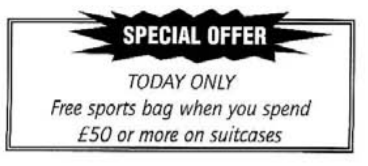
- You will receive a free suitcase if you buy a sports bag.
- This offer is limited to regular customers.
- This offer is on products that are less than £50.
- This offer is available for a short period.
What does the notice say?
.png)
- Buses will leave ten minutes earlier tomorrow.
- After today, there will be more buses than before.
- Until tomorrow, bus journeys will take ten minutes longer.
- Buses will only depart every 20 minutes starting tomorrow.
Choose the correct answer that goes with this text.

- Do not read our books while you are eating in the café.
- Pay in the café for any books that you want to buy.
- Bring your books along if you decide to sit in the cafe.
- Do not take books which you haven't bought yet into the café.
What does the notice say?
.png)
- Dog owners are required to stay away from specific areas of the beach.
- Starting this year, dogs are completely banned from this beach.
- Dogs are welcome at certain times throughout the year.
- Dogs are not permitted on this beach at any time without a leash.
If you put your money in a bank now, you may get 12% _____ annually.
- interest
- profit
- money
- income
The scientists are working on a drug capable of _____ the spread of cancerous cells.
- arresting
- catching
- seizing
- grasping
- critically
- deeply
- fatally
- seriously
His new book is certainly out of the _____. I’ve never read anything like it before.
- normal
- ordinary
- average
- usual
It is no longer possible to _____ the link between climate change and carbon emissions.
- dismiss
- prove
- assure
- debate
Many couples do not want to _____ the responsibility of bringing up a large family of three or four children.
- turn out
- take on
- turn over
- take up
I _____ a five-day trip to London to have a good rest, but I couldn't find time.
might take
- took
- was to take
was taking
The manager would rather his driver _____ to the airport earlier. He would not have missed the flight.
should come
had come
came
might have come
There's no way I can let you go out again tonight. _____, it's raining very hard.
- Although
- However
- As a result
- Besides
There are _____ that not only governments but also individuals should join hands to tackle.
- such many environment problems
- so fewer environment problems
- such a lot of environment problems
- too numerous environment problems
Read the text and decide which answer best fits each gap.
How well do you sleep?
Do you need complete silence to sleep at night? While some people can sleep through noise, others are woken up by the slightest sound. It appears that as we sleep, our brains produce rapid pulses, or waves, called 'sleep spindles'. Research has that our ability to sleep well may depend on the number of sleep spindles we produce.
Scientists conducted a three-day study on 12 volunteers, described themselves as good sleepers. On the first night, the scientists let the volunteers sleep in silence. On the following nights, however, they were subjected to various noises, ranging from the sound of a running tap to jet engine roars.
Measurements of brain activity showed that the participants who reacted least to the noise were the ones who produced more sleep spindles, even on the quiet night. It is hoped that this discovery will new ways to help people having sleeping.
Read the passage and decide if statements are TRUE, FALSE or NOT GIVEN.
Mau Piailug, ocean navigator
Mau sailed from Hawaii to Tahiti using traditional methods.
In early 1976, Mau Piailug, a fisherman, led an expedition in which he sailed a traditional Polynesian boat across 2,500 miles of ocean from Hawaii to Tahiti. The Polynesia Voyaging Society had organised the expedition. Its purpose was to find out if seafarers in the distant past could have found their way from one island to the other without navigational instruments, or whether the islands had been populated by accident. At the time, Mau was the only man alive who knew how to navigate just by observing the stars, the wind and the sea.
He had never before sailed to Tahiti, which was a long way to the south. However, he understood how the wind and the sea behave around islands, so he was confident he could find his way. The voyage took him and his crew a month to complete and he did it without a compass or charts.
His grandfather began the task of teaching him how to navigate when he was still a baby. He showed him pools of water on the beach to teach him how the behaviour of the waves and wind changed in different places. Later, Mau used a circle of stones to memorise the positions of the stars. Each stone was laid out in the sand to represent a star.
The voyage proved that Hawaii's first inhabitants came in small boats and navigated by reading the sea and the stars. Mau himself became a keen teacher, passing on his traditional secrets to people of other cultures so that his knowledge would not be lost. He explained the positions of the stars to his students, but he allowed them to write things down because he knew they would never be able to remember everything as he had done.
The purpose of Mau's voyage was to find out if navigating between islands had been possible in the past.
- True
- False
- Not given
At the time of his voyage, Mau had unique navigational skills.
- True
- False
- Not given
Mau was familiar with the sea around Tahiti.
- True
- False
- Not given
Mau thought it would be difficult to use a compass and charts.
- True
- False
- Not given
The first inhabitants of Hawaii could read and write.
- True
- False
- Not given
Read and choose the correct answer for each question.
Nanotechnology refers to the creation and use of materials or devices at extremely small scales. These materials or devices fall in the range of 1 to 100 nanometers (nm). One nm is equal to one-billionth of a meter (0.000000001 m), which is about 50.000 times smaller than the diameter of a human hair. Scientists refer to the dimensional range of 1 to 100 nm as the nanoscale, and materials at this scale are called nanocrystals or nanomaterials.
The nanoscale is unique because nothing solid can be made any smaller. It is also unique because many of the mechanisms of the biological and physical world operate on length scales from 0.1 to 100 nm. At these dimensions, materials exhibit different physical properties; thus scientists expect that many novel effects at the nanoscale will be discovered and used for breakthrough technologies.
A number of important breakthroughs have already occurred in nanotechnology. These developments are found in products used throughout the world. Some examples are catalytic converters in automobiles that help remove air pollutants, devices in computers that read from and write to the hard disk, certain sunscreens and cosmetics that transparently block harmful radiation from the Sun, and special coatings for sports clothes and gear that help improve the gear and possibly enhance the athlete's performance. Still, many scientists, engineers, and technologists believe they have only scratched the surface of nanotechnology's potential.
Nanotechnology is in its infancy, and no one can predict with accuracy what will result from the full flowering of the field over the next several decades. Many scientists believe it can be said with confidence, however, that nanotechnology will have a major impact on medicine and health care; energy production and conservation; environmental cleanup and protection; electronics, computers, and sensors, and world security and defense.
(Adapted from Encarta DVD 2009)
- A new physical property of matters in nature
- A way of manufacturing technological products
- An introduction to a new technology
- An overview of how technology will develop
- converters
- automobiles
- technologies
- properties
According to the passage, which of the following statements is NOT true about nanotechnology?
- No other products are smaller than those made by nanotechnology.
- Nanotechnology allows the production of things at extremely small scales.
- Nanotechnology has seen a number of important breakthroughs.
- Medicine and healthcare will be greatly affected by nanotechnology.
The author mentions some sunscreen and cosmetics products as examples of _____.
- products that enhance the appearance of athletes
- the full realization of nanotechnology's potential
- products that convert harmful ultraviolet rays into beneficial ones
- applications of nanotechnology in daily life
Which of the following best describes the tone of the author?
- informative and positive
- skeptical and critical
- analytic and cautionary
- pragmatic and realistic
Choose the best way to rearrange the following sentences in order to make a meaningful conversation.
a. That's true, but I'm worried about falling behind on my projects.
b. I'm overwhelmed at work, so I'm thinking about skipping my vacation to catch up.
c. Taking a break can refresh your focus. Health comes first.
d. I understand you're under pressure, but it's important to take breaks. Constant work leads to burnout.
- b-a-c-d
- b-d-c-a
- b-d-a-c
- b-c-d-a
Choose the best way to rearrange the following sentences in order to make a meaningful conversation.
a. Exactly! Do you know that earthquakes can potentially lead to tsunamis?
b. Have you heard about earthquakes or tsunamis?
c. Oh, I didn't know that two disasters were related like that.
d. Yes, I've heard of them. Earthquakes are when the ground shakes and tsunamis are huge ocean waves, right?
- c-d-b-a
- b-c-a-d
- b-d-c-a
- b-d-a-c
Choose the best way to rearrange the following sentences in order to make a meaningful conversation.
a. I really like your apartment. It's so spacious and well-decorated.
b. No, I mean it! It’s one of the most spacious and relaxing apartments I’ve ever seen.
c. Oh, go on! You're just saying that!
d. Well, thanks for saying so. It’s nice to hear that it’s made such a good impression!
- a-d-b-c
- a-c-b-d
- b-d-a-c
- d-a-b-c
Choose the best way to rearrange the following sentences in order to make a meaningful conversation.
a. I don't think so. I'd just like a refund, please.
b. I'd like to return this hat.
c. I'm sorry. We don't give refunds. However, we'll be happy to offer you credit toward another purchase in our store.
d. It's too old-fashioned.
e. What seems to be the problem with it?
f. Would you like to exchange it for one that's more stylish?
- b-f-c-a-d-e
- b-e-f-d-a-c
- b-e-d-f-a-c
- b-a-e-c-d-f
Choose the best way to rearrange the following sentences in order to make a meaningful conversation.
a. Did you know there's a petition in the apartment building to prohibit my bulldog?
b. You should know, I think that public opinion is swinging in her favor.
c. How dare she? Just because he barked at her one time.
d. That's right. Convince enough people that your dog doesn't pose a danger.
e. I heard that Mrs. Kurtzweiler started it because your dog could injure someone.
f. Well, I'll just have to do something about that.
- a-f-d-e-c-b
- a-d-e-b-c-f
- a-b-f-e-c-d
- a-e-c-b-f-d