Đề ôn luyện PSA phần Tiếng Anh vào 6 THCS Ngoại ngữ năm 2025 - Đề số 2
8/15/2023 6:00:00 AMI _____ with my grandparents on a farm when I was a child.
- used to staying
- use to stay
- used to stay
David: _____ you mind if I have a look at your project on community development?
Jane: No, not at all.
- Do
- Shall
- Can
Children younger than 5 years old are _____ free to festival events.
- admit
- admitted
- admittedly
Peter: What _____ your flight?
Mary: There was a big snowstorm in Birmingham that delayed a lot of flights.
- held up
- went up
- hung up
I'm sure you'll have no difficulty _____ the exam because you are well-prepared.
- pass
- to pass
- passing
According to our school's regulations, students _____ use mobile phones in class.
- needn't
- mustn't
- shouldn't
- _____ do family members decorate their houses and make Chung cakes?
- They do all those things before Tet.
- Where
- When
- Why
Those _____ boys often play tricks on their friends.
- mischievous
- obedient
- angelic
Read the following passage and choose the best answer for each blank.
When friendships end
Most friendships slowly come to an end over time. People grow apart, move house or go to different schools, amongst other things. Other friendships, however, end very suddenly. Sometimes a friend might end your relationship without telling you why. When a friendship is over and you don’t know the reasons why, it can leave you feeling confused and down in the . In some cases, these emotions can develop into more serious feelings of rejection or self-doubt, especially if the friendship a significant role in your daily life.
When a friendship ends, try to work out why it has ended. Maybe it was your fault because you did things annoyed your friend. Perhaps your friend was held up with you being late all the time, or they couldn't rely on you when they needed help. Maybe you didn't see eye to eye on important matters.
Whatever the reasons for the split, don’t disrespect your friend by gossiping or giving them a hard time. Your friend has the right to end your relationship, so the best thing to do is just let it go. You never know - there may come a time in the future when you and your friend make , and you don’t want to say anything now when you might regret later. Choosing kindness and now may preserve the chance of reconciliation later on.
Read the following passage and choose the correct answer to each of the questions.
Artist Adrian Gray is an unusual kind of artist. He makes shapes by balancing stones. He first discovered stone balancing when he was making sculptures out of stone on a beach one day. He accidentally balanced one stone on another in what seemed an impossible way.
Adrian has always been interested in stones. He was born in Bristol in the south of England. He studied geology and spent a long time travelling, studying and photographing stones in places like the Himalayas and around the Pacific. A tropical illness caused him to stop travelling and to settle back in Britain. He chose to live in a small seaside town and began to develop his art of stone balancing.
Adrian displays his art for local people and visitors to see. Most of the people who see Adrian's work are amazed. They cannot believe that it's possible to balance rocks on such a small point of contact. They often believe that he's using glue or magnets of some kind. So, how do the stones balance? It seems that it's all to do with physics. Gravity and friction cause the stones to stay in place.
Adrian's works of art take different lengths of time to complete. Some can take a few seconds or minutes while others take days. Of course, Adrian's works do not last long. A gust of wind, a wave or a downfall of rain can cause the stones to suddenly fall. That's why he has a camera set up at all times so that he can take photos of his work before it disappears. Adrian sells these photos to make a living. He also works as a stonemason and a roofer, and makes bird tables and chests out of driftwood.
Which of the following could also be a title for this text?
- Using natural resources for art
- A different kind of art
- Different ways to make money from art
What did Adrian study in school that relates to his art?
- Geology
- Sculpture
- Photography
What is NOT true according to the passage?
- Local people show their suspicion on Adrian's works.
- Stones can be balanced because of gravity and friction.
- Adrian spends equal time on each stone artwork.
What does the writer say about Adrian's works of art?
- They are often destroyed by the weather.
- They are sometimes fixed with glue.
- They always take hours to create.
What would a reader learn about Adrian Gray from the text?
- He prefers working with wood.
- He has only worked with stones.
- He has many different skills.
Choose the correct answer in the box to complete the conversation. Write only the letter A-D in each blank.
|
A. I love having everything I need right outside my door. B. And what about the neighbors? C. And every building makes different noises, so that takes some time to get used to. D. But I feel a little bit lonely. |
Peter: So, how's the new flat your family's just moved into?
Jane: Great, thanks! Of course, it's always strange sleeping in a new place.
Peter: Oh, yes.
Jane: I've just met one girl around my age so far. She seemed very friendly.
Peter: It must be a change for you, living in the city now.
Jane: It is, but it's really convenient to be so close to everything now, school, all the shops, you know? I think I'm going to be very happy here.
Peter: I hope so too.
Choose the sentence that is CLOSEST meaning to the sentence given.
The only student who failed the exam was John.
- With the exception of John, everyone passed the exam.
- Everyone, apart from John, failed the exam.
- Together with other students, John failed the exam.
Choose the sentence that is CLOSEST meaning to the sentence given.
A child is influenced as much by his schooling as by his parents.
- A child's parents have greater influence on him than his schooling.
- Schooling doesn't influence a child as much as his parents do.
- A child's schooling influences him as much as his parents do.
Choose the sentence that is CLOSEST meaning to the sentence given.
Human beings are responsible for the changes in the environment.
- Humans are trying to prevent changes in the environment.
- Human beings take responsibilities for the changes in the environment.
- Environmental changes have nothing to do with people.
Choose the sentence that is CLOSEST meaning to the sentence given.
She started learning English 3 years ago.
- She learned English for 3 years and then stopped.
- She has learnt English for 3 years.
- She began learning English when she was three years old.
Read and do the following tasks.
A. This place isn't for adults or teenagers.
B. This activity is for a small group of people.
C. Children should feed the fish from South America carefully.
D. For this price, you can get close to some animals.
E. There are two ways to get information about this.
F. Children are asked not to tap on the glass.
What does this notice say?

=> Answer:
What does this notice say?
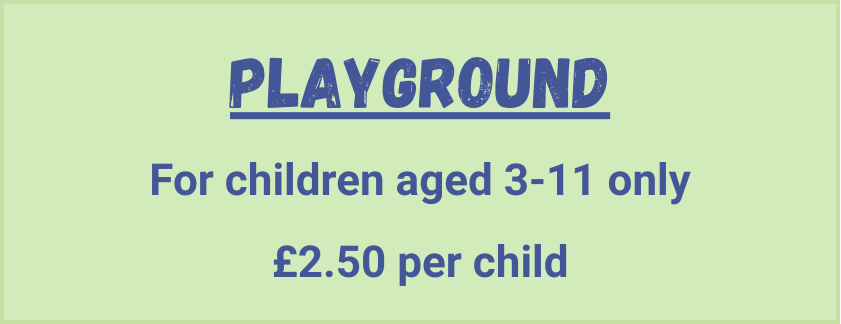
=> Answer:
What does this notice say?
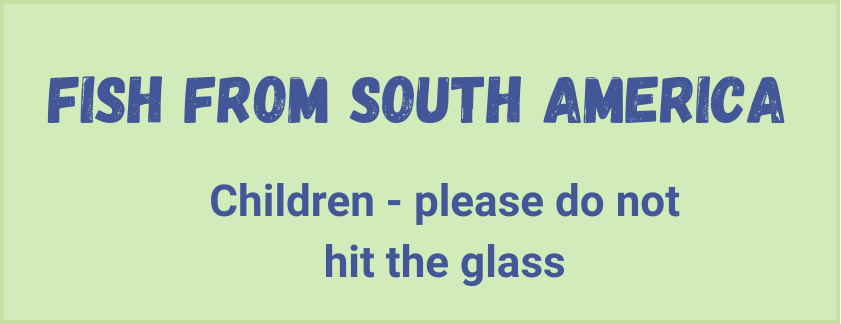
=> Answer:
What does this notice say?
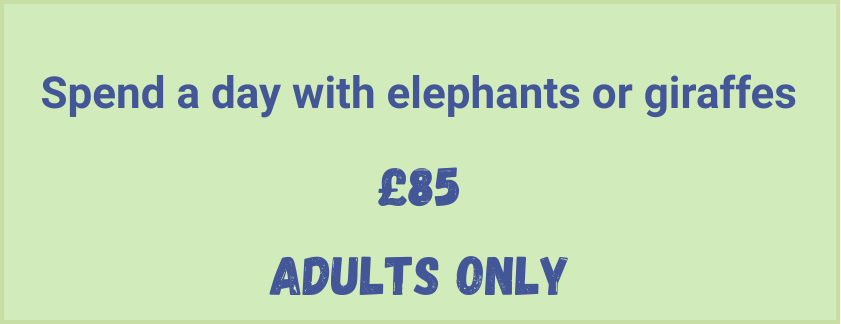
=> Answer: