Đề ôn luyện PSA phần Tiếng Anh vào 6 THCS Ngoại ngữ năm 2025 - Đề số 17
8/30/2023 6:00:00 AM- a little
- any
- a few
Raja _____ every evening after he comes back from work.
- jogged
- will jog
- jogs
Those mangoes at the top of the tree look so ripe. I think we should pick _____.
- them
- their
- it
Tina was nervous, but she knew she had to _____ to her teacher that she had lost her library book.
- disclose
- confess
- accuse
- won't
- needn't
- mustn't
He's allergic to cats, _____ he can't visit his friend who has one.
- so
- but
- because
Please explain the _____ between these two math problems.
- different
- difference
- differently
We were disappointed _____ the restaurant running out of our favorite dish.
- about
- of
- on
Read the following passage and choose the best answer for each blank.
Clothing habits are a matter of personal preference in the United States. Most people are free to wear they feel comfortable. Business people in large urban areas are likely suits or dresses, while clothing in rural areas is less formal. Most Americans tend to dress casually when not in formal or business situations.
When eating, most Americans a fork in the hand with which they write. Americans eat away from home often, and they usually pay their own meals when dining with friends.
When Americans greet one another they often a firm handshake. They may greet strangers the street by saying “Hello” or “Good morning”. Friends often greet each other with “How are you?” and respond “Fine, thanks.” Americans do not really expect any other answer to the question “How are you?” because it is a way of saying hello. Except in formal situations, people address each other by their given names once they are acquainted.
Although Americans are generally informal people, it would be best to schedule an appointment going to visit someone, especially in business when an appointment has been made, it is considered to be prompt.
Read the following passage then choose the best answer to each question below.
Different cultures follow their own special customs when a child's baby teeth fall out. In Korea, for example, they have the custom of throwing lost teeth up on the roof of a house. According to tradition, a magpie will come and take the tooth. Later, the magpie will return with a new tooth for the child. In other Asian countries, such as Japan and Vietnam, children follow a similar tradition of throwing their lost teeth onto the roofs of houses.
Birds aren't the only animals thought to take lost teeth. In Mexico and Spain, tradition says a mouse takes a lost tooth and leaves some money. However, in Mongolia, dogs are responsible for taking teeth away. Dogs are highly respected in Mongolian culture and are considered guardian angels of the people. Tradition says that the new tooth will grow good and strong if the baby tooth is fed to a guardian angel. Accordingly, parents in Mongolia will put their child's lost tooth in a piece of meat and feed it to a dog.
The idea of giving lost teeth to an angel or fairy is also a tradition in the West. Many children in Western countries count on the Tooth Fairy to leave money or presents in exchange for a tooth. The exact origins of the Tooth Fairy are a mystery, although the story probably began in England or Ireland centuries ago. According to tradition, a child puts a lost tooth under his or her pillow before going to bed. In the wee hours, while the child is sleeping, the Tooth Fairy takes the tooth and leaves something else under the pillow. In France, the Tooth Fairy leaves a small gift while in the United States, she usually leaves money.
What is the passage mainly about?
- Presents for young children's lost teeth
- The importance of baby teeth in different countries
- Traditions concerning children's lost teeth
According to Korean tradition, which bird is believed to take a child's lost tooth?
- A magpie
- A sparrow
- An eagle
According to the passage, where is a child's lost tooth thought to be taken away by a mouse?
- In Mongolia and Spain
- In Mexico and Spain
- In Japan and Vietnam
According to paragraph 2, parents in Mongolia feed their child's lost tooth to a dog because _____.
- they think that it will help the dog live longer
- they believe that this will make their child’s new tooth good and strong
- they hope that their child will get some gifts for his or her tooth
Which of the following is NOT true about the tradition of tooth giving in the West?
- Children give money to the Tooth Fairy.
- Lost teeth are traditionally given to an angel or fairy.
- Children put their lost teeth under their pillows.
Choose the correct answer in the box to complete the conversation. Write only the letter A-D in each blank.
|
A. Take your coursebook with you when you go so he can explain everything to you using that. B. How's your biology homework going? C. Can I ask for your homework to take with me? D. In that case, it probably won't be much use looking online. |
Anna:
Bill: Not very well. I can't work out what I have to do.
Anna: You can find all the information you need there, but if you don't know what to do with it, it's not really going to help you. Have you seen Mr Benson about it?
Bill: No, not yet.
Anna: It might be best, as he set the homework in the first place.
Bill: Good idea!
Choose the sentence that is CLOSEST in meaning to the sentence given.
He cannot afford a new computer.
- The new computer is so expensive that he cannot buy it.
- He wishes he hadn't bought an expensive computer.
- The new computer is cheap enough for him to buy.
Choose the sentence that is CLOSEST in meaning to the sentence given.
We decided not to visit the crowded amusement park but explore a nearby nature reserve yesterday.
- We decided not to visit the crowded amusement park yesterday because we didn't like it.
- We explored a nearby nature reserve instead of visiting the crowded amusement park yesterday.
- Instead of exploring a nearby nature reserve, we decided to visit the crowded amusement park yesterday.
Choose the sentence that is CLOSEST in meaning to the sentence given.
The new restaurant looks good, yet it seems to have few customers.
- In order to get more business, the new restaurant should improve its appearance.
- The new restaurant has few customers due to its appearance.
- In spite of its pleasant appearance, the new restaurant does not appear to attract many customers.
Choose the sentence that is CLOSEST in meaning to the sentence given.
As the bus arrived in Bursa an hour later than the scheduled time, I missed the opening of the concert.
- The concert in Bursa started an hour later than the scheduled time so I didn't miss the start.
- I arrived in Bursa at the scheduled hour and went on to the concert an hour later.
- The concert had started by the time I got there as the bus reached Bursa a full hour late.
Read and do the following tasks.
A. It's possible to stand near the river after the rain.
B. If you are not careful, they may escape.
C. This system works as usual despite the weather.
D. You cannot use this for travel until tomorrow.
E. You may not find anything online about it today.
F. There are some problems because of the weather.
What does this notice say?

=> Answer:
What does this notice say?
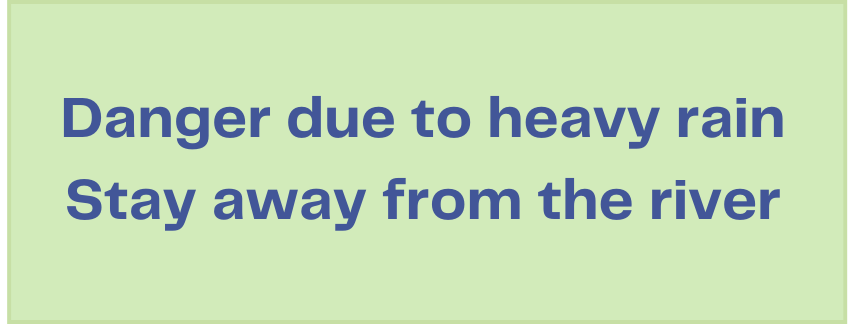
=> Answer:
What does this notice say?
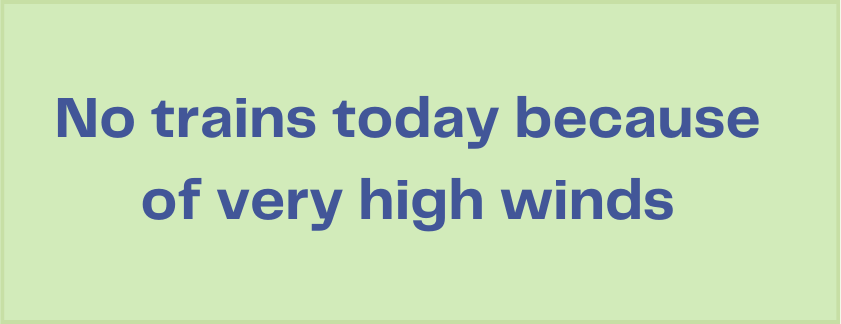
=> Answer:
What does this notice say?

=> Answer: