The First Great Emperor
11/15/2023 9:38:23 AM
Do you know?
- Qin Shi Huang became the king of Qin at the age of 13 in 246 BCE. He became the first emperor of a unified China in 221 BCE and ruled until his death at the age of 49.
- The tomb of Qin Shi Huang, discovered in 1974 and renowned for its Terra Cotta Army, has many unsolved mysteries.
Let's gather further details about this renowned emperor.
Let's learn some new words before you read the passage:
Listen and complete the passage.
| servants | cost | forts | tireless |
| canals | subjects | warriors | unified |
In the year 221 BCE, the first great emperor of China united the nation and became the complete master of his kingdom. He called himself Qin Shi Huang (Chin Shee Whang). He was a ruler, but he trusted no one. Qin created a new capital city for China. He created a single money system to be used by all of his in all of China. He started a single, system of weights and measurements for everything. This even included the size of cartwheels.
Qin forced thousands of his subjects to work on his special projects. His most famous project is still visible today. He began building the 5,500-mile-long Great Wall of China. The Great Wall so many lives that it was called “the longest graveyard in the world.” He also insisted on digging , building new , and fixing old roads. This emperor trusted no one. He even ordered the destruction of most of the books in the kingdom. These books included those of the great Chinese philosopher, Confucius. Many scholars buried their books to save them. However, if the king’s found the buried or hidden books, the owners were killed on the spot.
One of the emperor’s most secret projects was discovered in modern China. In 1974, a farmer accidentally fell into an underground tomb where he found an entire army standing in order. The army was made of terra cotta, a kind of clay. The emperor had more than 8,000 of these clay figures in his tomb. These included , chariots, and horses. Surprisingly, scientists believe that there are even more of these clay figures that have yet to be discovered.
Read and answer the following questions.
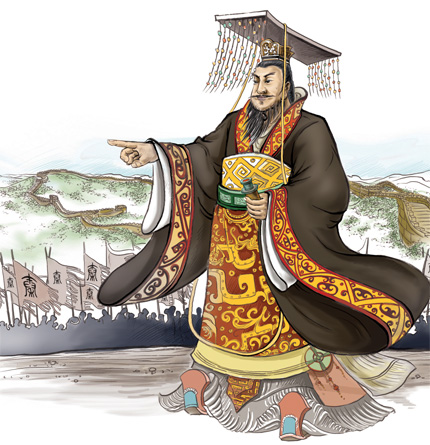
In the year 221 BCE, the first great emperor of China united the nation and became the complete master of his kingdom. He called himself Qin Shi Huang (Chin Shee Whang). He was a tireless ruler, but he trusted no one. Qin created a new capital city for China. He created a single money system to be used by all of his subjects in all of China. He started a single, unified system of weights and measurements for everything. This even included the size of cartwheels.
Qin forced thousands of his subjects to work on his special projects. His most famous project is still visible today. He began building the 5,500-mile-long Great Wall of China. The Great Wall cost so many lives that it was called “the longest graveyard in the world.” He also insisted on digging canals, building new forts, and fixing old roads. This emperor trusted no one. He even ordered the destruction of most of the books in the kingdom. These books included those of the great Chinese philosopher, Confucius. Many scholars buried their books to save them. However, if the king’s servants found the buried or hidden books, the owners were killed on the spot.
One of the emperor’s most secret projects was discovered in modern China. In 1974, a farmer accidentally fell into an underground tomb where he found an entire army standing in order. The army was made of terra cotta, a kind of clay. The emperor had more than 8,000 of these clay figures in his tomb. These included warriors, chariots, and horses. Surprisingly, scientists believe that there are even more of these clay figures that have yet to be discovered.
Source: Daily Warm-ups - Nonfiction Reading Grade 6
What significant action did Qin Shi Huang take to unify the various regions of China?
- He started the Silk Road trade.
- He created the first Chinese navy.
- He applied the foreign system of measurements.
- He established a single currency system.
- Many other projects started to support its construction.
- Many workers lost their lives during its construction.
- The whole wall is still in a good condition.
- It was used to promote foreign trade at that time.
Why were many books buried during the king's rule?
- To protect them from destruction ordered by the emperor
- To protest against the emperor's policies
- To preserve part of religious rituals
- For ceremonial purposes in honor of the emperor
What was NOT mentioned about the underground tomb discovered in 1974 related to Qin Shi Huang?
- It houses over 8,000 terra cotta figures.
- It included a map of the entire kingdom.
- It is believed to have more mysteries to discover.
- It stayed secret until the accidental exploration in 1974.
Based on the passage, which characteristic can be inferred about Emperor Qin Shi Huang?
- Indifferent
- Empathetic
- Suspicious
- Generous
Build your vocabulary by learning these intensive phrases/idioms:
Rearrange the words in a correct order to make a complete sentence (kéo từng từ/cụm từ về vị trí đúng để tạo thành câu hoàn chỉnh).
Choose the sentence CLOSEST in meaning to the sentence given.
Faced with the risk of a strike, the company was compelled to enter talks with the employees' union.
- The company added insult to injury by resorting to violence in an attempt to suppress the strike.
- The employees were forced to begin anew as the company declined to engage in negotiations.
- After the strike, the employees' union got a foot in the door when the company offered a discussion.
- The threat of a strike forced the company's hand to negotiate with the employees' union.
Choose the word(s) CLOSEST in meaning to the underlined word(s).
The rebels threatened to blast the bridge to kingdom come if their demands were not met.
- devastate the bridge
- renovate the bridge
- excavate the bridge
- estimate the bridge
At the family reunion, the siblings finally agreed to bury the _____ and put their past disagreements behind them.
- treasure
- hatchet
- pickaxe
- hammock