[IELTS 5.] Unit 3.1 - Grammar
12/17/2020 5:00:00 PM(*Hãy xoay ngang màn hình nếu bạn dùng trên điện thoại nhé!)
(Vui lòng xem hết bài giảng trước khi ấn nút "Next" để làm bài tập.)
Complete the sentences 1-6 using the verbs in the brackets and decide on the correct grammatical form from the alternatives given.
1. Managing an actor's image through media relations became popular in the 1980s. Up until then actors (not care) much about their public image.
2. Newspapers and magazines (respect) the privacy of celebrities more than they do nowadays.
3. As a child I loved playing the guitar and I (dream) of being a well-known musician.
4. Until the 1990s, footballers (not earn) such large salaries and they didn't use to be so famous.
5. Before working in television I (always think) that celebrities were special people, but now I know many of them are quite normal.
6. The photographers (wait) hours for the stars to arrive at the 2010 Oscar ceremony.
Fill in the gaps in this paragraph with verbs from the box in the past simple.
| allow | be | not - be | be | invent | increase | lay | mean | not - own | receive | replace | ride | take | walk |
The pace of change in the world of technology is amazing. It ...wasn't... (not) long ago that the postal service our only way to communicate over any distance. It days and sometimes weeks to receive letters from within the same country. As a result, the news in the letters already out of date when people them. In the workplace, this that business was mostly conducted locally, over relatively short distances.
When Alexander Graham Bell the telephone in 1876, it the foundation for the communication systems we have today. The telephone two people to communicate instantly across a great distance. Eventually computers typewriters and dramatically the speed of our daily work life. Nowadays the Internet is an essential part of every business.
However, it is not just communications that have changed. Only 50 years ago most people a car. People to work or bicycles. Changes in travel as well as the increased speed of communications have led to the global business world that we have today.
Fill in the gaps with past simple or past continuous form of the verbs in brackets. In which gaps could you use used to?
I ...had... (have) a wonderful biology teacher, Mrs Hughes. She (make) us excited about the subject because she was so interested herself. I remember one lesson in particular; we (study) different types of plants, and Mrs Hughes (describe) the different parts of the flower. She (pick up) a purple flower, I can't remember exactly what it was, and then suddenly we (notice) that she (cry)! She (apologise) and (say) that sometimes nature was so beautiful it just made her cry! We (not/know) what to do at first, but it certainly (make) us think. Something similar (happen) while she (show) us how to work the microscope. She (examine) a slide of some plant issue and she (smile) all over her face. She suddenly (get) all excited and (say), 'Isn't it wonderful?' Some students (laugh) at her when she (not/look) but I didn't. Somehow her enthusiasm (inspire) me, and I (start) to like biology.
A teacher and student are talking about local customs. Fill in the gaps with the verbs in brackets in the correct form. Use would or used to where possible.
Teacher: What sort of thing ...did you use to do... (you/do) as a child?
Yoko: Oh, when I was a child growing up in Japan there were many customs that we (follow). For example, I remember we (move) house when I was seven and we (visit) our new neighbours with gifts. At that time the tradition was that people (give) gifts of Japanese noodles, but it is different now and people tend to give things like soap or towels or nothing at all.
Teacher: (you/have) one tradition that you particularly remember?
Yoko: Yes, one tradition that I (really/like) was in the spring when the cherry blossoms were out. As a family we (go) into the countryside and we (spend) the day eating, drinking and singing. One year my father (take) a lovely photo of me and my sisters and I still keep that picture on my wall today.
Teacher: And (you/have to) do anything you didn't like?
Yoko: Yes. I remember how we (have to) clean the house thoroughly. This ceremony is called Osoji and my sisters and I (not/look forward to) it very much!
Read the paragraph. Write x in the blanks if the verbs are right. Correct the verbs if they are wrong by writing the correct form in the blanks.
I remember a trip I once (1) made to my grandmother's house. She (2) would live about 30 kilometres away from us and we (3) used to going there quite often with our mother. On this occasion, we (4) set off to my grandmother's after school on a cold winter's day. When we were about to leave, we (5) were noticing that some snow was beginning to fall, and as we (6) were driving along we (7) were realising that it (8) snowed more and more heavily. Suddenly we had to brake hard as the car in front stopped suddenly. We (9) were skidding and (10) went off the road into a ditch! It was pretty scary, but we were lucky and none of us were hurt. We got out of the car, and my mother (11) was phoning for help on her mobile phone. While we (12) were waiting for help it (13) was stopping snowing and we (14) sang lots of songs to keep ourselves cheerful. Eventually, the truck (15) was coming and pulled our car out of the ditch. The car wasn't badly damaged, but we (16) decided to turn round and go home. We didn't manage to see our grandmother that day, but it was so frightening that I will never forget it.
Example:
(1) made => x
(2) would live => used to live/ lived
Questions:
|
(3) used to going => (4) set off => (5) were noticing => (6) were driving => (7) were realising => (8) snowed => (9) were skidding => |
(10) went off => (11) was phoning => (12) were waiting => (13) was stopping => (14) sang => (15) was coming => (16) decided => |
Complete the report with the past simple or past perfect simple of the verbs in brackets.
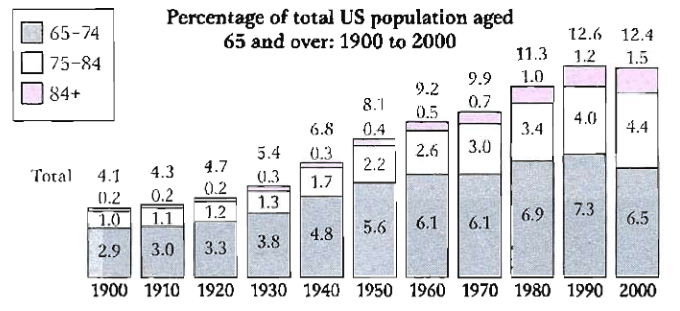
The chart shows the percentage of people aged 65 and over in the United States between 1900 and 2000. In the year 1900 just over 4% of the population ...was... (be) aged over 65. However by 1960 this figure (double).
The number of people aged between 75 and 84 (remain) fairly steady between 1900 and 1930, making up only 1-1.3% of the population. The figure (begin) to rise more significantly in 1940 and by 1970 it (triple) to reach 3% of the population. Although there (be) no change in the number of people aged 65-74 between 1960 and 1970, the number of people aged 75 and over (increase) during this time. By the year 2000, 12.4% of the US population (reach) the age of 65 or more, although this was slightly lower than in 1990 when it (peak) at 12.6%.
The chart shows that today people in the United States can expect to live longer than in 1990. By the year 2000, more than 12% of the population (manage) to live to the age of 65 and over compared to only 4.1% in 1900.
Fill in the gaps with the past simple, past perfect simple or past perfect continuous of the verbs in brackets.
Last year my friends ...arranged... (arrange) for us to try fire-walking, which is when you walk on hot coals. I (always/be) fascinated by it and I (hear) people say it was an unforgettable experience. I was very excited when I (arrive) on the day, although beforehand I (feel) a little frightened! My friends and I (come) in the hope that by the end of the day we would be able to say we (walk) across hot, burning coals.
Our teacher was very good, and by teatime, we (learn) a great deal and (prepare) the fires. I (expect) to be terrified when the time came to walk, but as I (take off) my shoes and socks, I (not/feel) afraid. I (approach) the coals as all my friends before me (do), and started walking! I could feel the heat, but as I (step) back onto the grass at the other end, I knew the coals (not/burn) my feet at all. As I (hope), all my friends (manage) the walk and none of us were burnt. The whole experience was amazing, and I just wished I (do) it sooner.
Fill in the gaps with a verb from the box in the past simple, past perfect simple or past perfect continuous tense. Use each verb once.
| be | buy | decide| develop | already - discuss | feel | like | make | phone | run | start | stay | never - take | visit | not - wait | work |
1. She ...had been working... as a waitress for five years when he met her.
2. The lecture by the time they got there.
3. In the supermarket he all the ingredients he needed and then went home to make her birthday cake.
4. Holly did very well in her exam, which was a shock because she an exam before.
5. They went on a big tour of Britian. First they in London for a few days. Then they Cambridge, York, and Edinburgh, and then Bath. They to Bath before, but they it so much that they to go back again.
6. Scientists announced the launch of the new drug last week. They it for five years.
7. By the time I got to the meeting they the important issues and they the big decisions without me. I from my mobile to tell them the train was late and I annoyed that they for me.
8. I looked terrible when I saw Joe last night because I for over an hour and I was exhausted.