[IELTS 5.] Unit 9.1 - Reading & Listening
1/8/2021 5:00:00 PMYou are going to hear a speaker at an environmental awareness conference talking about a European satellite called Envisat. Write no more than two words or a number for each answer.
Envisat satellite:
- Envisat was launched .
- Envisat has instrument systems.
- In 1990s, ESA launched and .
- ESA will spend 2.3 billion euros over .
- This is the same as of coffee per person per year.
Listen to some conversations and fill in the missing information in the forms.
| Conversation 1 | Conversation 2 | Conversation 3 | |
| Type of room | |||
| Room No. | |||
| Floor | |||
| Cost | £ | £ | £ |
Listen to the recording and choose the correct answer.
When does your mother arrive?
- Tuesday, 14th May
- Thursday, 14th May
- Tuesday, 4th May
Listen to the recording and choose the correct answer.
When are you going on holiday?
- 23rd March
- 21st March
- 25th March
Listen to the recording and choose the correct answer.
When do the exams begin?
- 21st June
- 25th June
- 26th June
Listen to the recording and choose the correct answer.
When does school start?
- 5th July
- 15th July
- 13th July
Listen to the recording and choose the correct answer.
When are you going to move into the new house?
- Next Monday, 8th February
- Next Monday, 18th February
- Next Tuesday, 18th February
Listen to the recording and choose the correct answer.
When does the Art Museum open?
- 31st September
- 1st September
- 4th September
Listen to the recording and choose the correct answer.
When are you leaving?
- 13th April
- 30th April
- 23rd April
Listen to the recording and choose the correct answer.
Here is an interesting date in Britain.
- 13th February
- 14th February
- 15th February
Listen to the recording and choose the correct answer.
Do you know when Halloween is?
- 31st October
- 30th October
- 23rd October
Listen to the recording and choose the correct answer.
When is Boxing Day?
- 26th December
- 29th December
- 27th December
Listen to the recording and choose the correct answer.
In Britain, Autumn begins on _____.
- 3rd September
- 13th September
- 23rd September
Listen to the recording and choose the correct answer.
When is the shortest day of the year in Britain?
- 21st December
- 22nd December
- 23rd December
You will hear some great names in British history. As you listen, write down the years of their birth and death in the correct columns.
| Name | Birth | Death |
| Henry VIII | ||
| Queen Elizabeth | ||
| William Shakespeare | ||
| Queen Victoria | ||
| Sir Winston Churchill |
Reading the following passage.
Speed reading
What is speed reading, and why do we need it?
Speed reading is not just about reading fast. It is also about how much information you can remember when you have finished reading. The World Championship Speed-Reading Competition says that its top competitors average between 1,000 and 2,000 words a minute. But they must remember at least 50 percent of this in order to qualify for the competition.
Nowadays, speed reading has become an essential skill in any environment where people have to master a large volume of information. Professional workers need reading skills to help them get through many documents every day, while students under pressure to deal with assignments may feel they have to read more and read faster all the time.
Although there are various methods to increase reading speed, the trick is deciding what information you want first. For example, if you only want a rough outline of an issue, then you can skim the material quickly and extract the key facts. However, if you need to understand every detail in a document, then you must read it slowly enough to understand this.
Even when you know how to ignore irrelevant detail, there are other improvements you can make to your reading style which will increase your speed. For example, most people can read much faster if they read silently. Reading each word aloud takes time for the information to make a complete circuit in your brain before being pronounced. Some researchers believe that as long as the first and last letters are in place, the brain can still understand the arrangement of the other letters in the word because it logically puts each piece into place.
Chunking is another important method. Most people learn to read either letter by letter or word by word. As you improve, this changes. You will probably find that you are fixing your eyes on a block of words, then moving your eyes to the next block of words, and so on. You are reading blocks of words at a time, not individual words one by one. You may also notice that you do not always go from one block to the next: sometimes you may move back to a previous block if you are unsure about something.
A skilled reader will read a lot of words in each block. He or she will only look at each block for an instant and will then move on. Only rarely will the reader's eyes skip back to a previous block of words. This reduces the amount of work that the reader's eyes have to do. It also increases the volume of information that can be taken in over a given period of time.
On the other hand, a slow reader will spend a lot of time reading small blocks of words. He or she will skip back often, losing the flow and structure of the text, and muddling their overall understanding of the subject. This irregular eye movement quickly makes the reader tired. Poor readers tend to dislike reading because they feel it is difficult to concentrate and comprehend written information.
The best tip anyone can have to improve their reading speed is to practice. In order to do this effectively, a person must be engaged in the material and want to know more. If you find yourself constantly having to re-read the same paragraph, you may want to switch to reading material that grabs your attention. If you enjoy what you are reading, you will make quicker progress.
Adapted from Complete IELTS Band 4-5 SB
Complete the table below.
Choose NO MORE THAN TWO WORDS from the passage for each answer.
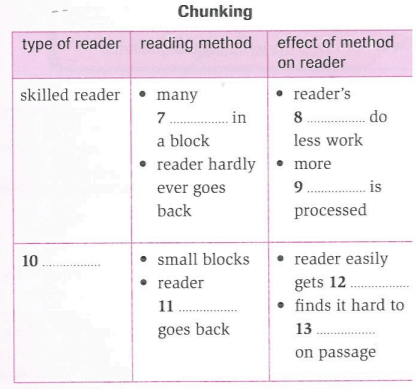
| 7. | 11. |
| 8. | 12. |
| 9. | 13. |
| 10. |
Complete the description and overview below of chart B.
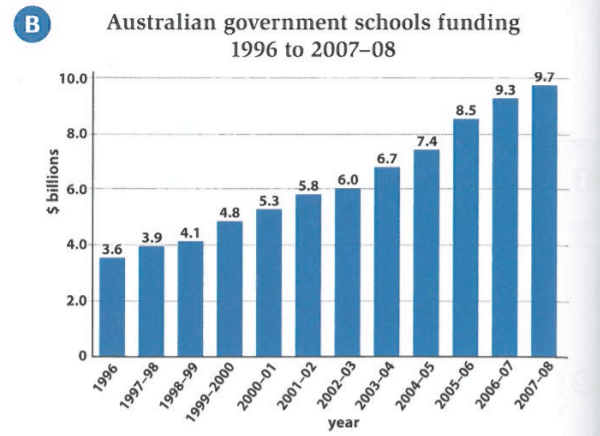
According to the chart, the amount of money received by schools in Australia from 3.6 to 6 billion dollars between 1996 and 2003. It then to 9.7 billion dollars in 2008.
There was a general trend in government funding between 1996 and 2008.