[IELTS 5.] Unit 10.1 - Reading & Listening
1/11/2021 5:00:00 PMListen and answer the questions.
Decide whether these statements are true or false.
1. Eating fish might be bad for the heart.
2. Eating fish is good for the growth of the brain.
3. Some fish may contain a poison.
4. The Fisheries Scholarship funded this student's project.
5. The Fisheries Scholarship influenced the results of the study.
6. Comprehensive information is available about the pros and cons of eating fish.
7. The research noticed strong negative effects on the brain from the mercury contained in fish.
8. The student concludes that it is better for one's health to avoid eating fish.
Listen again and fill in the gaps in the extract from the talk with the words given.
We discovered that, the literature available on the risks and benefits of fish consumption, there are still important gaps in this information. these gaps, , decisions about how to advise people on fish consumption should be made based on what we know now.
, in terms of heart disease, it has been shown that consuming even small quantities of fish can lower your risk of heart disease by 17%. , consuming fish is known to have a beneficial effect on brain development. , exposure to mercury through eating fish can have a negative effect on IQ levels, the effects that have been observed are relatively small.
, it would seem that the health benefits of eating fish outweigh the risks.
Listen to the conversation and fill in the missing information in the notes below.
Ellen has got a . Her nose is and she has a sore throat. Here is some advice. She should take some and it's a good idea for her to drink lots of . She'd better see a doctor first, and then go for a rest. It's helpful to cook with some garlic in it and drink a every half an hour. It really works.
Listen to the conversation and fill in the missing information in the notes below.
The customer wants to buy a kind of camera which would be and to handle. The shop assistant recommended one which is and has a good . The price is only . The customer liked the one the shop assistant recommended but she disliked the . Finally, the customer bought a camera.
Listen to the conversation and fill in the missing information.
Customer's name: Mr.
When to book:
Type of room:
Room number:
Floor:
Day to come:
Day to leave:
Requirement: to at 7:10 in the morning
Reading the following passage.
How to Borrow Books
Most libraries require you to register before you are allowed to borrow any of their materials. This means you will probably be asked to fill out and sign a registration card. When you do this, you are not only giving the library your name and address for their files, you are also signing an agreement. The agreement says, basically, that you will obey the rules of the library. A parent or guardian is sometimes also required to sign the card.
To be entitled to use your school library, you probably must only be enrolled in that school. Once you are registered, you will be issued a library or borrower's card. On this card will be your name and a number. Each time you check out, that is, officially borrow something from the library, you will have to present this card to the librarian.
If your library is large enough, it may have film equipment that you may borrow. To do so, however, the library usually requires a separate registration. You may also have to take and pass a course the library gives on how to operate the different pieces of equipment. You usually check out and return borrowed materials at the same desk. The sign on this desk may read Circulation Desk, Check Out Here, or perhaps Charge Desk.
The library staff member at this desk will take your card and stamp the book card with a date. This is the date by which you are expected to return the material to the library, so others can have the chance of borrowing it. Many libraries allow you to renew the book if it has not been requested by others.
Some libraries charge a fine for each day a library book is overdue, kept out beyond the date stamped on the book card. There are also often fines for books returned damaged or written in. Should you lose a library book, you may be required to pay the library the amount it was worth. Not paying fines could result in your losing all library privileges.
Adapted from Basic IELTS Reading
Complete the summary below by choosing NO MORE THAN THREE WORDS from the passage for each answer.
Most libraries require you to register before you borrow any books. First of all, you will need to fill out and sign and while doing so, you are also with the library. Later each time you check out, you will have to present a library card to the librarian. In some libraries, you will be required to make a separate registration if you want to borrow and at the same time, you will have to take and on how to operate the equipment. When you borrow library books, the librarian will put a on the book card so that you know when to return them. If you want to keep the books longer, you can it if nobody requests them.
Reading the following passage.
Real-Time Electronic Discussion for Teaching Writing
The most obvious use of real-time electronic discussion is for the teaching of writing. Students in general, and particularly second language students, often have a great fear of expressing their ideas in writing. To help overcome this fear and give their students as much writing practice as possible, some composition teachers conduct almost all of their courses through electronic discussion. They find that the more students write, the more comfortable they get with it - especially because their writing occurs in such a powerful communicative context. Every word they put down is not for the purpose of being corrected by their teacher, but rather for the purpose of sharing ideas with their classmates.
Janice Cook teaches several ESL writing courses at Kapiolani Community College in Honolulu. All of Cook's classes are taught 100% online, with students writing back and forth together in pairs, in small groups, and as a class. Students write about the writing process, discuss electronically things they have read, share their own work with the others and compose compositions together. Cook contributes to the process as a guide rather than as an all-knowing expert. She has taught this way for 3 years and says she feared even the thought of going back to non-networked writing instruction.
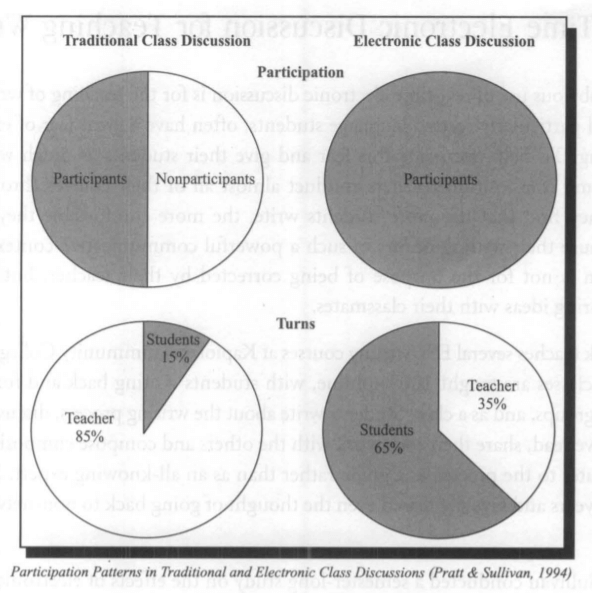
Pratt and Sullivan conducted a semester-long study on the effects of electronic discussion on teaching ESL writing at the University of Puerto Rico. They compared two ESL writing classes taught with the same syllabus but under different conditions. One class met one or two times a week in a computer-networked classroom where virtually all class discussion was carried out electronically. The other class was conducted in a traditional classroom with oral discussion.
An analysis of the transcripts of large group discussions, one from each class, showed strong differences in participation patterns. Whereas only 50% of the students spoke up even once during the oral discussion, 100% of the students participated in the electronic discussion. Furthermore, in the oral discussion, the teacher took 85% of the conversational turns, whereas in the electronic discussion the teacher took only 35% of the turns.
Pratt and Sullivan used pre- and post-writing samples to compare the writing improvement of the two groups. They found that students in the computer-networked class showed significantly greater gains in writing than the students did in the traditional class.
Studies of native speaker composition classes have also shown similar advantages for computer networked writing instruction, particularly for students who come into a course less skilled or confident about their writing. Linguists have found that less confident students not only communicate more during electronic discussions than during face-to-face ones but also make more useful comments in their own writing.
Adapted from Basic IELTS Reading
Refer to the passage and complete the following notes about the advantages of the use of real-time electronic discussion for teaching writing with ONE WORD taken from the passage.
Advantages of the Use of Real-time Electronic Discussion for Teaching Writing
| Context | Students are put in a highly context. |
| Purpose of writing | Students write for ideas with each other. |
| Teachers | He/She works for the process as a . |
| Students' participation in the study conducted | The percentage for the students' participation is %. |
| Students' turns in the study conducted | Students take percent of the conversational turns. |
| Results of the study | The of the students in writing are significantly greater. |