Midterm Test - Reading & Listening
1/14/2021 5:05:00 PMListen and complete the notes below.
Write NO MORE THAN TWO WORDS AND/ OR A NUMBER for each answer.
Traditional Samoan Houses
Overall design
- house: round or
- no walls
- : to shelter occupants from wind and rain
- floor: to control temperature
Roof
- dome-shaped and thatched using leaves
- sides prevent dampness
- high top permits loss
Supporting posts
- made using wood from the around the village
- used to show of chiefs and speakers at meetings
- attached using rope made by the in the village
- rope pulled tightly to form a around beams and posts
/independent.co.uk.jpg)
Listen and choose the correct answer to each of the following questions.
- What made miners come to where the Yanomami live?
- What are the Yanomami doing to protect their traditions?
What made miners come to where the Yanomami live?
- Fresh water
- Cattle
- Gold
What are the Yanomami doing to protect their traditions?
- Learning to use their land in the best way
- Planting more trees and make water cleaner
- Recording their language and history
Listen and complete the table below. Write NO MORE THAN TWO WORDS AND/OR A NUMBER for each answer.
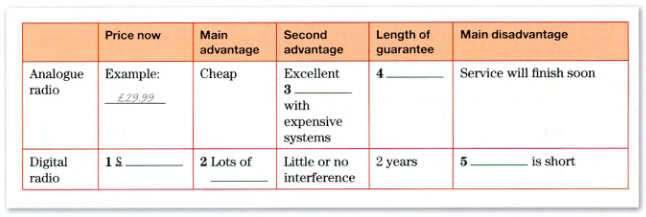
1. £
2.
3.
4.
5.
Listen to the recording and complete the gaps in the table. Write NO MORE THAN ONE WORD AND/OR A NUMBER for each answer.
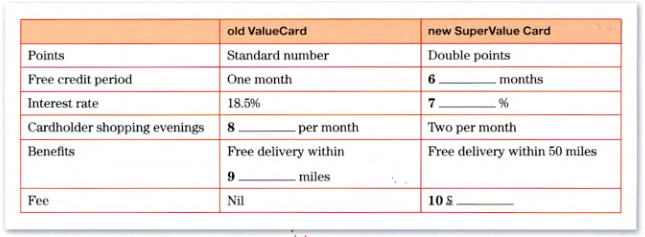
6.
7.
8.
9.
10.
Read and answer the following questions.
Amphibians
/amphibianfact.jpg)
What is an amphibian? An amphibian is an animal that spends part of its life underwater and part on land. When amphibians are underwater, they breathe with gills. When they are on land, they breathe with lungs. They are cold-blooded. This means that their body temperature changes depending on the temperature around them.
There are three different kinds of amphibians. The first group is newts and salamanders. These animals are about three inches long. They have four legs and four "fingers" on each leg. They are red-orange and transform to the color green.
The second type is frogs and toads. Frogs and toads are very similar. Toads have a warty back and spend less time in the water. They eat insects and other small animals. Frogs begin as tadpoles. They spend time close to the water so that they can lay their eggs.
The last group is caecilians. These are worm-like creatures. Millions of years ago, there were other types of amphibians, but they are now extinct.
Source: Daily Warm-ups Reading Grade 4
How is an amphibian different than most sea mammals?
- An amphibian eats different foods.
- An amphibian breathes underwater with gills.
- An amphibian can swim.
- There is not enough information about them.
- There are new species being discovered every day.
- They now no longer exist in the ecosystem.
Read the following passage and decide if statements are TRUE, FALSE or NOT GIVEN.
What Is Happening to Our Planet?
Sometimes humans kill animals indirectly. Few places on the planet are untouched by humans. The ever-increasing human population needs more space. Industries use more and more of the Earth's natural resources. The result: in less than one hundred years, as many as two hundred known species of birds and mammals have vanished
How? Many natural habitats are disappearing. The Earth's rainforests are being destroyed, along with their inhabitants. Toxic wastes, air pollution, and radiation take terrible tolls on wildlife. Changes in the planet's ozone layer and in its climate threaten all animals, including humans.
In 1977, President Jimmy Carter asked for an official study of the environment. What, he asked, would our planet be like in the year 2000 if present trends continue? This study was done by several U.S. government departments at the direction of Dr. Gerald Barney. Published in 1980, the Global 2000 Report to the President provided startling warnings and predictions about the fate of the Earth if we do not make changes in the way we treat it.
The report predicted, among other things, that "between half a million and 2 million species - 15 to 20 percent of all species on earth could be extinguished by the year 2000." It warned of more hardship for the Earth's human inhabitants as well, more starvation, for example.
This report strongly urged the government to take immediate action. It gave recommendations for change. But by the time the study was completed, Ronald Reagan had been elected president and his administration ignored the report.
The 1980s were not a good decade for the environment. It is likely that a global report now would be even bleaker than the one published after the 1970s. Many environmentalists wonder if we can stop the destruction of our planet before it is too late. When, they ask, will humans realise that they are not meant to be masters of the Earth, only one of its guests?
Adapted from Basic IELTS Reading Band 3.5-4.5
The increase of human population and the needs of industries result in the death of lots of birds and mammals.
- True
- False
- Not given
In 1977, President Jimmy Carter believed that the present trends would continue.
- True
- False
- Not given
According to the report, more than 2 million species on earth would disappear by 2000.
- True
- False
- Not given
Ronald Reagan was elected president after the study was completed.
- True
- False
- Not given
Ronald Reagan's administration didn't think that the report was necessary.
- True
- False
- Not given
It is possible that it will be too late when we stop the destruction of the Earth.
- True
- False
- Not given
The environmentalists don't think that humans are masters of the Earth.
- True
- False
- Not given
Reading the following passage.
Cupcakes are made from a mixture of ingredients. Different flavoured cupcakes have different mixtures. The icing used to decorate the cakes contains sugar, water, colouring and flavouring. Water and sugar are different types of compounds. These compounds are made from elements.
Elements, compounds and mixtures
Chemical substances occur in three types.
- Elements - these contain one type of atom only. They cannot be chemically broken down into simpler substances.
- Compounds - these contain two or more different elements bonded together. A chemical reaction is needed to break up a compound. This will involve energy.
- Mixtures - these may contain two or more elements and/or compounds. They are mixed in any proportion and can be separated out.
When a baker mixes the flour, sugar, fat, eggs, flavouring and colour together to make cupcakes, he or she is making a mixture. The icing sugar, water and colour make a different mixture. The sugar and water are compounds.
The compound water is made from the elements hydrogen and oxygen. Sugar contains the elements hydrogen, oxygen and carbon.
In this unit, we will be looking at flavourings, the substances that are added to food or drink to give it a particular taste. They are added because people would probably refuse to eat certain products without them. Margarine and ice cream, for example, would have unacceptable tastes, whereas certain jellies, some other sweets, and meat replacement products would have little or no taste.
Natural flavours are those found in nature. Those from vegetable sources include vanilla, strawberry, lemon and nuts. An example of an animal source is beef flavouring, added for example to chips. Essential oils and fruit juices can also be used to flavour foods. They are sourced in nature and obtained through physical processes such as distillation and fermentation.
Some animal flavours, such as bacon and beef flavour in crisps, are vegetarian because they are artificial rather than made from animal sources.
There are also nature-identical flavourings. An example is vanillin, which is often produced cheaply from lignin, a polymer, rather than from vanilla pods. These flavourings are chemically identical to natural flavourings, but have been produced chemically rather than naturally, e.g. by a process of chemical extraction. The human body does not notice the difference as their molecules are identical to natural ones.
Artificial flavourings consist of chemically synthesized compounds which have no source whatsoever in nature. Although the word natural has positive connotations, some natural flavours may have contaminated sources, which are harmful. Artificial flavours undergo strict testing because they are subject to laws (e.g. The European Flavouring Regulation (1334/2008) and may therefore be purer and safer. Using natural flavourings is also more expensive and may be considered a waste at a time when we are trying to preserve nature.
Complete the sentences below by choosing NO MORE THAN TWO WORDS OR NUMBERS from the text for each answer.
1. A compound cannot be separated without energy and a .
2. Although mixtures consist of a combination of elements and compounds, it is possible for these to be .
3. If flavourings were not added, people would probably to consume margarine.
4. Flavours can only described as natural if they have a natural .
5. Vanillin is chemically produced, but in chemical composition to a natural flavouring.