[IELTS 5.] Unit 19.2 - Reading & Listening
2/13/2021 5:00:00 PMListen to the audio and answer the questions. Write NO MORE THAN TWO WORDS AND / OR A NUMBER for each answer.
1. According to Phil, what are the two problems with some renewable energy sources?
-
-
2. List two things that Professor Jenkins wants to see in the student's report.
-
-
Solar energy production costs forecast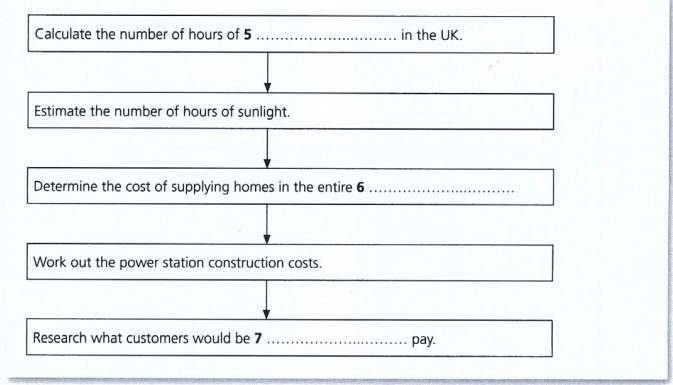
5.
6.
7.
Complete the summary below using words from the box. Write ONE option A-G in each blank.
| A. data | E. prediction |
| B. highlight | F. evaluate |
| C. statistics | G. reduction |
| D. demonstrate |
Project content summary
The alternative energy project will cover 3 main areas: a comparison, a price and an analysis. The students will use information given to them by their tutor and government . Using a system of comparison between the data sets they will any discrepancies for further analysis.
Listen to the first part of the lecture and complete the sentence below. Write NO MORE THAN THREE WORDS AND/OR A NUMBER for each answer.
Recent changes in society are eroding the traditional structure.
Slightly fewer than 50% of American children under 13 live in .
Statistics show that cohabiting couples are more reliable than married couples.
DINKS focus on rather than having children.
Listen to the second part of the lecture and complete the sentence below. Write NO MORE THAN THREE WORDS AND/OR A NUMBER for each answer.
How many children in the UK now live in single parent families?
According to some sociologists, who is responsible for the rise in single parenting?
What have the largest group of lone parents never done?
Where are single parent families more likely to live?
Listen to the last part of the lecture and choose TWO answers.
Which two points does the lecturer give as disadvantages for living alone?
- People living alone will need help from the community.
- It is more likely to foster a fragmented population.
- It creates an accommodation shortage.
- It is more expensive to live alone.
- People may have children too late.
Read the following passage and choose which of the headings from A - I match the blanks. There are two extra headings, which do not match any of the paragraphs.
List of headings
A. Advice for graduates seeking employment
B. Defence of the plans
C. Detailed information about the review recommendations
D. Introduction of the plans
E. More background and some details
F. The reaction of students
G. The reaction of the NUS
H. The reaction of unions and newer universities
I. The reaction of universities
1.
Plans to allow universities in the UK to charge unlimited tuition fees were today greeted with dismay from students and lecturers but welcomed by vice-chancellors at top-flight institutions. Fees of up to £6,000 a year would go directly to universities, but above that figure they would pay a levy that would increase for each additional £1,000, restricting the extra income, under proposals set out by a review of higher education funding. Graduates would also repay their loans later and over a longer period.
2.
Lord Browne of Madingley proposed a new system under which one graduate in five in lower-paid jobs would repay less than today but higher-earning graduates would pay more. His proposals, following a review of higher education finance lasting almost a year, will form the basis of a new system for funding universities in the future. "Under these plans universities can start to vary what they charge,' he said, 'but it will be up to students whether they choose the university. The money will follow the student, who will follow the quality. The student is no longer taken for granted, the student is in charge."
3.
Aaron Porter, president of the National Union of Students said: "If adopted, Lord Browne's review would hand universities a blank cheque and force the next generation to pick up the tab for devastating cuts to higher education. The only thing students and their families would stand to gain from higher fees would be higher debts. A market in course prices between universities would increasingly put pressure on students to make decisions based on cost rather than academic ability or ambition."
4.
The review recommends:
- Graduates would not start to repay student loans until they earn £21,000 a year. This threshold would rise in line with earnings to protect graduates with lower incomes. The current threshold is £15,000.
- Repayments would stay at 9 percent of income but graduates with higher earnings would pay a higher interest rate of 2.2 percent above inflation, equal to the Government's cost of borrowing. Lower-paid graduates would continue to pay no real interest rate on loans.
- Student loans would be paid over a maximum of 30 years, after which they would be written off. The current maximum is 25 years.
- Student support should be simplified, with a flat living loan of £3,750 for all undergraduates and maintenance grants of up to £3,250. Full grants would go to students whose family income was £25,000 or less and partial grants to those with household income up to 660,000.
5.
Professor Steve Smith, president of Universities UK, which represents vice-chancellors, said: "We are extremely pleased that Lord Browne's proposals build on the fair and progressive elements of the current system. No parent or student would have to pay tuition fees upfront, only a graduate would pay when they are earning £21,000 per year. This will be crucial in supporting those from disadvantaged backgrounds through university."
6.
But union leaders and representatives of newer universities warned of the 'devastating' impact on families if the recommendations are implemented. Professor Les Ebdon, chair of million+, which represents new universities, said: "There is a real risk that some students who would have gone to university will decide not to go and that opportunity and social mobility will be fatally undermined."
7.
Lord Browne, the former group chief executive of BP, said that despite higher fees, the number of people going to university should expand. His plans allow for a 10 percent increase in the number of student places over the next four years. Part-time students would also have access to student loans to cover the cost of their tuition fees, giving more people a second chance to study for a degree later in life, he said. His plans would create a market in higher education, with many research universities likely to charge £6,000 or £7,000 a year, a handful of top universities charging higher fees, but many newer universities that focus on teaching charging less.