[IELTS 5.] Unit 19.1 - Reading & Listening
2/11/2021 5:00:00 PMComplete the diagram below. Write NO MORE THAN THREE WORDS AND/OR A NUMBER for each answer.

1.
2.
3.
4.
You will hear a recording of a lecture on deep sea exploration.
Listen to the first part of the lecture and complete the time line using NO MORE THAN TWO WORDS AND/OR NUMBERS FROM THE RECORDING.
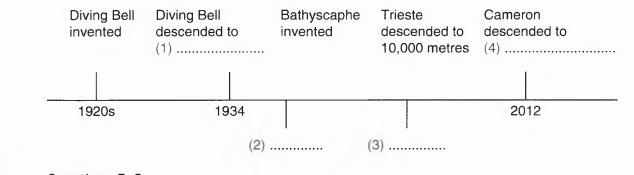
(1)
(2)
(3)
(4)
Read the passage Global Warming and look at the following statements. Write
|
YES if the statement agrees with the writer; NO if the statement does not agree with the writer; NOT GIVEN if the information is not given in the passage. |
Global Warning
It seems as if every time you turn on the television news, you hear one or the other of the following catchphrases of the 1990s: global warming, greenhouse effect, climate change. As it often is with catchphrases, hardly anyone knows what these terms really mean or how they relate to each other.
In the past 100 years, in our effort to make the Earth a more civilised place, industrial production has increased by fifty times. Four-fifths of that growth has come since 1950. This production - most of it based on the burning of wood, and of fossil fuels like coal, oil, and natural gas - has greatly increased the amount of carbon dioxide in the atmosphere. When fossil fuels are burned, they release carbon into the air in the form of carbon dioxide. Carbon dioxide allows heat that would normally escape from the Earth's atmosphere to remain trapped, as it would in a greenhouse - thus the greenhouse effect.
When do you burn fossil fuels? When you turn on a light, or run an air conditioner, or take a hot shower, or make toast, you contribute to the greenhouse effect. It is a by-product of the use of energy - electricity, gasoline, or oil.
But how can carbon dioxide be bad when human beings exhale it every time they breathe? Plants need carbon dioxide; they use it to grow. Oceans absorb it. And forests drink it in. Without carbon dioxide, the average surface temperature on Earth would be 0 degrees Fahrenheit, instead of 59 degrees Fahrenheit. In nature, carbon dioxide is necessary and harmless. Here is the problem: in our effort to make the world a more comfortable place, people have produced far too much of it.
By drilling holes into glaciers and testing the air bubbles trapped in ancient ice, by looking at the fossilised plant tissues, even by looking at the air sealed in old telescopes, scientists have calculated that the atmosphere before the Industrial Revolution contained about 280 parts per million of carbon dioxide - the highest level recorded in the past 160,000 years. The current reading is near 360 parts per million. In the next 140 years, the carbon dioxide level should reach at least 560 parts per million.
We have increased the amount of carbon dioxide in the air by 25 percent in the past century. Carbon dioxide is not exclusively responsible for the greenhouse problem, however. Other greenhouse gases include chlorofluorocarbons, nitrogen oxides and methane.
People usually do not understand what catchphrases really mean.
- YES
- NO
- NOT GIVEN
Most of the growth in industrial production in the past 100 years came before 1950.
- YES
- NO
- NOT GIVEN
Carbon dioxide allows heat to be trapped in the Earth's atmosphere.
- YES
- NO
- NOT GIVEN
People burn more fossil fuels when they take a hot shower than when they make toast.
- YES
- NO
- NOT GIVEN
People who use electricity help to produce the greenhouse effect.
- YES
- NO
- NOT GIVEN
The carbon dioxide level in the next 140 years will increase at least by two times what it was before the Industrial Revolution.
- YES
- NO
- NOT GIVEN
Carbon dioxide causes more problems than the other greenhouse gases do.
- YES
- NO
- NOT GIVEN