[IELTS 6.] - Mindset 1: Unit 1.1 - Reading & Writing
7/4/2022 10:02:37 AMHãy xoay ngang màn hình nếu bạn dùng trên điện thoại nhé!
Vui lòng xem hết bài giảng trước khi ấn nút "Next" để làm bài tập.
Very little information _____ about this disease because it is very rare.
- knows
- is known
- know
- are known
In the US, the first stage of compulsory education _____ as elementary education.
- to be generally known
- is generally known
- generally known
- is generally knowing
The smoke from burning fuels causes pollution if it _____ into the atmosphere.
- releases
released
will be released
- is released
Choose the underlined part that needs correction.
With his important contributions, Albert Einstein considered one of the greatest physicists of all time.
- With
- important
- considered
- greatest
Choose the underlined part that needs correction.
The measurement unit known as a “foot” has originally based on the size of the human foot.
- measurement
- has
- size
- foot
Complete the article. Use the present passive form of the verbs in the brackets.
Thousands of books have been written about the territorial instinct of animals. Humans are territorial too, and when we understand this, some kinds of aggressive behavior can be understood more easily.
Every country is a territory with boundaries which (clearly/define). Within each country, there are smaller territories: countries and cities. Throughout history, wars have been fought by people protecting the territory in which they live.
However, there are other kinds of territory as well. One such territory (call) 'personal space'. For animals, the size of this space depends on the conditions in which the animal (rear) whether in the wild or in a zoo. For humans, it depends on the density of the population in the place where they grew up. To some extent, the size of an individual's personal space (determine) by their culture.
Personal space may be divided into four zones: the intimate, personal, social and public zones. The intimate zone extends fifteen to forty-five centimeters from the body. Only close friends and relatives (allow) to enter the intimate zone. If a stranger enters it, the individual becomes anxious and may feel threatened.
Read the following text.
One of the worst disasters in the nineteenth-century United States was the Great Chicago Fire of 1871. The fire raged through the city from the evening of October 8 until the early hours of October 10, when a rainfall finally helped extinguish it. By that time, the fire had swept through an area of about nine square kilometers, destroying everything in its path: houses, apartment buildings, streets, sidewalks, even lampposts. Property damage was estimated at around 200 million dollars, and over 100,000 people (out of the city's total population of 300,000) were left homeless. Three hundred people lost their lives, a relatively small number for such a large fire.
The first alarm notifying the fire department of the fire was pulled at a pharmacy at 9:40 in the evening. The origin of the fire has been famously traced to Mrs. O'Leary's barn. However, the popular legend that has the fire being started when Mrs. O'Leary's cow kicked over a kerosene lantern is simply not true. A newspaper reporter later admitted to having invented that story for its sensationalistic value. Nevertheless, it was determined that the fire did begin in Mrs. O'Leary's barn, although the exact cause remains unknown. Interestingly enough, Mrs. O'Leary's house, just in front of her barn, escaped damage.
Write NO MORE THAN THREE WORDS AND/OR A NUMBER for each answer.
1. On what date did the fire begin?
2. How many people died in the fire?
3. Where did the fire start?
Read the following text.
Sifting through the sands of time
When you're on the beach, you're stepping on ancient mountains, skeletons of marine animals, even tiny diamonds. Sand provides a mineral treasure-trove, a record of geology's earth-changing processes.
Sand: as children we play on it and as adults we relax on it. It is something we complain about when it gets in our food, and praise when it's moulded into castles. But we don't often look at it. If we did, we would discover an account of a geological past and a history of marine life that goes back thousands and in some cases millions of years.
Sand covers not just sea shores, but also ocean beds, deserts and mountains. It is one of the most common substances on earth. And it is a major element in man-made items too — concrete is largely sand, while glass is made of little else.
What exactly is sand? Well, it is larger than fine dust and smaller than shingle. In fact, according to the most generally accepted scheme of measurement, devised by the Massachusetts Institute of Technology, grains qualify if their diameter is greater than 0.06 of a millimetre and less than 0.6 of a millimetre.
Depending on its age and origin, a particular sand can consist of tiny pebbles or porous granules. Its grain may have the shape of stars or spirals, their edges jagged or smooth. They have come from the erosion of rocks, or from the skeletons of marine organisms which accumulate on the bottom of the oceans, or even from volcanic eruptions.
Colour is another clue to sand's origins. If it is a dazzling white, its grains may be derived from nearby coral from crystalline quartz rocks or from gypsum, like the white sands of New Mexico. On Pacific islands jet black sands form from volcanic minerals. Other black beaches are magnetic. Some sand is very recent indeed, as is the case on the island of Kamoama in Hawaii, where a beach was created after a volcanic eruption in 1990. Molten lava spilled into the sea and exploded in glassy droplets.
Usually, the older the granules, the finer they are and the smoother the edges. The fine, white beaches of northern Scotland, for instance, are recycled from sandstone several hundred million years old. Perhaps they will be stone once more, in another few hundred million.
Sand is an irreplaceable industrial ingredient whose uses are legion: but it has one vital function you might never even notice. Sand cushions our land from the sea's impact, and geologists say it often does a better job of protecting our shores than the most advanced coastal technology.
Answer the questions below. Choose NO MORE THAN THREE WORDS from the passage for each answer.
1. What TWO materials made by humans are mentioned in the passage?
2. Which part of a grain of sand have scientists measured?
3. What TWO factors determine the size and shape of a piece of sand?
4. Which event produced the beach on Kamoama island?
5. Where, according to the passage, can beaches made of very ancient sand be found?
6. Who claims that sand can have a more efficient function than coastal technology?
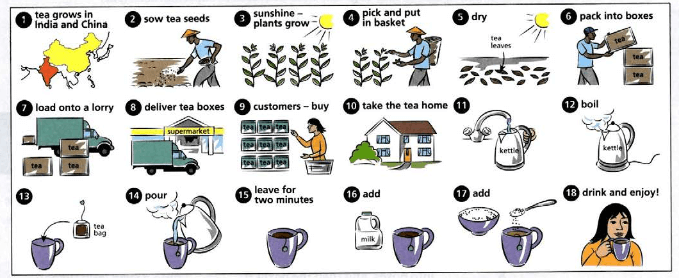
The pictures below show how tea is produced. They also illustrate the process of making a cup of tea.
Summarize the information by selecting and reporting the main features.