[IELTS 6.] - Mindset 1: Unit 4.1 - Reading & Writing
7/7/2022 10:17:26 AM(*Hãy xoay ngang màn hình nếu bạn dùng trên điện thoại nhé!)
(Vui lòng xem hết bài giảng trước khi ấn nút "Next" để làm bài tập.)
Complete the text with a, an, the or x (no article).
Melting Ice Reveals Secrets
A group of scientists have been studying life in Weddell Sea in Antarctica. Because of climate change, two ice shelves have melted and this has given scientists opportunity to see what has been living below ice.
The melting of the shelves in 1995 and 2002 opened up large sea floor, which had been covered for at least twelve thousand years.
Scientists spent ten weeks investigating the area. Using remote camera, they found and collected about a thousand new species. They also found that other species of animals are now able to live in there because water is warmer.
Read the following text.
The Navajo tradition of weaving has evolved over time, going through several distinct phases that marked changes in styles and materials used. Originally, the Navajo wove blankets, shawls, and dresses for personal use out of the wool of churro sheep. This characterized what is known as the classic period. Following this came the transitional period, starting around 1870, when synthetic dyes came into use. These produced more varied and brighter colors than the vegetable dyes that had been used in the earlier period. At this time, weavers also began to use machine spun cotton for the warp, weaving through it a weft of merino sheep wool, which produced a thicker yarn than the wool of the churro sheep. During the rug period, from about 1900 to 1930, weavers concentrated on producing rugs for the tourist trade instead of on items for personal home use. They wove according to what they believed their customers wanted. Thus, some of the designs of this period were very similar to oriental carpet designs, and the rugs were thicker than earlier ones to match the tourists' perception of what a rug should look like.
Classify the phrases as describing
|
A. classic period B. transitional period C. rug period |
made for use at home rather than for selling:
colored with dyes made from plants:
made with brightly colored yarns:
patterns looked like oriental rugs:
made partly out of cotton:
sold to tourists:
Read the following passage.
Prehistoric insects spawn new drugs
by Steve Connor
A. Insects entombed in fossilised amber for tens of millions of years have provided the key to creating a new generation of antibiotic drugs that could wage war on modern diseases. Scientists have isolated the antibiotics from microbes found either inside the intestines of the amber-encased insects or in soil particles trapped with them when they were caught by sticky tree resin up to 130 million years ago. Spores of the microbes have survived an unprecedented period of suspended animation, enabling scientists to revive them in the laboratory.
B. Research over the past two years has uncovered at least four antibiotics from the microbes and one has been able to kill modern drug-resistant bacteria that can cause potentially deadly diseases in humans. Present-day antibiotics have nearly all been isolated from micro-organisms that use them as a form of defence against their predators or competitors. But since the introduction of antibiotics into medicine 50 years ago, an alarming number have become ineffective because many bacteria have developed resistance to the drugs. The antibiotics that were in use millions of years ago may prove more deadly against drug-resistant modern strains of disease-causing bacteria.
C. Raul Cano, who has pioneered the research at the California Polytechnic State University at San Luis Obispo, said the ancient antibiotics had been successful in fighting drug-resistant strains of staphylococcus bacteria, a 'superbug' that had threatened the health of patients in hospitals across the globe. He now intends to establish whether the antibiotics might have harmful side effects. 'The problem is how toxic they are to other cells and how easy they are to purify,' said Cano.
D. A biotechnology company, Ambergene, has been set up to develop the antibiotics into drugs. If any ancient microbes are revived that resemble present-day diseases, they will be destroyed in case they escape and cause new epidemics. Drug companies will be anxious to study the chemical structures of the prehistoric antibiotics to see how they differ from modern drugs. They hope that one ancient molecule could be used as a basis to synthesise a range of drugs.
E. There have been several attempts to extract material such as DNA from fossilised life-forms ranging from Egyptian mummies to dinosaurs but many were subsequently shown to be contaminated. Cano's findings have been hailed as a break-through by scientists. Edward Golenburg, an expert on extracting DNA from fossilised life-forms at Wayne State University in Detroit, said: 'They appear to be verifiable, ancient spores. They do seem to be real.' Richard Lenski, professor of microbial ecology at Michigan State University, said the fight against antibiotic-resistant strains of bacteria such as tuberculosis and staphylococcus could be helped by the discovery.
F. However, even the use of ancient antibiotics may not halt the rise of drug-resistant bacteria. Stuart Levy, a micro-biologist at Tufts University in Boston, warned that the bacteria would eventually evolve to fight back against the new drugs. 'There might also be an enzyme already out there that can degrade it. So the only way to keep the life of that antibiotic going is to use it sensibly and not excessively,' he said.
Which paragraph contains the following information?
two examples of bacteria that are no longer killed by modern antibiotic drugs:
a reference to the length of time we have been using antibiotic drugs:
the original source of the new drugs being developed:
the location of the studies into the new antibiotic drugs:
examples of other studies similar to Cano's:
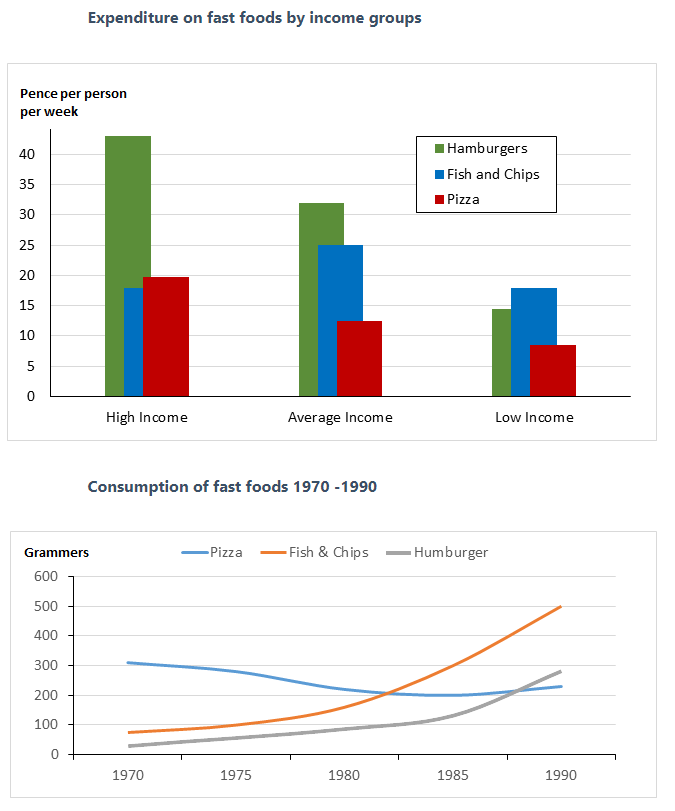
The chart below shows the amount of money per week spent on fast foods in Britain. The graph shows the trends in consumption of fast foods.
Summarize the information by selecting and reporting the main features, and make comparisons where relevant.