[IELTS 6.] - Mindset 2: Review Test 1
9/5/2022 9:55:06 AMComplete the notes below. Write NO MORE THAN THREE WORDS AND/OR A NUMBER for each answer.
TRAVEL AGENCY
Departure time: 8:00 a.m on Saturdays
Return time: p.m.
Transportation: or minibus
Group size: 15 - 25 tourists
Cost: £ per person including
Peak season: Tourists need to 2 days ahead
Payment:
Reference number of tour:
Which THREE attractions can tourists visit at present in Edinburgh?
- City Hall
- Old Castles
- Zoo
- Art Studio
- Royal Palace
- Seabird Centre
- Aquarium
Listen to the audio and choose the correct answer for each question.
The Dark which makes up Hampstead Heath is _____.
- very large
- fairly large
- fairly small
According the speaker, Hampstead underground station is _____.
- the shallowest in the system
- the deepest in the system
- the oldest in London
The speaker suggests that after their walk, people might want to _____.
- have a meal in the famous restaurants
- avoid Hampstead village as it is very busy
- visit Hampstead village to look at the shops
The houses in the Vale of the Heath are built _____.
- on the edge of the heath
- on the heath itself
- opposite the heath
The speaker advises walkers to remove their headphones to _____.
- hear the silence away from the traffic
- ensure they are not being followed
- listen to the noises in the park
Which activity can be done at each of the following locations on the heath?
Choose FIVE answers below and write the correct letter, A-G, in each blank.
|
Activities A. have picnics B. go fishing C. view London D. have a swim E. attend concerts F. watch plays G. have snacks |
Kenwood House
grassy slopes
open-air stage
ponds
Parliament Hill
Listen to the audio and choose the correct answer for each question.
The conversation may take place in a _____.
- university
- bookstore
- canteen
The topic of the first lecture is _____.
- local snack
- study strategies
- social life
Which TWO main factors are important for students’ successful study?
- using time effectively
- doing researching
- taking more lectures
- working independently
- coping well with stress
Complete the table below. Write NO MORE THAN THREE WORDS for each answer.
|
Listening to lecture |
the lecture Prepare for lecture ahead, check notes after lecture |
|
|
Powerpoint Group work |
|
Reading online materials |
Need a Approach: and analyzing method |
|
Writing essay |
A good Do before handing in |
Complete the notes below. Write NO MORE THAN THREE WORDS AND/OR A NUMBER for each answer.
The driest continent is .
Australia is about times larger than Britain.
Three main structural features of Australia:
- The Great Western Plateau
- The Central Eastern Lowlands
- The
The hottest month in Australia is .
The flag of Australia indicates its historical relationship with .
English is Australia’s official language just by , not by law.
of Australian are migrants.
Australian employees have paid annual leave, sick leave and .
Australia’s own history and culture are mainly affected by the .
The Australian government carried a policy to finance arts.
Read the following passage and complete the tasks.
Sleepy Students Perform Worse
A. Staying up an hour or two past bedtime makes it far harder for kids to learn, say scientists who deprived youngsters of sleep and tested whether their teachers could tell the difference. They could. If parents want their children to thrive academically, “Getting them to sleep on time is as important as getting them to school on time," said psychologist Gahan Fallone, who conducted the research at Brown Medical School.
B. The study, unveiled Thursday at an American Medical Association (AMA) science writers meeting, was conducted on healthy children who had no evidence of sleep- or learning-related disorders. Difficulty paying attention was among the problems the sleepy youngsters faced - raising the question of whether sleep deprivation could prove even worse for people with attention deficit hyperactivity disorder, or ADHD. Fallone now is studying that question, and suspects that sleep problems “could hit children with ADHD as a double whammy”.
C. Sleep experts have long warned that Americans of all ages do not get enough shuteye. Sleep is important for health, bringing a range of benefits that, as Shakespeare put it, “knits up the ravelled sleave of care”. Not getting enough is linked to a host of problems, from car crashes as drivers doze off to crippled memory and inhibited creativity. Exactly how much sleep correlates with school performance is hard to prove. So, Brown researchers set out to test whether teachers could detect problems with attention and learning when children stayed up late - even if the teachers had no idea how much sleep their students actually got.
D. They recruited seventy-four 6- to 12-year-olds from Rhode Island and southern Massachusetts for the three-week study. For one week, the youngsters went to bed and woke up at their usual times. They already were fairly good sleepers, getting nine to 9.5 hours of sleep a night. Another week, they were assigned to spend no fewer than ten hours in bed a night. The other week, they were kept up later than usual: First- and second-graders were in bed no more than eight hours and the older children no more than 6.5 hours. In addition to parents’ reports, the youngsters wore motion detecting wrist monitors to ensure compliance.
E. Teachers were not told how much the children slept or which week they stayed up late, but rated the students on a variety of performance measures each week. The teachers reported significantly more academic problems during the week of sleep deprivation, the study, which will be published in the journal Sleep in December, concluded. Students who got eight hours of sleep or less a night were more forgetful, had the most trouble learning new lessons, and had the most problems paying attention, reported Fallone, now at the Forest Institute of Professional Psychology.
F. Sleep has long been a concern of educators. Potter-Burns Elementary School sends notes to parents reminding them to make sure students get enough sleep prior to the school’s yearly achievement testing. Another school considers it important enough to include in the school’s monthly newsletters. Definitely, there is an impact on students’ performance if they come to school tired. However, the findings may change physician practice, said Dr. Regina Benjamin, a family physician in Bayou La Batre, who reviewed the data at the Thursday’s AMA meeting. “I don't ask about sleep” when evaluating academically struggling students, she noted. “I’m going to start.”
G. So how much sleep do kids need? Recommended amounts range from about ten to eleven hours a night for young elementary students, to 8.5 hours for teens. Fallone insists that his own second-grader get ten hours a night, even when it meant dropping soccer-season that practice did not start until 7:30 - too late for her to fit in dinner and time to wind down before she needed to be snoozing. “It’s tough,” he acknowledged, but “parents must believe in the importance of sleep."
Which paragraph contains each of the following pieces of information?
Traffic accidents are sometimes caused by lack of sleep.
The number of children included in the study.
How two schools are trying to deal with the problem.
How the effect of having less sleep was measured.
Complete the following sentences using NO MORE THAN TWO WORDS from the text for each gap.
Fallone is now studying the sleep patterns of children with .
The researchers used that show movement to check that children went to bed at the right time.
Students with less sleep had problems with memory, remembering new material, and .
Fallone admitted that it was for children to get enough sleep.
Do the following statements agree with the information given in the passage?
| TRUE | if the statement agrees with the information |
| FALSE | if the statement contradicts the information |
| NOT GIVEN | If there is no information on this |
The results of the study were first distributed to principals of American schools.
Some of the children in the study had previously shown signs of sleeping problems.
The study could influence how doctors deal with children’s health problems.
Fallone does not let his daughter play soccer.
Staying up later is acceptable if the child is doing homework.
Read the passage and complete the tasks.
That Vision Thing
In the past, management took a minor role in influencing motivation. It was generally considered that if the correct tools, training, and environment were provided, individuals would do their jobs, and that this was sufficient in itself. People in organizations were considered 'personnel'. But look how it has now changed. 'Personnel' have become 'human resources', and staff are now seen in terms of strategic potential, and with appropriate development, are one of the most important assets organizations may have.
A key aspect of this is motivation, and to achieve it, the latest buzzword is envisioning. We often hear management gurus propounding the thesis that any leader of worth must have a vision. This can unite, inspire, and direct the energies of the staff in the right direction. In the absence of such a 'visionary leader', the organization necessarily flounders in complete aimlessness - or at least, that is what we are led to believe. And yet I strongly disagree that this 'vision thing' (as famously referred to by former American President, George Bush Senior) is worth much at all. I'd even go further, stating that it can be distinctly bad for the organization.
The first fact to realize is that 'envisioning' fails to acknowledge the true human nature of organizations. These places are not composed of lemmings., all with a simplistic and single-minded dedication towards one goal. They are most obviously composed of groups of human beings, and with their rich variety of personalities and experiences, no such community can be homogeneous and share exactly the same set of personal values. These people are, in fact, merely loosely-bound cohorts pursuing different objectives (status, money, power, or individually defined agendas), in different manners. Thus a truly shared and meaningful vision is very difficult, and often impossible, to generate.
Yet the 'visionary' manager attempts to do just this. The trouble is, the high-minded dictates of his fresh MBA do not mention becoming bogged down in a long, labored excess of word-smithing, or how, in order to reach a consensus, the vision necessarily loses all individuality. The books do not mention the passionless and sterile written exhortation which is ultimately produced, of working towards 'unshakable integrity'. As admirable in content, as these may be, they are merely corporate mantras rather than words to be lived by. Few will believe in something imposed from above, instead merely complying at a superficial level.
The unfortunate fact is, when turning from rhetoric to reality, the contradictions can be overwhelming. Deep down, all staff members know that envisioning is attempted not to create a more egalitarian company, but only as a means of enriching the company directors. But what about those staff member? Few of them work merely for the love of their job. In a materialistic and consumer-driven world, they work for hard and tangible rewards. This can take many forms, but certainly involves the company giving back profit in the form of salary, overtime, TOIL, bonuses, perks and extra days off. Personal visions never, ever, mention these.
Here's another reason why envisioning is dubious at best. Workers do not like to be treated as products in the service of profits, or cogs in the organizational machine, yet envisioning ranks them as even worse - as animals in a sociological experiment. The assumption is that they lack their own personal vision and are helplessly adrift, deficits which can only be remedied by a great leader who can herd the lost sheep in the right direction. This is not a feeling likely to enhance commitment to the cause and often make staff feel the very opposite, a fact about which I can personally testify from my own experiences of working in big companies where the envisioning farce was played out.
Personal visions are, in fact, necessarily complex. Almost everyone would surely have difficulties in articulating their deepest motivations, as well as in being honest about this to themselves. They would similarly have some reluctance to openly talk on the subject, often with people who might be competitors for that next promotion. Furthermore, envisioning begs the question of whether a vision is even necessary. Some people are not driven by a determination to stridently blaze a trail through life. This may merely show a spiritual calm, and a desire to appreciate the present. It may also be a smarter and more strategic approach to life's unpredictable turns, applying equally well to the business world. In short, a lack of vision may be better - much better.
George Bush, as with many presidents, occasionally did not articulate his thoughts clearly, but his famously dismissive comment about envisioning speaks volumes. 'That vision thing' is remarkable in its concision. In just three words, it encapsulates the trendy, contrived, pigeon-holing, simplistic, top-down, and often insulting and hypocritical nature of the process. Mr Bush, you have my vote.
Answer the questions. Choose NO MORE THAN TWO WORDS from the passage for each answer.
Broadly, what do staff need in order to most benefit a company?
Which people advise envisioning?
What do they believe a lack of vision might cause?
What aspect can groups of people never have in common?
Complete the flow chart. Choose NO MORE THAN THREE WORDS from the passage for each answer.

18.
19.
20.
21.
22.
23.
Most people _____
- can define what makes them want to succeed.
- will discuss their personal visions with others.
- are interested in promotions.
- express their deeper feelings truthfully.
Personal visions _____
- take people forward in life.
- result in the absorption of immediate details.
- provide deference against unexpected events.
- help calm people's minds.
With regard to envisioning, the author feels _____
- critical.
- contemptuous.
- impartial.
- suspicious.
Read the following passage and complete the tasks.
A LIBRARY AT YOUR FINGERTIPS
A few years ago, at the height of the dotcom boom, it was widely assumed that a publishing revolution, in which the printed word would be supplanted by the computer screen, was just around the corner. It wasn’t: for many, there is still little to match the joy of cracking the spine of a good book and settling down for an hour or two of reading. A recent flurry of activity by big technology companies – including Google, Amazon, Microsoft and Yahoo! – suggests that the dream of bringing books online is still very much alive.
The digitizing of thousands of volumes of print is not without controversy. On Thursday, November 3, Google, the world’s most popular search engine, posted a first installment of books on Google Print, an initiative first mooted a year ago. This collaborative effort between Google and several of the world’s leading research libraries aims to make many thousands of books available to be searched and read online free of charge. Although the books included so far are not covered by copyright, the plan has attracted the ire of publishers.
Five large book firms are suing Google for violating copyright on material that it has scanned and, although out of print, is still protected by law. Google has said that it will only publish short extracts from material under copyright unless given express permission to publish more, but publishers are unconvinced. Ironically, many publishers are collaborating with Google on a separate venture, Google Print Publisher, which aims to give readers an online taste of books that are commercially available. The searchable collection of extracts and book information is intended to tempt readers to buy the complete books online or in print form.
Not to be outdone, Amazon, the world’s largest online retailer, has unveiled plans for its own foray into the mass e-book market. The firm, which began ten years ago as an online book retailer, now sells a vast array of goods. No doubt piqued that Google, a relative newcomer, should impinge upon its central territory, Amazon revealed on Thursday that it would introduce two new services. Amazon Pages will allow customers to search for key terms in selected books and then buy and read online whatever part they wish, from individual pages to chapters or complete works. Amazon Upgrade will give customers online access to books they have already purchased as hard copies. Customers are likely to have to pay around five cents a page, with the bulk going to the publisher.
Microsoft, too, has joined the online-book bandwagon. At the end of October, the software giant said it would spend around $200 million to digitize texts, starting with 150,000 that are in the public domain, to avoid legal problems. It will do so in collaboration with the Open Content Alliance, a consortium of libraries and universities. (Yahoo! has pledged to make 18,000 books available online in conjunction with the same organization.) On Thursday, coincidentally the same day as Google and Amazon announced their initiatives, Microsoft released details of a deal with the British Library, the country’s main reference library, to digitize some 25 million pages; these will be made available through MSN Book Search, which will be launched next year.
These companies are hoping for a return to the levels of interest in e-books seen when Stephen King, a best-selling horror writer, published “Riding the Bullet” exclusively on the Internet in 2000. Half a million copies were downloaded in the first 48 hours after publication. This proved to be a high-water mark rather than a taste of things to come. While buyers were reluctant to sit in front of a computer screen to read the latest novels, dedicated e-book reading gadgets failed to catch on. Barnes and Noble, a leading American bookshop chain, began selling e-books with fanfare in 2000 but quietly pulled the plug in 2003 as interest faded.
The market for e-books is growing again, though from a tiny base. According to the International Digital Publishing Forum, which collates figures from many of the world’s top publishers, in the third quarter of 2004, worldwide sales were 25% higher than the year before. Unfortunately, this only amounted to a paltry $3.2 million split between 23 publishers in an industry that made sales worth over $100 billion that year.
Both retailers and publishers reckon they will eventually be able to persuade consumers to do a lot more of their reading on the web. Some even hope they can become to online books what Apple’s iTunes is to online music. There are crucial differences between downloading fiction and downloading funk. Online music was driven from the bottom up: illegal file sharing services became wildly popular, and legal firms later took over when the pirates were forced (by a wave of lawsuits) to retreat; the legal providers are confident that more and more consumers will pay small sums for music rather than remain beyond the law. The iPod music player and its like have proved a fashionable and popular new way to listen to songs. The book world has no equivalent.
So the commercial prospects for sellers of online books do not yet look very bright. They may get a lift from some novel innovations. The ability to download mere parts of books could help, for instance: sections of manuals, textbooks or cookery books may tempt some customers; students may wish to download the relevant sections of course books; or readers may want a taste of a book that they subsequently buy in hard copy. The ability to download reading matter onto increasingly ubiquitous hand-held electronic devices and 3G phones may further encourage uptake. In Japan, the value of e-books (mainly manga comic books) delivered to mobile phones has jumped, though it will be worth only around ¥6 billion ($51 million) in 2005, according to estimates.
A few years ago, it was widely thought that _____.
- people would read fewer ‘paper’ books
- companies like Amazon would go bankrupt
- the dotcom boom would soon end
Publishers are unhappy with Google because _____.
- Google is only publishing extracts, not complete books
- they think Google is in breach of copyright
- Google is co-operating with leading research libraries
Amazon will _____.
- sell books that previously only Google sold online
- buy the copyright for many books it sells online
- allow people to buy only parts that they want to read from books
It is clear that most readers, if given the choice, prefer _____.
- ‘paper’ books
- reading from computer screens
- using dedicated e-book readers
Complete the following sentences using NO MORE THAN THREE WORDS from the text for each gap.
If companies publish books online that are not covered by copyright, they avoid .
The is very small but getting larger.
The expect that they will be able to convince more people to read online.
The has nothing similar to an iPod.
In Japan, most of the publications sent to mobile phones are .
Do the statements on the next page agree with the information given in the reading passage?
TRUE - if the statement agrees with the views of the writer
FALSE - if the statement contradicts the views of the writer
NOT GIVEN - if it is impossible to say what the writer thinks about this
Books that are out of print are not covered by copyright law.
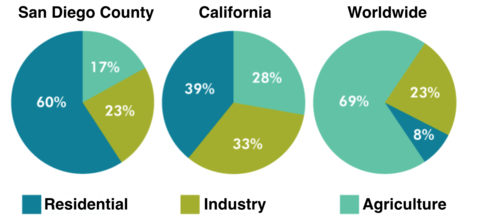
The pie charts below compare water usage in San Diego, California and the rest of the world.
Summarize the information by selecting and reporting the main features, and make comparisons where relevant.
You should spend about 40 minutes on this task. Write at least 250 words about the following topic:
It is commonly believed that nowadays main factors that affect a child's development are media, pop culture and friends. A different point of view is that family plays the most significant role.
Discuss both views and give your opinion.
Speaking Part 1
Time: 4-5 minutes
In this first part of the test, you're going to answer some questions about yourself:
- Do you live in a house or an apartment?
- Who do you live with?
- How long have you lived there?
- What part of your home do you like the most?
- Would you change anything about your home? Why / why not?
- Do you plan to live there for a long time?
- Are there many amenities near your home?
Please click Next to see the model answers.
(Adapted from IELTS Practice Online)
Do you live in a house or an apartment?
Who do you live with?
How long have you lived there?
What part of your home do you like the most?
Would you change anything about your home? Why / why not?
Do you plan to live there for a long time?
Are there many amenities near your home?
Speaking Part 2
Time: 3-4 minutes
In this second part of the test, you're going to talk about a given topic for 1-2 minutes.
|
Describe what you usually do in your leisure time. You should say:
and explain why you like to spend your free time this way. |
You will have one to two minutes to talk about this topic.
You will have one minute to prepare what you are going to say.
Speaking Part 2
Time: 3-4 minutes
In this second part of the test, you're going to talk about a given topic for 1-2 minutes.
|
Describe what you usually do in your leisure time. You should say:
and explain why you like to spend your free time this way. |
You will have one to two minutes to talk about this topic.
You will have one minute to prepare what you are going to say.
Speaking Part 3
Time: 4-5 minutes
In the last part of the test, you're going to answer questions related to the given topic in Part 2.
- Why it is important for people to have time for leisure activities?
- What types of leisure activities are popular in your country?
- Are the types of leisure activities that are popular today the same as those that were popular when your parents were young?
- How can our leisure activities help us in our future life?
Please click Next to see the model answers.
(Adapted from IELTS Mentor)
Why it is important for people to have time for leisure activities?
What types of leisure activities are popular in your country?
Are the types of leisure activities that are popular today the same as those that were popular when your parents were young?
How can our leisure activities help us in our future life?