[IELTS 6.] - Mindset 2: Review Test 3
9/19/2022 9:35:40 AMComplete the notes below. Write NO MORE THAN THREE WORDS/ OR A NUMBER for each answer.
SUMMER TOUR RESERVATION
Nationality: American
Name: Ariel Lee
Contact number:
Trips have: main resorts; ; special activities
Fee: $20 - $35 per person
Leave time: 7:00 am
Transport: minibus or
At peak season tourists have to .
Complete the table below. Write NO MORE THAN THREE WORDS AND/OR A NUMBER for each answer.
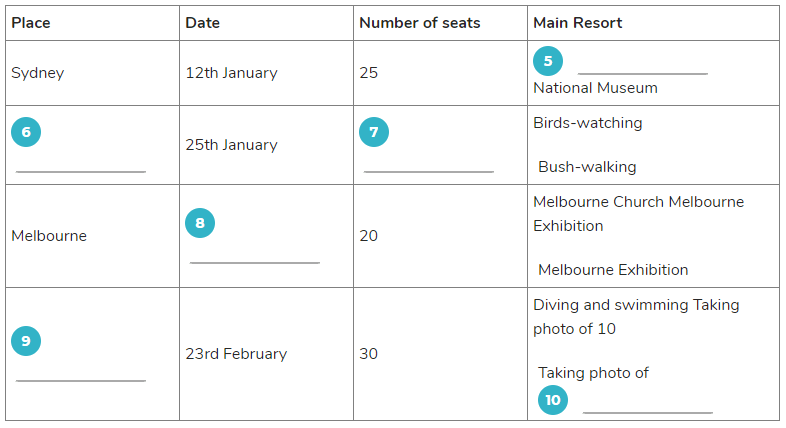
5.
6.
7.
8.
9.
10.
Listen to the audio and do the tasks.
Write NO MORE THAN FOUR WORDS OR A NUMBER for the answer.
The house was built between .
It was originally constructed as a/an _____.
- family home
- office
- public house
Write NO MORE THAN FOUR WORDS for each answer.
The house contains art from:
Until recently, the art gallery was:
Tomorrow’s talk will be at: o'clock
Complete the sentences below. Write NO MORE THAN FOUR WORDS for each answer.
Breakfast is served in the cafeteria or .
You can choose between an English breakfast or .
A car park was built because of an increase in .
The garden contains many .
The animals at Apsley House are all .
Listen to the audio and choose the correct answer for each question.
Which college does Chris suggest would be best?
- Leeds Conservatory of Contemporary Music
- The Henry Music Institute
- The Academy in London
What entry requirements are common to all the colleges?
- An audition
- An essay
- An interview
How much does the course at Leeds Conservatory of Contemporary Music cost?
- £6,000 a year
- £7,000 a year
- £8,000 a year
What other expenses are payable to the colleges?
- Application fee
- Insurance
- Train fare
When is the deadline for Leeds Conservatory of Contemporary Music?
- January 9th
- January 19th
- January 30th
Which facilities do the colleges have?
Choose FIVE answers from the box and write the correct letter, A-G, in each blank.
Facilities
A. large gardens
B. multiple sites
C. practice rooms
D. recording studio
E. research facility
F. student canteen
G. technology suite
Northdown College
The Academy in London
Leeds Conservatory of Contemporary Music
The Henry Music Institute
The James Academy of Music
Complete the notes below. Write NO MORE THAN TWO WORDS for each answer.
ECONOMICS COURSE GUIDELINES
During lectures
Students:
will receive information about economics and the to concentrate on
will be provided with information about the subject will be provided with a framework for further study
will have an opportunity to be taught by a in the field
will take part in the learning culture in
Common problems students have with techniques used in lectures
may not develop : no immediate questions
newer techniques help improve more than lectures
How to avoid problems and make learning easier
leave time to read on the book list
test yourself with quizzes
if you have had a , revise what you previously learned
use the web to do more
check the sources of information on the web are
with your classmates
Read the following passage and complete the tasks.
THE LOCH NESS MONSTER
In the Scottish Highlands there, is believed to be a monster living in the waters of Loch Ness. The waters of Loch Ness are one mile wide and 24 miles long, the largest body of fresh water in the United Kingdom. To many skeptics, this monster is only a modem day myth, but to others who claim they have seen it, the monster exists and still lurks in the waters of Loch Ness today.
Throughout Scotland, research has been done at several lakes but Loch Ness is the icon for monsters – Nessie, as the monster is affectionately named, being the most popular of them all. Both professionals and amateurs flock to this lake with their cameras in the hope of capturing a brief glimpse of Nessie and possibly solving the mystery of the Loch Ness monster.
The very first sighting of Nessie was as far back as 565 AD. It is believed that she ate a local farmer and then dived back into the waters, with no accounts of being seen again for over 100 years. However, since the turn of the 20th century, several other people have claimed to see her. Some people believe that old Scottish myths about water creatures such as Kelpies and water horses have contributed to the idea of tills wondrous monster lurking beneath.
2007 brought about the most recent sighting of Nessie. A tourist named Gordon Holmes from Yorkshire visited the Loch Ness waters and claimed that not only saw her but has captured her on video. He claimed she was jet black, about 15 metres long and traveling in a very straight line at about 6 miles per hour. Despite this supposed evidence, controversy still reigns and opinions clearly divided about its existence. The video footage has been discredited amid accusations of tampering, whilst others claim mat the image caught by Holmes could be nothing more than a tree trunk or even one of the otters that inhabit the loch.
Some scientists believe that the Loch Ness monster could a mirage or a psychological phenomenon in as much as sometimes we see what we want to see. Of course, those who have seen her beg to differ, but many experiments have been conducted to arrive at theories to explain what it is that people could be witnessing. It has been suggested that Nessie could be related to a prehistoric animal known as a Plesiosaur, an animal that measured up to ten metres in length and is otherwise thought to be extinct, although this theory is unsupported by any data. One scientist, in particular, has been researching the lake itself to find out more about its history. It seems that for such a large animal to live in this lake it would require a vast food source, but for such an amount of fish to survive there would need to be plenty of microscopic animals called zooplankton. The only way to find out how much of this there is in the water is to measure the amount of algae. Algae needs light to survive so by measuring just how deep the daylight can penetrate the lake scientists can then start to work out what kind of population can be sustained. Despite results that suggest that the fish population was too small, the conclusions drawn were inconclusive.
In the 1900s, a ten-year observational study was carried out, recording an average of 20 sightings of Nessie per year. The phenomenon exploded in second half of the century when photos were publicly released of a ‘flipper’. Submarines were sent into die Loch Ness to try to discover more about this creature (and now are actually run as tourist attractions). Another theory behind why Nessie rose to the top of the waters where she was more likely to be seen, was that disruption from nearby road works in the 1930s forced her to move to higher levels due to the amount of vibration fell in the water. Another argument centres on the geographical placement of the Loch, which sits on the Great Glen fault line, formed over 400 million years ago. Some scientists have claimed that resulting seismic activity in the lake could cause disturbances on its surface and people could be mistaking this for Nessie.
Up until today, there is no convincing proof to suggest that the monster is real, which given the preponderance of digital cameras, webcams trained on the loch and other technological advances in recording equipment, suggests that the myth of Nessie may be just that – a myth. Nonetheless, accommodation all over the Scottish Highlands offers tours of the lake itself so tourists can try to catch their own glimpse of Nessie. In 2007, it was estimated that related tourism brought in an estimated £6 million to the region, thanks to the attention of the film industry.
Do the following statements agree with the information given in the passage?
| TRUE | if the statement agrees with the information |
| FALSE | if the statement contradicts the information |
| NOT GIVEN | if there is no information on this |
The first reported sighting of the Loch Ness monster was in 1962.
It is believed the idea for the Loch Ness monster may have been inspired by other stories of sea creatures.
The last person who claims to have seen the Loch Ness monster has video footage.
There is evidence to suggest that the Loch Ness monster is related to the plesiosaur.
Testing of algae in the loch proved that the food source was insufficient to sustain Nessie.
Movement along a fault line could have caused Nessie to rise to the surface.
Answer the questions below using NO MORE THAN THREE WORDS AND/OR A NUMBER from the passage for each answer.
When was the first recorded sighting of Nessie?
What was Gordon Holmes suspected of doing to the video footage?
What common animal may have been caught on camera and mistaken as proof of Nessie?
Images of what caused an increase in the number of Nessie enthusiasts?
What can visitors hoping to see Nessie travel in?
Disturbances caused by what could have caused the creature to surface?
What has promoted tourism in the Loch Ness area in recent years?
Read the following passage and complete the tasks.
SCULPTURE
A Sculpture, the practice of creating a three-dimensional object for artistic and aesthetic purposes, dates back as far as prehistoric times. Since objects created are intended to be enduring, traditionally sculptures have been forged from durable materials such as bronze, stone, marble and jade; however, some branches of the art also specialise in creating figurines of a more ephemeral nature, ice sculpture, for example. The practice of sculpting in many countries has traditionally been associated with religious philosophy; for example, in Asia many famous sculptures are related to Hinduism or Buddhism.
B In Africa, perhaps more than any other region in the world, three-dimensional artwork is favoured and given more emphasis than two dimensional paintings. Whilst some experts hold that the art of sculpture in the continent dates back to the Nokcivilisation of Nigeria in 500 BC, this is disputed due to evidence of the art’s existence in Pharaonic Africa.
C To the expert eye, African art is clearly defined by the region from which it is from and easily identifiable from the differences in technique used and material from which it is made. Figurines from the West African region are sculpted in two distinctly different forms. The first is characterised by angular forms and features with elongated bodies, such sculptures being traditionally used in religious rituals. Conversely, the traditional wood statues of the Mande speaking culture possess cylindrical arms and legs with broad, flat surfaces. Metal sculptures which hail from the eastern regions of West Africa, are heralded by many as amongst the most superior art forms ever crafted.
D Central African sculpture may be a little more difficult to identify for the novice observer as a wider variety of materials may be used, ranging from wood to ivory, stone or metal. However, despite tills, the distinct style of usage of smooth lines and circular forms still helps to define the origin of such works. In both Eastern and Southern Africa, typically, art depicts a mixture of human and animal features. Art from the former region is usually created in the form of a pole carved in human shape and topped with a human or animal image which has a strong connection with death, burial and the spiritual world. Such creations are less recognised as art in the traditional sense than those from other parts of Africa. In Southern Africa, the human/animal hybrid representations are fashioned from clay, the oldest known examples dating back to between 400 and 600 A.D.
E Although these distinct and defining regional differences in artistic expression exist, there are also universal similarities which define African art as a whole. Primarily a common characteristic is that focus is predominantly on representation of the human form. A second common trait of African art is that it is often inspired by a ceremonial or performance-related purpose; the meaning behind the art and its purpose often intended to be interpreted in a different way depending on an individual’s age, gender or even social and educational status.
F Throughout the African continent, artworks tend to be more abstract in nature than intending to present a realistic and naturalistic portrayal of the subject in question. Artists such as Picasso, Van Gogh and Gauguin are said to have been influenced and inspired by African art. Its ability to stimulate emotional reaction and imagination generated a great deal of interest from western artists at the beginning of the 20th century. As a result, new European works began to emerge which were of a more abstract nature than previously conceived. More intellectually and emotionally stimulating art was born than had been seen before in a culture which had traditionally faithfully represented and depicted the true and exact form of its subjects.
G The ‘Modernism’ movement of the 20th century embraced innovation in literature and art, its devotees wishing to move beyond realism in artistic expression. The sculptor Henry Spencer Moore, born in 1898 in Yorkshire, was one of the key players involved in introducing and developing his own particular style of modernism to the British art world. He is best known for his abstract bronze sculptures of the human form, many critics drawing parallels between the undulating landscapes and hills of his home county Yorkshire and the shapes and lines of his sculptures.
H By the 1950s, Moore’s work was increasingly in demand and he began to secure high profile commissions including an artwork for the UNESCO building in Paris. By the end of Moore’s career, due to his popularity and the scale of the projects he undertook, the sculptor was extremely affluent; however, a huge proportion of his wealth was donated to the Henry Moore Foundation established with the aim of supporting education and promotion of the arts. The foundation is a registered charity and has continued to offer funding to a wide range of projects including grants to arts institutions and bursaries and fellowships for students and artists since Moore’s death in 1986.
Complete the summary. Choose ONE WORD ONLY from the passage for each answer.
In Africa, sculpture is more predominant and more highly than canvas art, for example.
In Asia, many prestigious works are connected to values.
Sculpture is an ancient art in which figurines are created from materials which are, in the main, to ensure longevity of the art form; however, though more , materials such as ice are used in certain spheres.
Complete the table. Choose NO MORE THAN TWO WORDS from the passage for each answer.
| REGIONAL AFRICAN ART | ||
| Region | Style | Additional Information |
| Eastern Africa | Subjects similar to the area of the country. | Less sought-after than other styles of African art. |
| Southern Africa | Artwork representing human & animal form | Made from |
| Western Africa |
Style 1 Sharp lines, long bodies |
Conventionally made for the purpose of |
|
Style 2 Cylindrical, broad and flat lines crafted from |
Made by Mande speakers | |
| Central Africa | Smooth lines & circular forms | Often more difficult to recognize due to the diversity of used |
Answer the questions below using NO MORE THAN THREE WORDS from the passage for each answer.
Verification of art in which civilisation sheds doubt on the theory that African art dates back to the Nok period?
What material is used for the African sculptures many consider to be the best?
What ceremonial event are the creations from Eastern Africa connected with?
Due to African influence, what did Western art become that allowed it to be more intellectually and emotionally stimulating?
What did Moore most often depict which brought him the greatest recognition?
Read the following passage and complete the tasks.
PREPARING FOR THE THREAT
It is an unfortunate fact that over the past 20 years, around 260 million people a year have been affected by natural disasters around the world. Regrettably, a vast majority of the victims of this staggering number are from developing countries. Whether it be earthquakes, tornadoes, floods, volcanoes or tsunamis, over the past twenty years, natural disasters have been happening more frequently and affecting more people than ever before. It follows that the international community should address the issue of ‘disaster preparedness’ and establish a process by which natural disasters are dealt with.
On December 26, 2004, a massive earthquake centered off the coast of the Indonesian island of Sumatra caused a series of deadly tsunamis in the Indian Ocean. The damage from this extraordinary disaster was estimated to be in the vicinity of US $13 billion – the equivalent to the combined GDP1 of the world’s developing countries for an entire year. In a matter of seconds, the tsunami waves wiped out the long years of struggle for development, and the world was once again reminded of the fearsome and destructive power of natural disasters.
1: Gross Domestic Product is the total value of goods and services produced by a country in a year.
The United Nations designated the 1990s as the International Decade for Natural Disaster Reduction, and has been active in promoting and developing international cooperation on disaster preparedness. The UN’s Yokohama Strategy for a Safer World: Guidelines for Natural Disaster Prevention, Preparedness and Mitigation was adopted in 1994. Among the guidelines, developing countries are encouraged to organise and implement their domestic resources for disaster reduction activities and donor developed countries are encouraged to give greater priority to disaster prevention, mitigation and preparedness in their assistance programs and budgets, including through increasing financial contributions.
In January, 2005 the UN World Conference on Disaster Reduction (WCDR) met in Kobe, Hyogo Prefecture to discuss and debate how the international community should address issues of disaster preparedness and mitigation. The meeting itself attended by over 4,000 delegates representing some 168 countries occurred almost 10 years to the day after the Great Hanshin earthquake in Kobe. The January meeting of the WCDR in Kobe provided experts and scientists from over 150 countries, government officials, Non-Government Organisation (NGOs) and United Nations representatives an opportunity to review the Yokohama Strategy. It recorded on the 2005-15 Yokohama Strategy Action Plan that participant countries and agencies should work over the next 10 years to reduce vulnerability to natural disasters. The Action Plan encourages as a first step, the integration of disaster prevention programs in all development and policy-making plaits for all countries. Jim Edgeland, UN representative stated, “Disaster risk reduction is not an additional expense – it is an essential investment in our common future, but the benefits of this investment will be calculated not only in dollars or euros or yen saved, but most importantly, in saved lives in every corner of the globe.”
Perhaps the most significant work done at the WCDR meetings was the drafting and adoption of the Hyogo Declaration. This document expresses the united determination of the international community to rely not only on advanced technology or facilities for disaster preparedness, but on a people-centered early warning system. The people-centered system requires effective communication and education in the building of disaster-resilient countries and communities.
As the intergovernmental panels of the WCDR were meeting, the Great Hanshin-Awaji Earthquake Forum was also underway. The earthquake measuring a magnitude of 7.3, led to the Joss of over 6,400 lives and widespread destruction affecting some 460,000 households. This public forum offered a variety of sessions, during which the lessons learned from the disastrous earthquake were discussed. Earthquake expert Professor Tomohiro Kawata said, “Because this disaster happened over a decade ago, the memory of the devastation can be forgotten. Part of our gathering here today is to make sure that we do not forget what happened back in 1995.’’ Also included were some personal stories from the earthquake victims themselves. Earthquake victim Kumiko Nagota told attendees that her house collapsed in the Kobe earthquake and she was trapped under it. She tried to call for help but after a while she lost her voice and just had to wait there until help came. Attendees were told of how the town mobilised to facilitate recovery and reconstruction. An exhibition hall showed pictures of mounds of rubble produced by the earthquake as well as a display of objects donated by earthquake victims including a broken clock and a child’s toy that molted in the fires caused by the earthquake. Said Kawata, “As well as being a memorial, our facility and, indeed this forum, is a place to learn from earthquake experiences and incorporate the things we learned into our preparations for future disasters”. During the forum, it was agreed that in May 2005, a new hub for the coordination of international disaster recovery support activities would be established in Kobe.
Do the following statements agree with the information given in the passage?
| TRUE | if the statement agrees with the information |
| FALSE | if the statement contradicts the information |
| NOT GIVEN | if there is no information on this |
Mostly people from poorer countries are affected by natural disasters.
Present-day natural disasters are more dangerous than disasters of the past.
It will take the countries affected by the tsunami many years to rebuild.
Being prepared and knowing what to do in a disaster should be a global issue.
According to the passage, reducing the risk of disasters is important because _____
- countries can then focus on growth and development.
- communities will be drawn together in support of each other.
- help international communities to be more economically stable.
- it will save lives and money.
According to the writer, the most important outcome of the World Conference on Disaster Reduction (WCDR) was the _____
- discussion and debate amongst the international community attendees.
- chance for participants to review the Yokohama Strategy.
- writing and acceptance of the Hyogo Declaration.
- acknowledgement that disaster risk reduction is an investment in the future.
The town of Kobe was effectively rebuilt due to _____
- the support of the United Nations.
- the people of Kobe.
- the Government of Japan.
- the leadership of Professor Kawata.
The stated purpose of the Great Hanshin-Awaji Earthquake Forum was _____
- to help others Ire better prepares for any future natural disasters.
- for people to learn more about natural disasters.
- to remember the Kobe earthquake of 1995.
- for people to remember and learn from what happened.
Match each statement with the correct disaster control initiative, A-D.
|
Disaster Control Initiatives A. Hyogo Declaration B. Great Hanshin-Awaji Earthquake Forum C. World Conference on Disaster Reduction D. Yokohama Strategy for a Safer World |
people should be the early broadcasters of disaster information
led to a new central area for support in disaster recovery
a reminder of the impact of disasters
in times of disaster, developed countries should do more to help less-developed countries
national development and disaster prevention should be considered at the same time
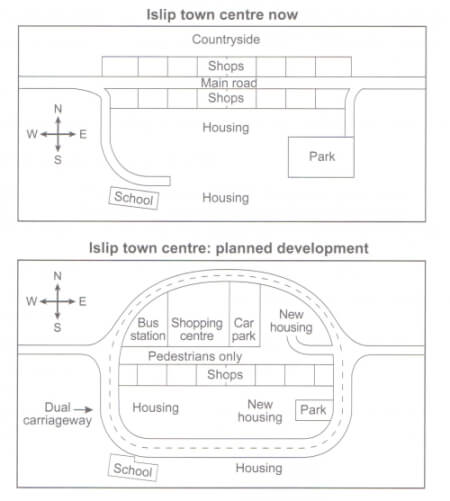
The maps below show the centre of a small town called Islip as it is now, and plans for its development.
Summarize the information by selecting and reporting the main features, and make comparisons where relevant.
You should spend about 40 minutes on this task. Write at least 250 words about the following topic:
Fossil fuels are essential for producing electricity, powering industry and fueling transportation. However, one day we will reach a point when all the world’s fossil fuels have been depleted.
How can we conserve these resources? What are some alternatives to fossil fuels?
Give reasons for your answer and include any relevant examples from your own knowledge or experience.
Speaking Part 1
Time: 4-5 minutes
In this first part of the test, you're going to answer some questions about yourself:
- Do you think pollution is a big problem nowadays?
- What do you do to prevent our environment from pollution?
- Have you ever participated in any environmental events?
- Would you like to work in a company related to environmental protection?
- How can we protect the environment?
- Do you think you've done enough to protect the environment
- Is there education about environmental protection at school?
Please click Next to see the model answers.
(Adapted from IELTS Dragon & IELTS-up)
Do you think pollution is a big problem nowadays?
What do you do to prevent our environment from pollution?
Have you ever participated in any environmental events?
Would you like to work in a company related to environmental protection?
How can we protect the environment?
Do you think you've done enough to protect the environment?
Is there education about environmental protection at school?
Speaking Part 2
Time: 3-4 minutes
In this second part of the test, you're going to talk about a given topic for 1-2 minutes.
|
Describe your idea of starting a new business. You should say:
and explain whether you would personally start it or not. |
You will have one to two minutes to talk about this topic.
You will have one minute to prepare what you are going to say.
Speaking Part 3
Time: 4-5 minutes
In the last part of the test, you're going to answer questions related to the given topic in Part 2.
- What challenges and difficulties do people face when they try to open a small business?
- What are some of the advantages and disadvantages of small businesses compared to large companies?
- Why do some people open their own businesses?
- What qualities does a small business owner need to have?
- Compare owning and running a small business to being an employee in a large company.
Please click Next to see the model answers.
(Adapted from IELTSMaterial.com)
What challenges and difficulties do people face when they try to open a small business?
What are some of the advantages and disadvantages of small businesses compared to large companies?
Why do some people open their own business?
What qualities does a small business owner need to have?
Compare owning and running a small business to being an employee in a large company.