[IELTS 6.] - Mindset 2: Review Test 4
9/19/2022 10:45:31 AMComplete the notes below. Write NO MORE THAN THREE WORDS AND /OR A NUMBER for each answer.
Conference ending date:
Conference venue:
Reservation phone no:
Student rate per day:
Contact person:
Closing date for talks:
Summary should have:
Maximum length:
Also send:
Email address: @uniconf.edu.au
Complete the notes below. Write NO MORE THAN THREE WORDS AND/OR A NUMBER for each answer.
CAMPUS CLINIC
Patient's name: Mary Nixon
Faculty:
Registered No.:
Date of birth: 20th November 1987
Nationality:
Address:
Case history:
Listen to the audio and do the tasks.
Which of these describes Mary’s problem?
- sneeze
- sore throat
- nausea
How long does Mary’s symptom last?
- one week
- two weeks
- three weeks
What’s wrong with Mary according to the doctor?
- She got headache.
- She got allergy.
- She was exhausted.
Which TWO things does the doctor suggest?
- to have a rest at home
- to have a check in a hospital
- to stop eating seafood
- to eat more fruits
- to take some medicine
Complete the table below. Write NO MORE THAN THREE WORDS for each answer.
| PLACE | FUNCTION |
| Supply library information: Apply for library card | |
| Supply computers to search information of books | |
| Leisure Bar | Supply |
| Dictionaries; Course books; Literature materials | |
| Important books | |
| Periodical Room | Current issues; Newspapers; Magazines; |
| Photocopier and printer | |
| Conference Room | Work table and |
Which of the TWO following warnings are to students?
- Reference book
- Recalled book
- Back newspaper
- Library Card
- Student locker
Complete the sentences below. Write NO MORE THAN TWO WORDS AND/OR A NUMBER for each answer.
THE HEALTH BENEFITS OF ART AND MUSIC
According to the speaker, art and music can benefit patients’ emotional, and physical well-being.
Florence Nightingale first noted the improvements in the year .
The results of many studies did not prove a link between health and art as they were rarely .
The American study looked at the effects of architecture on patients’ .
The patients who were in a ward with a were not in hospital for as long and needed less medication.
Complete the table below. Write NO MORE THAN THREE WORDS for each answer.
Recent research Projects
| Type of patient | Type of art/music | Effect on patients | Other improvements |
| Unborn babies | heart rate increase | mother felt relaxed | |
| Cancer patient | improvements in well-being | ||
| Hip replacement (elderly) | eased anxiety |
staff
|
Read the following passage and complete the tasks.
DEPRESSION
A. It is often more difficult for outsiders and non-sufferers to understand mental rather than physical illness in others. While it may be easy for us to sympathise with individuals living with the burden of a physical illness or disability, there is often a stigma attached to being mentally ill, or a belief that such conditions only exist in individuals who lack the strength of character to cope with the real world. The pressures of modern life seem to have resulted in an increase in cases of emotional disharmony and government initiatives in many countries have, of late, focussed on increasing the general public’s awareness and sympathy towards sufferers of mental illness and related conditions.
B. Clinical depression, or ‘major depressive disorder’, a state of extreme sadness or despair, is said to affect up to almost 20% of the population at some point in their lives prior to the age of 40. Studies have shown that this disorder is the leading cause of disability in North America; in the UK almost 3 million people are said to be diagnosed with some form of depression at any one time, and experts believe that as many as a further 9 million other cases may go undiagnosed. World Health Organisation projections indicate that clinical depression may become the second most significant cause of disability’ on a global scale by 2020. However, such figures are not unanimously supported, as some experts believe that the diagnostic criteria used to identify՛ the condition are not precise enough, leading to other types of depression being wrongly classified as ‘clinical’.
C. Many of us may experience periods of low morale or mood and feelings of dejection, as a natural human response to negative events in our lives such as bereavement, redundancy or breakdown of a relationship. Some of us may even experience periods of depression and low levels of motivation which have no tangible reason or trigger. Clinical depression is classified as an on-going state of negativity, with no tangible cause, where sufferers enter a spiral of persistent negative thinking, often experiencing irritability, perpetual tiredness and listlessness. Sufferers of clinical depression are said to be at higher risk of resorting to drug abuse or even suicide attempts than the rest of the population.
D. Clinical depression is generally diagnosed when an individual is observed to exhibit an excessively depressed mood and/or ‘anhedonia’ – an inability to experience pleasure from positive experiences such as enjoying a meal or pleasurable social interaction – for a period of two weeks or more, in conjunction with five or more additional recognised symptoms. These additional symptoms may include overwhelming feelings of sadness; inability to sleep, or conversely, excessive sleeping; feelings of guilt, nervousness, abandonment or fear; inability to concentrate; interference with memory capabilities; fixation with death or extreme change in eating habits and associated weight gain or loss.
E. Clinical depression was originally solely attributed to chemical imbalance in the brain, and while anti-depressant drugs which work to optimise levels of ‘feel good’ chemicals – serotonin and norepinephrine – are still commonly prescribed today, experts now believe that onset of depression may be caused by a number, and often combination of, physiological and socio-psychological factors. Treatment approaches vary quite dramatically from place to place and are often tailored to an individual’s particular situation; however, some variation of a combination of medication and psychotherapy is most commonly used. The more controversial electroconvulsive therapy (ECT) may also be used where initial approaches fail. In extreme cases, where an individual exhibits behaviour which Indicates that they may cause physical harm to themselves, psychiatric hospitalisation may be necessary as a form of intensive therapy.
F. Some recent studies, such as those published by the Archives of General Psychiatry, hold that around a quarter of diagnosed clinical depression cases should actually be considered as significant but none-the-less ordinary sadness and maladjustment to coping with trials in life, indicating that in such cases, psychotherapy rather than treatment through medication is required. Recovery as a result of psychotherapy tends, in most cases, to be a slower process than improvements related to medication; however, improvements as a result of psychological treatment, once achieved, have been observed in some individuals to be more long term and sustainable than those attained through prescription drugs. Various counselling approaches exist, though all focus on enhancing the subject’s ability to function on a personal and interpersonal level. Sessions involve encouragement of an individual to view themselves and their relationships in a more positive manner, with the intention of helping patients to replace negative thoughts with a more positive outlook.
G. It is apparent that susceptibility to depression can run in families. However, it remains unclear as to whether this is truly an inherited genetic trait or whether biological and environmental factors common to family members may be at the root of the problem. In some cases, sufferers of depression may need to unlearn certain behaviours and attitudes they have established in life and develop new coping strategies designed to help them deal with problems they may encounter, undoing patterns of destructive behaviour they may have observed in their role models and acquired for themselves.
The passage has seven sections A-G.
Which paragraph contains the following information?
Details of treatment alternatives for worst case scenario depression.
Information regarding cases where drug treatment is inappropriate.
Details of how those diagnosed with depression may be more vulnerable than other members of society.
Information about society’s attitudes to depression and similar illnesses.
Information regarding why estimates of incidence of future growth in cases may be overly exaggerated.
Which THREE of the following statements are true of depression?
- Governments have generally failed to take action to educate the general public about the condition.
- The highest reported number of cases are in the USA.
- In Britain, it is likely that there are more individuals who live with the condition without the help of a doctor than those being officially treated.
- Clinical depression may be triggered by divorce.
- Lethargy may be one of the symptoms of depression.
- Prescribed pharmaceuticals have radically changed over recent years.
- Approaches to treating depression are not universal.
Complete the summary of paragraphs F and G with the list of words A-L below.
|
A. gratifying B. longevity C. ambition D. optimistic E. pessimistic F. difficulty G. inconclusive H. self-image I. gradual J. unequivocal K. immediate L. categorical |
Whilst recovery through counselling rather than medicine may be more , results once achieved may have more with some patients.
Counselling sessions are geared towards improving the subject’s relationship with others and their own , encouraging sufferers of depression to take on a more outlook.
The extent to which genetic disposition and sociological factors impact on state of mind is . Many people undergoing counselling therapy do so with the purpose of unlearning negative behaviour and reactions.
Read the passage and complete the tasks.
A GUIDE TO WOMANOMICS
A. In rich countries, girls now do better at school than boys, more women are getting university degrees than men arc, and females are filling most new jobs. Arguably, women are now the most powerful engine of global growth. In 1950, only one-third of American women of working age had a paid job. Today two-thirds do, and women make up almost half of America’s workforce. Since 1950, men’s employment rate has slid by 12 percentage points, to 77%. In fact, almost everywhere more women are employed and the percentage of men with jobs has fallen – although in some countries, the feminisation of the workplace still has far to go: in Italy and Japan, women’s share of jobs is still 40% or less.
B. The increase in female employment in developed countries has been aided by a big shift in the type of jobs on offer. Manufacturing work, traditionally a male preserve, has declined, while jobs in services have expanded. This has reduced the demand for manual labour and put the sexes on a more equal footing. In the developing world, too, more women now have paid jobs. In the emerging East Asian economy, with 100 men in the labour force, there are now 83 women, higher even than the average in OECD countries. Women have been particularly important to the success of Asia’s export industries, typically accounting for 60-80% of jobs in many export sectors, such as textiles and clothing.
C. Of course, it is misleading to talk of women’s “entry” into the workforce. Besides formal employment, women have always worked in the home, looking after children, cleaning or cooking, but because this is unpaid, it is not counted in the official statistics. To some extent, the increase in female paid employment has meant fewer hours of unpaid housework. However, the value of housework has fallen by much less than the time spent on it, because of the increased productivity afforded by dishwashers, washing machines and so forth. Paid nannies and cleaners employed by working women now also do some work that used to belong in the non-market economy.
D. The increase in female employment has also accounted for a big chunk of global growth in recent decades. GDP growth can come from three sources: employing more people; using more capital per worker, or an increase in the productivity of labour and capital due to new technology. Since 1970, women have filled two new jobs for every one taken by a man. Back-of-the-envelope calculations suggest that the employment of extra women has not only added more to GDP than new jobs for men but has also chipped in more than either capital investment or increased productivity. Carve up the world’s economic growth a different way and another surprising conclusion emerges: over the past decade or so, the increased employment of women in developed economies has contributed much more to global growth. Women are becoming more important in the global marketplace not just as workers, but also as consumers, entrepreneurs, managers and investors. Women have traditionally done most of the household shopping, but now they have more money of their own to spend. Surveys suggest that women make perhaps 80% of consumers’ buying decisions – from health care and homes to furniture and food.
E. Women’s share of the workforce has a limit. In America, it has already stalled. However, there will still be a lot of scope for women to become more productive as they make better use of their qualifications. At school, girls consistently get better grades and in most developed countries, well over half of all university degrees are now being awarded to women. In America, 140 women enrol in higher education each year for every 100 men; in Sweden, the number is as high as 150. (There are, however, only 90 female Japanese students for every 100 males.) In years to come, better-educated women will take more of the top jobs. At present, for example, in Britain, more women than men train as doctors and lawyers, but relatively few are leading surgeons or partners in law firms. The main reason why women still get paid less on average than men is not that they are paid less for the same occupations, such as nursing and teaching. This pattern is likely to change.
F. Making better use of women’s skills is not just a matter of fairness. Plenty of studies suggest that it is good for business, too. Women account for only 7% of directors on the world's corporate boards – 15% in America, but less than 1% in Japan. Yet a study by Catalyst, a consultancy, found that American companies with more women in senior management jobs earned a higher return on equity than those with fewer women at the top. This might be because mixed teams of men and women are better than single-sex groups at solving problems and spotting external threats. Studies have also suggested that women are often better than men at building teams and communicating.
G. In poor countries too, the underutilisation of women stunts economic growth. A study last year by the World Economic Forum found a clear correlation between sex equality (measured by economic participation, education, health and political empowerment) and GDP per head. Correlation does not prove the direction of causation. However, other studies also suggest that inequality between the sexes harms long-term growth. In particular, there is strong evidence that educating girls boosts prosperity. It is probably the single best investment that can be made in the developing world. Not only are better-educated women more productive, but they raise healthier, better-educated children. There is huge potential to raise income per head in developing countries, where fewer girls go to school than boys. More than two-thirds of the world’s illiterate adults are women.
H. It is sometimes argued that it is short-sighted to get more women into paid employment. The more women go out to work, it is said, the fewer children there will be and the lower growth will be in the long run. Yet the facts suggest otherwise. Data shows that countries with high female labour participation rates, such as Sweden, tend to have the decline in fertility has been greatest in several countries where female employment is low.
The text has 8 paragraphs (A – H). Which paragraph does each of the following headings best fit?
New producers, new consumers
More work, fewer children?
A better educated workforce
Women in new, expanding industries
According to the text, which FIVE of the following statements are true?
- A higher percentage of Italian women have jobs than Japanese women.
- More women than men work in Asia’s textile industries.
- The value of housework is not included in official statistics.
- Research shows that men make more purchasing decisions than women.
- Most surgeons in Britain are women.
- Firms with more women in senior management offer higher investment returns.
- Most illiterate people in the world are women.
- Some people think that lower birth rates lead to lower economic growth.
Since 1950, the percentage of _____.
- American women with jobs has increased
- American men with jobs has decreased
- Japanese and Italian women with jobs has remained stable
Economics can get bigger by _____.
- increasing the size of companies
- giving shares to workers
- using more advanced technology
Mixed teams of male and female managers are thought to be better at _____.
- building teams
- solving problems
- communicating
Research by the World Economic Forum shows that _____.
- sex equality leads to higher GDP
- there is a connection between sex equality and GDP
- higher education leads to higher GDP
Read the following passage and complete the tasks.
Destination Mars
Mars is the closest potentially habitable planet. It has solid ground, protective surface features, a thin atmosphere, more closely mimics the gravitational and lighting conditions on Earth, and is reachable - just. Most importantly, studies have found that this planet has vast reserves of frozen water, and there are other basic minerals as well. In contrast, the closest heavenly body - the moon - is dusty, barren, hostile, and dark. Settlement of the moon would be much easier, but since there are no resources there, it would ultimately be more costly and of little use. If there is any extraterrestrial site where humankind will ultimately settle, it must be Mars.
Yet this planet is much more distant than the moon, making the logistics daunting. Food, water, oxygen, and life-support systems for such a journey would be too heavy for current rocket science. Technological innovations would be necessary, and the timing of the trip absolutely critical. The different orbits of Mars and Earth mean that they most closely approach each other every 26 months, but this event itself fluctuates on a 15-year cycle. This means that only once in that time does a launch window open. That is quite few and far between, yet missions must necessarily leave at these times.
The trouble is, even then, the journey to Mars and back would take over a year, and the human body suffers profoundly when left in micro-gravity for that length of time. Without the need to stand, there is almost no flexing or pressure on the back or the leg muscles. These gradually shrink and weaken, while bones lose their density, and lungs their aerobic capacity. When left long enough in space, astronauts are unable to function properly. Yet these people will need their full physical strength and alertness for the many operational duties required. These include docking in space, approaches and landing on Mars, remote manipulation of machines, and dealing with any emergencies that arise.
Another hazard of such duration in a hermetically sealed spacecraft is disease. Human bodies constantly shed waste material (sweat, skin-flakes, hair, moisture, mucus, and the products of digestion), all of which allow microbes to breed prolifically. Coughs and sneezes spray fluids into the air, which, without gravity to pull them down to surfaces, simply float as airborne particles in those cramped confines, causing easy microbial exchange between crew members. Bacterial infections and fungal attacks can be prevalent, and human immune systems are weakened in micro-gravity. Thus, a long mission to Mars would require the best air-cleansing system available, rigorous disinfecting and hygiene procedures, plus an excellent supply of antibiotics.
On reaching Mars, the problems only increase. Staying on the planet for any significant length of time will be difficult. In the absence of a thick protective atmosphere or magnetosphere to burn up or deflect objects, respectively, astronauts will be exposed, to potentially lethal UV radiation, micro-meteoroids, solar flares, and high-energy particles, all of which regularly bombard the surface. Spacecraft and land-based capsules will need special shielding, which adds to the weight and expense. Construction of living quarters will be time-consuming, difficult, and dangerous. For a longer stay on Mars, the only solution, it seems, is to go underground.
One of the most interesting discoveries in this respect is of possible cave entrances on the side of Arsia Mons, a large Martian volcano. Seven such entrances have been identified in satellite imagery, showing circular holes resembling the collapse of cave ceilings. The hope is that these may lead to more extensive cave formations, or perhaps lava tubes, offering the protection necessary in such a hostile terrain. An additional benefit is the potential access to vital minerals, and most importantly of all, the possibility of frozen water. These sites therefore open up the possibility of independent and permanent settlement on this planet.
The most exciting option is to attempt that on the very first trip - in other words, making it a oneway journey. The advantage is that the duration of space travel is immediately halved, reducing the technological, biological, and financial challenges. This very strong argument is somewhat offset by the difficulties in establishing a permanent presence, as well as the necessary ongoing commitment to it - for example, in the delivery of food and supplies via unmanned spacecraft. Similarly, the psychological effects on these pioneers of permanent isolation from Barth and its community, as well as being crowded into confined Martian living quarters with the same companions, raise issues of whether such a settlement is humanly feasible.
This begs the question of why undertake such missions at all. The answer, according to proponents, is that it is our destiny. Throughout history, explorers have regularly embarked on journeys in the full knowledge that death may await them, or that even if they succeeded, their health and wellbeing would be severely compromised. And today, people regularly practise extreme sports, or work in dangerous occupations, all of which significantly lower their life expectancy. The risks involved in being a Martian pioneer are no different, and so, it is argued, there is no reason why they should deter us now.
Do the following statements agree with the information given in the reading passage?
| TRUE | if the statement agrees with the information |
| FALSE | if the statement contradicts the information |
| NOT GIVEN | If there is no information on this |
The greatest advantage of Mars is that it has many basic minerals.
Settlement of the moon would be more expensive.
The magnetosphere burns up objects.
A one-way expedition to Mars is better.
Complete the table. Choose NO MORE THAN TWO WORDS from the passage for each answer.

31.
32.
33.
34.
35.
Give TWO examples of the following categories. Choose NO MORE THAN TWO WORDS from the passage for each example.

36.
37.
38.
39.
40.
The diagrams show a structure that is used to generate electricity from wave power.
Summarise the information by selecting and reporting the main features, and make comparisons where relevant.
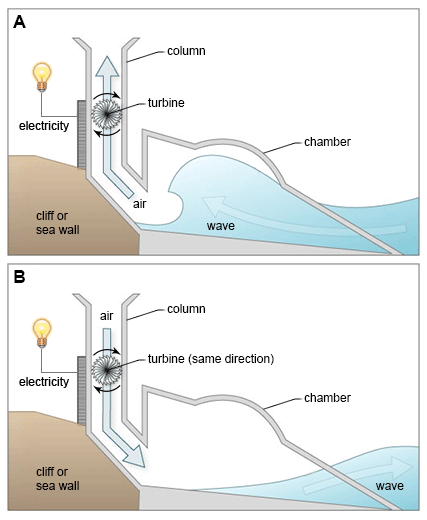
You should spend about 40 minutes on this task. Write at least 250 words about the following topic:
Some people who have been in prison become good citizens later, and it is often argued that these are the best people to talk to teenagers about the dangers of committing a crime.
To what extent do you agree or disagree?
Give reasons for your answer and include any relevant examples from your own knowledge or experience.
Speaking Part 1
Time: 4-5 minutes
In this first part of the test, you're going to answer some questions about yourself:
- How old were you when you started school?
- How did you get to school each day?
- Tell me something about your school.
- Did you enjoy your school? (Why?/Why not?)
- What were some of the most popular activities at primary school?
- Have you ever returned to see your old school again?
- Are you still in contact with any of the friends you had in primary school?
Please click Next to see the model answers.
(Adapted from IELTS Practice Online)
How old were you when you started school?
How did you get to school each day?
Tell me something about your school.
Did you enjoy your school? (Why?/Why not?)
What were some of the most popular activities at primary school?
Have you ever returned to see your old school again?
Are you still in contact with any of the friends you had in primary school?
Speaking Part 2
Time: 3-4 minutes
In this second part of the test, you're going to talk about a given topic for 1-2 minutes.
|
Describe an important holiday that is celebrated in your country. You should say:
|
You will have one to two minutes to talk about this topic.
You will have one minute to prepare what you are going to say.
Speaking Part 3
Time: 4-5 minutes
In the last part of the test, you're going to answer questions related to the given topic in Part 2.
- Why is it important to protect traditions?
- What's the most important tradition in your country?
- What kinds of traditions have disappeared in your country?
- Why should children learn about traditions?
- What can governments do to protect traditions?
Please click Next to see the model answers.
(Adapted from testieltsonline.com)
Why is it important to protect traditions?
What's the most important tradition in your country?
What kinds of traditions have disappeared in your country?
Why should children learn about traditions?
What can governments do to protect traditions?