Unit 6 - Lesson 1
3/1/2024 6:00:00 PM

KIẾN THỨC NGÔN NGỮ
Hãy cùng làm các bài tập về từ vựng và ngữ pháp thuộc Lesson 1 - Unit 6 ngay nhé!
In the future, our planet could become so _____ that we'll need to find new planets to live on.
- huge
- crowded
- spacious
- comfortable
_____'s atmosphere protects us from harmful radiation, unlike many other planets.
- Moon
- Sun
- Earth
- Globe
Scientists study how _____ works on different planets.
- human
- ground
- dirt
- gravity
Earth's atmosphere is rich in _____, unlike many other planets.
- oxygen
- water
- light
- pollution
Our solar system has eight _____, each with its own unique characteristics.
- features
- moons
- planets
- timelines
The Earth's _____ now is over 7 billion and keeps growing.
- information
- population
- pollution
- education
Earth and Venus are _____ in size, but very different in temperature.
- strange
- various
- similar
- familiar
Scientists use the _____ to send robots to explore other planets.
- space station
- natural resource
- solar system
- moonlight
The _____ on Jupiter is very low because it is far from the Sun.
- population
- temperature
- rainfall
- weather
On a clear night, you can have an amazing _____ of Mars with just a simple telescope.
- view
- temperature
- disaster
- population
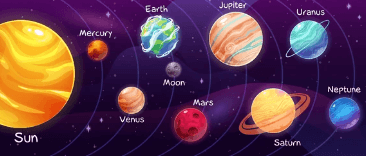
_____ is often called "the Red Planet" and is farther from the Sun than _____ - the 2nd planet from the Sun.
- Moon - Jupiter
- Mars - Jupiter
- Earth - Venus
- Mars - Venus
Rearrange the words in a correct order to make a complete sentence (kéo từng từ/cụm từ về vị trí đúng để tạo thành câu hoàn chỉnh).
Rearrange the words in a correct order to make a complete sentence (kéo từng từ/cụm từ về vị trí đúng để tạo thành câu hoàn chỉnh).
Rearrange the words in a correct order to make a complete sentence (kéo từng từ/cụm từ về vị trí đúng để tạo thành câu hoàn chỉnh).
Rearrange the words in a correct order to make a complete sentence (kéo từng từ/cụm từ về vị trí đúng để tạo thành câu hoàn chỉnh).
Give the correct form of the verb in brackets.
People (not live) on Mars in the next 30 years because it's too cold and lacks oxygen.
Give the correct form of the verb in brackets.
Technology (continue) to advance rapidly and change our lives in the next few decades.
Give the correct form of the verb in brackets.
Do you think robots (replace) humans in all jobs in the future?


KỸ NĂNG NGÔN NGỮ
Hãy cùng làm các bài tập đọc hiểu, hỏi đáp trong hội thoại thuộc Lesson 1 - Unit 6 ngay nhé!
Read and choose the correct answer.
Planets are interesting things in our solar system. Earth, our home, is special. It's suitable for living things because it has a lot of oxygen. Its temperature and gravity are also perfect for life.
Mars is another planet in our solar system. Scientists are interested in it due to its similarities to Earth. In spite of its colder temperature and weaker gravity, there might be water there.
Venus is different. Despite its similar size to Earth, its atmosphere is full of carbon dioxide, which is inhospitable for humans. The temperature on Venus is extremely high, and the surface pressure is strong.
Scientists want to find life on other planets. They look for places like Earth with good weather, water, and oxygen. While Earth is the only place with a thriving population, scientists keep studying other planets to see if life could exist there too.
Which of the following features is NOT correct about the Earth?
- It has mild temperature.
- It is rich in oxygen.
- It has suitable gravity for living things.
- It fills the atmosphere with CO2.
The gravity on Earth is _____.
- the strongest among the eight planets
- stronger than the gravity on Mars
- weaker than the gravity on Venus
- the weakest among the eight planets
The word "inhospitable" is CLOSEST in meaning to _____.
- convenient
- unsuitable
- sensible
- dirty
According to the passage, Earth is the only planet with _____.
- the presence of water
- high surface pressure
- a growing population
- oxygen
What is the main idea of the passage?
- Signs of life on Mars and Venus
- Some hypotheses about life on other planets
- Characteristics making Earth suitable for life
- The comparison of living conditions on three planets
Rearrange these sentences to make a complete dialogue by filling in the blank numbers from 1 - 10. Some blanks have been marked for you.
1 - A. Earth is very crowded now, right?
2 - B. Yes, so the idea of living on another planet, like Mars, is even more appealing.
3 - C. Mars is interesting, but there’s no oxygen there, how would we survive?
- D. So, if we choose Mars, what about food and water? Can we get them there?
- H. You're right, Venus is too hot and has high pressure. Therefore, Mars is the best choice.
6 - I. Yes, we could use heating systems and special clothing to stay warm.
7 - F. Sounds great. I've heard that Venus is also close to the Earth, but I guess its conditions are worse.
- G. Research suggests we could grow crops in special areas and get water from underground ice.
- E. But the temperature on Mars is also a problem. It's much colder than Earth.
- J. We will use technology to make oxygen. Maybe from the ice on Mars.
11 - K. Amazing! Making Mars a place for humans to live is now possible.
12 - L. It would be a big step for humans.