Đề thi HSG lớp 12 môn Anh Tỉnh Lào Cai năm 2026
8/1/2026 9:00:00 AMListen and complete the notes below. Write NO MORE THAN ONE WORD OR A NUMBER for each answer.
HOLIDAY PREPARATION
• Collect the currency
• Cancel appointment with the hairdresser on
• Begin taking the tablets from
• Purchase
✓
✓ a small
✓ a spare lock,
✓ a(n) adapter.
• Book a taxi
Instructions for Laura's mum
• Feed the cat
Vet's details:
+ Name: Colin
+ Tel:
+ Address: Fore Street (opposite the )
• Water the
• Meet the heating on 30th April.
Listen and answer the questions below.
What does Dave think about Professor Jeffcott?
- He's not as interesting as some archaeology lecturers.
- He has a strong passion for archaeology.
- He's a typical archaeology lecturer.
What was the first part of Professor Jeffcott's talk about?
- The possibility of dating Neolithic structures more precisely at present.
- Artefacts that scientists have discovered on Neolithic sites.
- What Neolithic structures were used for a few hundred years ago.
According to Professor Jeffcott, a majority of Neolithic structures were built _____.
- between two and three thousand years ago
- by people before they moved from one place to another
- during a period of change
When studying Neolithic people, the researchers were surprised at _____.
the process by which they became farmers
- the range of skills they had
- the speed at which they developed new skills
What is Dave going to do next?
- Building a modern structure using prehistoric methods.
- Studying the way prehistoric buildings were built.
- Writing an essay on prehistoric building methods.
Complete the notes. Write NO MORE THAN TWO WORDS for each answer.
MAJOR EVENTS
9,000 - 8,000 years ago
Tribes of Neolithic people moved around
8,000 years ago
England and France were
6,000-5,000 years ago
First Neolithic housing appeared.
About 4,500-3,000 years ago
Stonehenge was built in stages.
was made and used for the first time.
Neolithic people started making sophisticated stone implements, accompanied by the appearance of .
Listen to a podcast on "The myth of race" and answer the questions given with NO MORE THAN THREE WORDS.
1. Besides geographic origin, what did Johann base his classification of humans into five groups on?
2. What is mentioned as the contradiction to the fact of slavery?
3. What was added to the US census on race in 2000?
4. What proportion of census respondents classified themselves as "some other race" in the 2010 survey?
5. How do many people feel about their racial identity?
It is imperative that letters of applicants _____ in an envelope with the name signed across the seal.
- are enclosed
- should enclose
- must enclose
- be enclosed
The _____ you drive in the city, the _____ it is that you will have an accident.
- more quickly - more probably
- quicker - more probable
- faster - more probable
- faster - more probably
_____ renewable and clean energy, the city's modern infrastructure is becoming more eco-friendly.
- Having been used
- Being used
- Once used
Using
AI chatbots can answer _____ questions and give timely feedback on students' homework.
- specialization
- specific
specify
- specifically
At first the children enjoyed the game but the novelty soon _____.
- turned down
- wore off
- went off
- took up
Two friends George and Frankie are talking to each other.
George: "In my opinion, action films are exciting."
Frankie: "_____"
- Yes. Congratulations!
- There's no doubt about it.
- What a nice opinion!
- You shouldn't have said that.
Electric buses and trains produce less greenhouse gas emissions. They _____ in our city recently.
- have been used
- used
- were using
- will have used
Jane really loves the _____ jewellery box that her parents gave her as a birthday present.
- nice wooden brown
- wooden brown nice
- nice brown wooden
- brown wooden nice
_____ out of order yesterday, I would be able to submit my report to my teacher by now.
- Weren't my typewriter
- Didn't my typewriter been
- Had my typewriter not been
- Were my typewriter not
Tom looks so frightened and upset. He _____ have experienced something terrible.
- must
- should
- can
- would
Justin is talking to Hailey, who is sitting in the corner of the room and seems rather shy.
Justin: "Why aren't you taking part in our activities? _____"
Hailey: "Yes. I can. Certainly."
- What is the matter with you?
- Are you busy right now?
- Can you help me with these decorations?
- Can I drive you home?
Most teenagers find it hard to manage time well, but he takes it all in his _____.
- side
- shoulders
- strike
- stride
The _____ curiosity for learning will keep people up to date in this ever-changing world.
- inspiring
- inevitable
- insatiable
- infallible
I think he should learn to respect others by simply not _____ in when people are talking.
- butting
- moving
- pushing
- plugging
You've lived in the city for most of your life, so _____ you're used to the noise.
- strangely
- presumably
- intensively
- predictably
Making more room for green space will help citizens to share the deep _____ with nature.
- patience
- stature
- balance
- affinity
I'm sorry to say that it seems you have been _____ your responsibilities.
- shouldering
- dispelling
- experiencing
- shirking
They don't want to _____ the risk of losing their business because they have spent all their savings.
- give
- run
- make
- set
I _____ sight of the robber just before he disappeared around the corner.
- got
- caught
- had
- took
After the game, Ashley and Jake are talking to each other.
Ashley: How well you played, Jake!
Jake: "_____"
Say it again. I like to hear your words.
Thank you! It's absolutely fair.
I think so. I'm proud of myself.
Many thanks, that's a nice compliment.
Complete the passage by changing the form of the word in capitals.
The Wicked Problem of Transitioning to Renewable Energy
As we replace fossil fuels with power sources that largely rely on weather, significant technological and policy challenges will need to be untangled.
Today, countries are moving to reduce our (DEPEND) on fossil fuels and to switch to energy sources that emit little or no greenhouse gases. In the United States, electricity generation provided by wind turbines and solar photovoltaic panels has grown by more than 100 percent and 800 percent, (RESPECTIVE) , since 2014, according to data from the U.S. Energy Information Administration. Most energy experts expect these renewable energy sources to be the (DOMINATE) forms of electricity generation in the future. However, these (INCREASE) popular energy sources have a much more complex relationship with weather. Whereas fossil fuels can be delivered on demand, weather is inherently variable. The complex, (CONNECT) issues involved in addressing this (VARY) create what is called a wicked problem - one that inherently resists simple solutions. (THANK) , scientists, engineers, and policymakers are making significant progress in cracking that problem and clearing the path toward (RENEW) as our primary energy source. Many scientists, engineers, and policy experts have recognized the special complexity that comes from treating weather as fuel and understand the new approaches on both the technology and policy fronts that will be required for the transition. (DISCIPLINE) teams are already beginning to address the issues involved in this transition by bringing together experts in different disciplines to communicate across the boundaries of academic fields. Many of us remain optimistic that we can succeed on this issue and achieve a society powered by the weather that is more (PROSPER) , secure, just, and resilient than the one we have today.
There are FIVE mistakes in the following passage. Identify the mistakes and write the corrections.
[content][/content]
Read the following passage and choose the best answer for each blank.
The founder of Microsoft, Bill Gates, has achieved success as a computer programmer, inventor and entrepreneur. His path to that point, however, was anything but typical. While attending Harvard University in the 1970s, he made a move and left university before graduating to start his own company. His parents didn't like the idea at first, but Gates down and worked hard to get their support. He founded Microsoft in 1975, which after a few short years caused a(n) in personal computing. During the time that Gates was at the head of the company, some of his employees regarded him as conceited and arrogant. He would sometimes in on presentations, expressing his dislike for certain ideas and proposals. He was often described as being impetuous; he did whatever he liked and was often hard to reach either in or out of the office. But whatever anyone may have thought of these minor shortcomings, Gates was a competitor in the computer software industry who often the competition. In his years as CEO of the company, he labored hard at Microsoft's range of software products, and whenever he achieved success in a particular area of computing, Gates the position with all his might. Since then, he has won international as one of the greatest computer software inventors of all time.
You are going to read about four independent jewellery designers. Choose from the sections of the article (A-D). The sections may be chosen more than once.
A. Emma Franklin
"It has always been about animals," Emma Franklin says. "My friend's grandmother had an amazing stag brooch with huge antlers and that's where it started. Everyone has a relationship with an animal in my collection." Franklin has focused on jewellery design since her teens and graduated from Central Saint Martins in 2005, setting up her own business immediately. Based in East London, Franklin, twenty-nine, hand-makes each necklace, bangle, ring, cuff link and pin, featuring any of fourteen animal heads, from a pig to a triceratops, as well as a shotgun. All her pieces are made in solid silver, plated in twenty-two-carat yellow gold or black rhodium, with black diamonds and freshwater pearls. Bespoke commissions, predominantly engagement rings, not all animal-related, are becoming more frequent. Franklin's robust designs are instantly recognisable, as she has discovered. "Recently in a pub this girl was wearing one of my rings at the bar, so I introduced myself. She was completely star-struck and fetched over her dad, who had bought it for her. I had to explain that it was really me who was excited."
B. Alexandra Jefford
"My design style constantly evolves," Alexandra Jefford says. "But even though I try new things, I can't kick my art background. I'm really inspired by art, architecture, design, furniture design." Jefford, forty-two, graduated in 1992 with a degree in fine art, began designing jewellery in 2003 and sold her first piece, a gold ring, on its first outing, at dinner with a friend. Her designs, produced on a project-by-project basis rather than as collections, include her signature Alphabet series for which she designed a slim font. Her recent O project interprets that letter in various typefaces. She combines jewellery design with other artistic pursuits such as sculptural welding and life drawing. Fans range from her daughter's friends to her mother's friends, although she doesn't always want to sell. "I become emotionally involved with all my pieces, so I find it really hard to let go. There are still some pieces that I hide "for the family museum". My husband says that I work as a shopper rather than a seller."
C. Hattie Rickards
Hattie Rickards' first collection of twelve rings, entitled Revealed, was launched last November and was an instant success. Her second, Geo, came out last month to even greater acclaim. "The ethos behind Geo is connection and relationships, bringing tessellating or geometrical shapes together making one, for example, the Kindred ring, where two puzzle pieces fit neatly together." Hampshire-born Rickards, set up on her own last year. "I wanted to create a high-end, luxury jewellery brand with an ethical backbone, which coincided with a gap in the market." All Hattie Rickards' jewellery is made using Fairtrade precious stones from Thailand and India and eighteen-carat, Fairtrade, fair-mined gold from Colombia. HRJ is one of the first twenty companies to become a certified user of this type of gold, many of its pieces having the premium "ecological" label. There are no plans for e-commerce, as Rickards believes this detracts from the meaning behind the piece. "I am passionate that people understand the symbolism behind my work. I don't want it to just be a ring on a website. The story is so important."
D. Mawi Keivom
Mawi Keivom, thirty-nine, is known for her architectural statement jewellery: chunky box chains with coloured pearls, spiked gold rings and brightly-coloured gems. Born in the North-east of India, forty miles from the Burmese border, into the Mahr tribe, Keivom draws her influences from a peripatetic childhood with her diplomat parents that took them to Africa, the Middle East, South-east Asia and Europe. Keivom studied fashion design in New Zealand, then, after a stint in New York, moved to London in 1993, where she met her husband, Tim Awan, and together they set up Mawi in 2001 - she as the jewellery designer, he as the business brain. "My style of jewellery is very individual and not for the faint-hearted. I have a very strong vision that translates into an industrial, graphic aesthetic offset with crystals and pearls that are a little bit feminine. I don't try to do something that is for the moment. My pieces are classic in their own right, not trend-specific."
Which designer pays attention to the source of the materials?
Which designer does not want to get her jewellery sold?
Which designer started up instantly after graduating?
Which designer creates designs that feature different versions of the same symbol?
Which designer intends her jewellery to stand the test of time?
Which designer designs pieces to reflect her belief that everything is linked by patterns?
Which designer uses inspirations from experiences when she was young?
Which designer prioritises the story behind each piece of jewellery?
Which designer does not work exclusively on making jewellery?
Which designer was originally inspired by a social connection?
Read the following passage and do the tasks that follow.
Time travel took a small step away from science fiction and toward science recently when physicists discovered that sub-atomic particles known as neutrinos - progeny of the sun's radioactive debris - can exceed the speed of light. The unassuming particle - it is electrically neutral, small but with a "non-zero mass" and able to penetrate the human form undetected – is on its way to becoming a rock star of the scientific world.
Researchers from the European Organization for Nuclear Research (CERN) in Geneva sent the neutrinos hurtling through an underground corridor toward their colleagues at the Oscillation Project with Emulsion-tRacking Apparatus (OPERA) team 730 kilometers away in Gran Sasso, Italy. The neutrinos arrived promptly - so promptly, in fact, that they triggered what scientists are calling the unthinkable - that everything they have learnt, known or taught stemming from the last one hundred years of the physics discipline may need to be reconsidered.
The issue at stake is a tiny segment of time - precisely sixty nanoseconds (which is sixty billionths of a second). This is how much faster than the speed of light the neutrinos managed to go in their underground travels and at a consistent rate (15,000 neutrinos were sent over three years). Even allowing for a margin of error of ten billionths of a second, this stands as proof that it is possible to race against light and win. The duration of the experiment also accounted for and ruled out any possible lunar effects or tidal bulges in the earth's crust.
Nevertheless, there's plenty of reason to remain skeptical. According to Harvard University science historian Peter Galison, Einstein's relativity theory has been "pushed harder than any theory in the history of the physical sciences". Yet each prior challenge has come to no avail, and relativity has so far refused to buckle.
So is time travel just around the corner? The prospect has certainly been wrenched much closer to the realm of possibility now that a major physical hurdle - the speed of light - has been cleared. If particles can travel faster than light, in theory travelling back in time is possible. How anyone harnesses that to some kind of helpful end is far beyond the scope of any modern technologies, however, and will be left to future generations to explore.
Certainly, any prospective time travelers may have to overcome more physical and logical hurdles than merely overtaking the speed of light. One such problem, posited by René Barjavel in his 1943 text Le Voyageur Imprudent is the so-called grandfather paradox. Barjavel theorized that, if it were possible to go back in time, a time traveler could potentially kill his own grandfather. If this were to happen, however, the time traveler himself would not be born, which is already known to be true. In other words, there is a paradox in circumventing an already known future; time travel is able to facilitate past actions that mean time travel itself cannot occur.
Other possible routes have been offered, though. For Igor Novikov, astrophysicist behind the 1980s' theorem known as the self-consistency principle, time travel is possible within certain boundaries. Novikov argued that any event causing a paradox would have zero probability. It would be possible, however, to "affect" rather than "change" historical outcomes if travelers avoided all inconsistencies. Averting the sinking of the Titanic, for example, would revoke any future imperative to stop it from sinking - it would be impossible. Saving selected passengers from the water and replacing them with realistic corpses would not be impossible, however, as the historical record would not be altered in any way.
A further possibility is that of parallel universes. Popularized by Bryce Seligman DeWitt in the 1960s (from the seminal formulation of Hugh Everett), the many-worlds interpretation holds that an alternative pathway for every conceivable occurrence actually exists. If we were to send someone back in time, we might therefore expect never to see him again - any alterations would divert that person down a new historical trajectory.
A final hypothesis, one of unidentified provenance, reroutes itself quite efficiently around the grandfather paradox. Non-existence theory suggests exactly that - a person would quite simply never exist if they altered their ancestry in ways that obstructed their own birth. They would still exist in person upon returning to the present, but any chain reactions associated with their actions would not be registered. Their "historical identity" would be gone.
So, will humans one day step across the same boundary that the neutrinos have? World-renowned astrophysicist Stephen Hawking believes that once spaceships can exceed the speed of light, humans could feasibly travel millions of years into the future in order to repopulate earth in the event of a forthcoming apocalypse. This is because, as the spaceships accelerate into the future, time would slow down around them (Hawking concedes that bygone eras are off limits - this would violate the fundamental rule that cause comes before effect).
Hawking is therefore reserved yet optimistic. "Time travel was once considered scientific heresy, and I used to avoid talking about it for fear of being labelled a crank. These days I'm not so cautious."
Does the following statement agree with the information given in the reading passage?
The origin of neutrinos still comes into question towards scientists.
True
False
Not given
Does the following statement agree with the information given in the reading passage?
It is safer to send neutrinos through underground corridors.
True
False
Not given
Does the following statement agree with the information given in the reading passage?
Researchers could hardly explain effects the moon might have had on the experiment.
True
False
Not given
Does the following statement agree with the information given in the reading passage?
The theory of relativity has often been challenged successfully.
True
False
Not given
Does the following statement agree with the information given in the reading passage?
Practical uses for time travel require more time to discover in the years to come.
True
False
Not given
Complete the table below. Choose NO MORE THAN THREE WORDS from the passage for each answer.
Read the following passage and choose the correct answer to each of the questions.
Over millions of years, the world's climate has undergone a series of dramatic changes that have most likely resulted from oscillations, or pendulum-like swings, in the rotation of the Earth. One such dramatic climate change was what is commonly called the Ice Age and was in reality a series of phases of colder and warmer weather that commenced approximately two million years ago. What we today refer to as the Ice Age was actually a sequence of weaker and stronger glacial periods during which sheets of ice expanded and moved varying distances south followed by interglacial periods when the glaciers melted to varying degrees and retreated to the north. These successive periods of colder and warmer weather have had striking effects on the world's landscape and on the life forms that inhabit the land. Each glacial period in the series of colder and warmer phases had a different impact, depending on how far south the ice extended, how long it lasted before melting, and how much it changed the landscape and sea levels.
The effect on the world's landscape that resulted from the changing climate was dramatic. Vast sheets of glacial ice in the northern latitudes of the world cut deep U-shaped valleys that still exist today and caused huge boulders and enormous amounts of clay and dust to be deposited across North America, Europe, and Asia and to reshape the landscape of these areas. As the glacial sheets of ice crept southward on the northern continents, they trapped large amounts of water. This served to reduce the amount of moisture in the atmosphere that could fall as rain or snow, reducing the amount of rainfall and leading to further aridity and the expansion of deserts in the tropical and subtropical regions. In addition, with so much water held in the glacial ice, the sea level fell, resulting in the exposure of land that today is covered with water. During glacial periods there was a land bridge from France to England, the islands of Japan and Java were connected to the Asian mainland, and Asia was linked to North America over what is today the Bering Strait. Then, during interglacial periods, when the glacial ice retreated to the north, more water became available as glaciers melted. Vegetation expanded with the increase in rainfall, and coastlines changed with the increase in ocean water; during interglacial periods, many areas that today are landmasses were covered with water.
[I] Prehistoric people seem to have adapted well to these environmental changes. [II] They could be found living in the grasslands of Asia, in the forests of Southeast Asia, and in the temperate areas of southern Europe, and they moved into and out of the more northerly regions as the glacial regions retreated and advanced. [III] Their diet changed to adapt to the changes in plant and animal life during succeeding glacial and interglacial periods, and the use of stone tools, the building of shelters, and the use of clothing came about during this period. [IV] It was these sorts of adaptations that enabled humans to survive and progress while many other species failed to survive and thrive during this period in the way that prehistoric people did.
What is stated about the Ice Age in paragraph 1?
- It caused little change to the landscape worldwide.
It was most likely caused by the variations in the Earth's rotation.
- It experienced a period of sustained intensely cold weather.
- It lasted for roughly two million years.
Which of the sentences expresses the essential information in the sentence in bold in paragraph 1?
- The constant movement of glaciers made a striking change to the weather patterns.
- There is a minor impact on the world's landscape as well as on the life forms on Earth.
- During the Ice Age, glaciers tended to freeze north of the equator and melt south of the equator.
The consecutive periods of colder and warmer weather have significantly affected the global landscape and its life forms.
The word dramatic in bold in paragraph 1 could best be replaced by _____.
- complicated
- inconspicuous
- remarkable
- incisive
All of the following are mentioned in paragraph 1 as factors that determined the impact of a glacial period EXCEPT _____.
the change in the composition of the water
- the length of time that a glacier lasted
- the effect that a glacier had on the geography of the land
- the amount of area that was covered with ice
The word aridity in paragraph 2 is OPPOSITE in meaning to _____.
- acidity
- irrigation
- humidity
- dryness
It is NOT true according to paragraph 2 that during glacial periods _____.
- France and England were connected
- Japan was a cluster of distinct islands
- Java was attached to Asia
- North America and Asia were connected
According to paragraph 3, prehistoric people _____.
- failed to adapt to environmental changes
- tended to stay in one place during the Ice Age
- lived only in the grassland areas of Asia
- were living in the less frigid parts of Europe
The word succeeding in paragraph 3 could be replaced by _____.
- following
- connecting
- preceding
- falling
What is NOT true about prehistoric people, according to paragraph 3?
- They started to use clothing.
They began to construct their shelter.
- They no longer utilized basic tools.
- They changed what they ate.
Where in paragraph 3 can the below sentence be placed to ensure the unity of the passage?
"They moved from place to place in response to climatic changes."
- [I]
- [II]
- [III]
- [IV]
Rewrite each of the following sentences in such a way that it has the same meaning as the as the original sentence.
She never thought of being able to pursue her passion in England.
=> At no time ...............
Rewrite each of the following sentences in such a way that it has the same meaning as the original sentence.
"Without the rapid growth in population, there wouldn't be food shortages" he said.
=> He blamed ...............
Rewrite each of the following sentences in such a way that it has the same meaning as the original sentence.
People believe that their victory was attributed to the proper strategies.
=> Their victory is ...............
Rewrite each of the following sentences in such a way that it has the same meaning as the original sentence.
Thanks to our students' careful preparation, the cultural exchange achieved immense success.
=> But for ...............
Rewrite each of the following sentences in such a way that it has the same meaning as the original sentence.
This movie was less funny than the audience expected.
=> This movie ...............
Rewrite the following sentences with the given words in such a way that the second sentence has the same meaning as the first one. Do not change the form of the word in brackets.
Eco-friendly infrastructure is the key factor to make our future city more livable. (THAT)
=> It is the eco-friendly infrastructure livable.
Rewrite the following sentences with the given words in such a way that the second sentence has the same meaning as the first one. Do not change the form of the word in brackets.
Our company has made neither a profit nor a loss this year. (EVEN)
=> Our company this year.
Rewrite the following sentences with the given words in such a way that the second sentence has the same meaning as the first one. Do not change the form of the word in brackets.
Laura's generosity means that people exploit her good nature. (ADVANTAGE)
=> Laura is her good nature.
Rewrite the following sentences with the given words in such a way that the second sentence has the same meaning as the first one. Do not change the form of the word in brackets.
Minh believes this job interview is really important. (STORE)
=> Minh this job interview.
Rewrite the following sentences with the given words in such a way that the second sentence has the same meaning as the first one. Do not change the form of the word in brackets.
Tim tried to be like Messi when he was a teenager. (MODELED)
=> Tim a teenager.
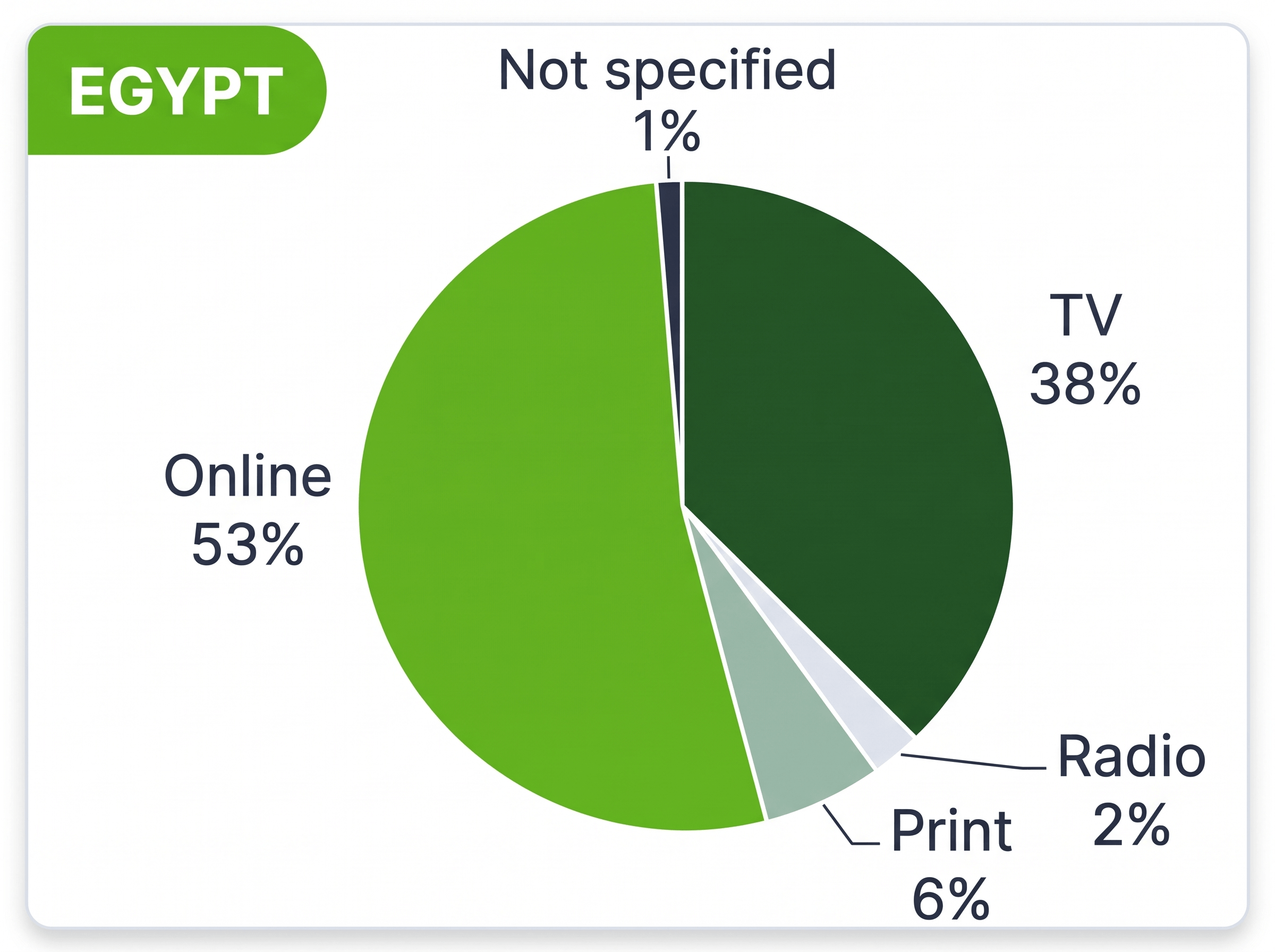
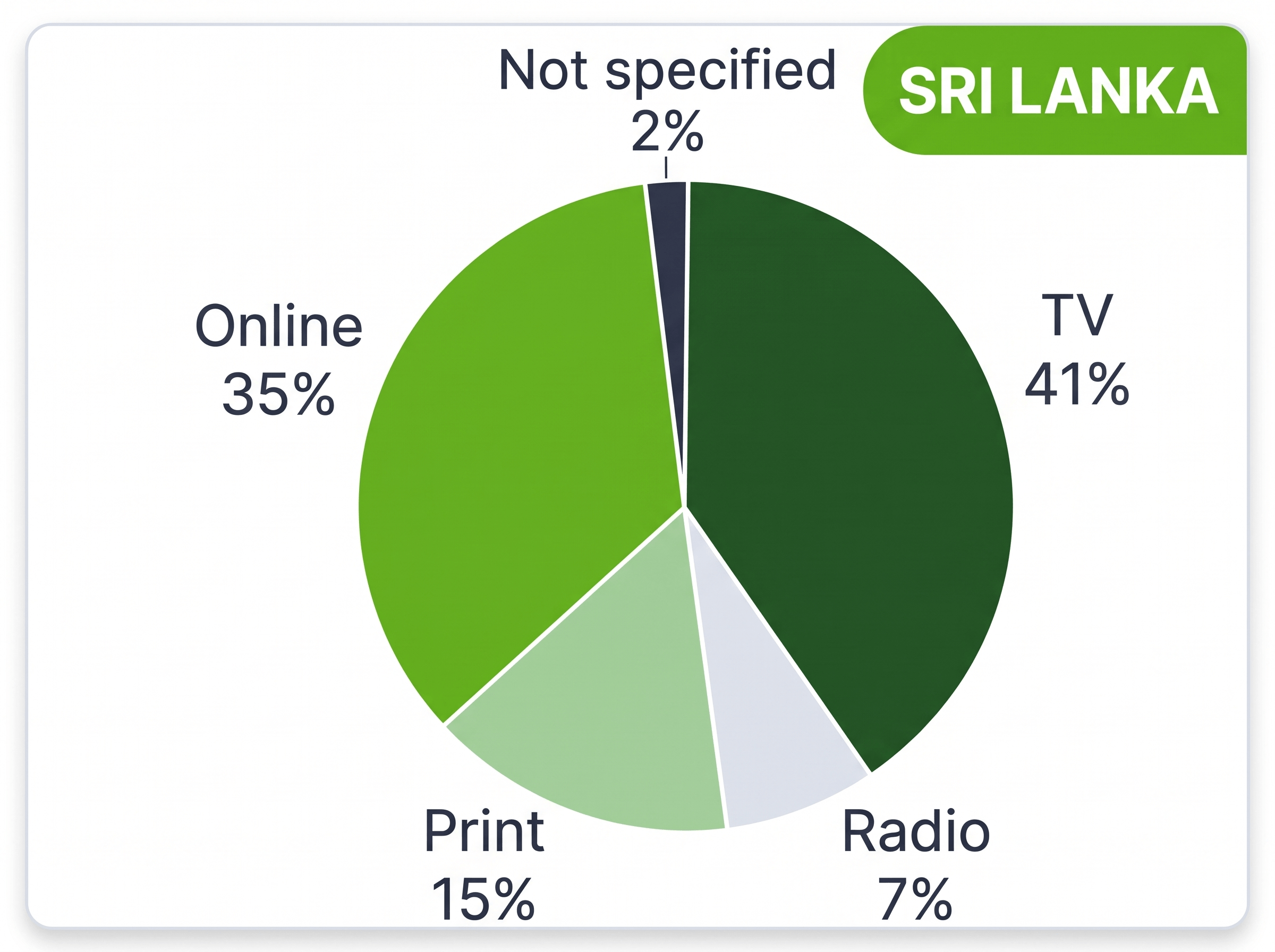
The charts below compare ways of accessing the news in Egypt and Sri Lanka in 2025. Summarize the information by selecting and reporting the main feature and make comparisons where relevant.
You should write at least 150 words.
Different ways of accessing the news in Egypt and Sri Lanka in 2025
Some people believe that the increasing popularity of online shopping has negative impacts on the environment, while others think it makes life easier and more convenient. Discuss both views and give your opinion. Use specific reasons and examples to support your answer.
You should write at least 250 words.