Đề số 67 ôn luyện vào 10 môn Anh Sở TPHCM
8/16/2024 6:00:00 AMChoose the word which has the underlined part pronounced differently from the others.
arrest
request
forest
contest
Choose the word which has the underlined part pronounced differently from the others.
described
established
closed
assigned
- friendliness
- occasion
- pagoda
- deposit
- damage
- consist
- erupt
- exchange
Our teacher often makes the students divide _____ small discussing groups.
- in
- to
- into
- by
_____ the 21st century, social media has become a powerful tool for communication.
- On
- In
- At
- Of
_____ the renovation of their football stadium, the team will be using another team’s ground next season.
- However
- Due to
- Because
- Whereas
We saw _____ positive results from our investigation on human breast cancer cells.
- lots
- many of
- much
- quite a few
The coming of the Internet _____ a dramatic change in people's leisure activities.
- held on
- took up
- brought about
- carried out
The great ship, _____ called Titanic, sailed for New York from Southampton on April 10th, 1912.
- that was
- who has
- which is
- where is
About 100 people _____ outside the theatre for tickets when we got there.
- are queuing
- queued
- were queuing
- have queued
People under a lot of stress may _____ headaches, minor pains, and sleeping difficulties.
- undertake
- experience
- evaluate
- cause
A customer is talking to the salesman.
Customer: Excuse me, could you tell me where the vegetable section is?
Salesman: _____
Would you like a half pound of vegetables?
Well, you are a vegetarian, aren't you?
I'm sorry; they are not very fresh today!
It's on aisle 8, next to the fruit section!
Roger is talking to Claire about her birthday party.
Roger: I am sorry, I can't make it to your party tomorrow.
Claire: _____.
No worries. I had other plans anyway.
Why on earth did you do that to me?
- It's all good. Maybe next time.
You shouldn't have done that.
What does the sign show?
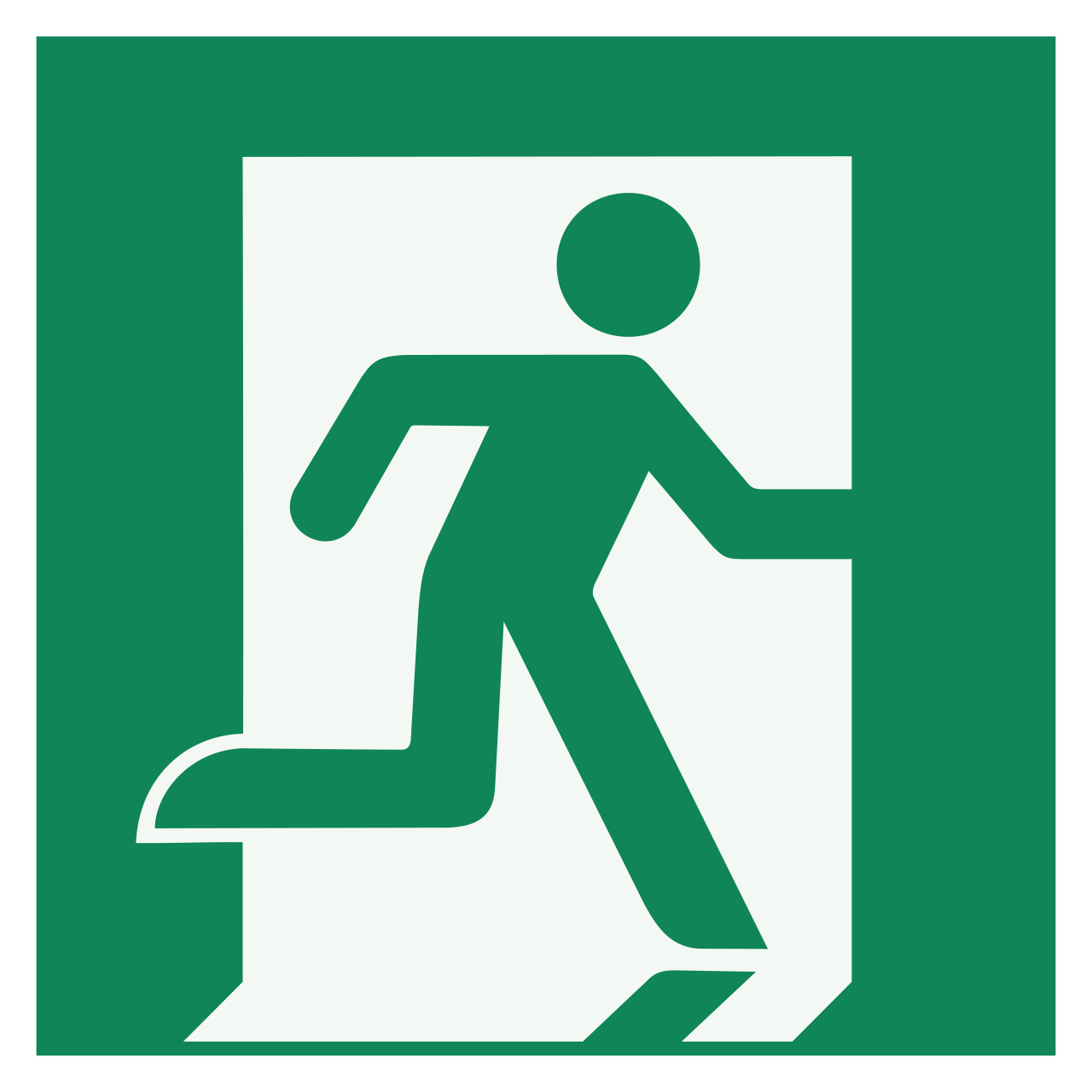
- A friendly reminder to increase stair use in a building
- The closest door to leave a building in an emergency
- A more creative way to get into a building
- The best place to visit in a building in special occasions
What does the sign tell you to do?

- Do not run or play at an indoor pool
- Do not try to help anyone falling into the pool
- Do not push anyone at the pool
- Do not jump into the pool with your friends
Read the text and choose the best answer to fill in the blanks.
An interesting school project
by Terry Smith
This month, we're doing a project on unusual animals and my team got the Japanese Macaques, or as they are often called, snow monkeys. It was exciting to out so much about them.
These monkeys live at much lower temperatures than any other monkeys, feeding on a few plants while hard to stay warm. But what makes them so strange is their to pass on new ideas to each other, something discovered in a scientific study when a single snow monkey started washing her food in the ocean. Following this, after a few generations, every monkey was doing it.
People who are in the Macaques often visit the Jigokudani Monkey Park in Jigokudani Valley, Japan. There the Macaques often have hot baths on a snowy winter's day. Well, this is not part of their typical . They have once again copied a single snow monkey who decided to jump into the hot spring water back in 1963 on a(n) cold day.
(Adapted from Simply PET Preliminary for School)
Read the following passage then choose the best answer to each question below.
The benefits of music for academic learning are well documented, thanks to research following young people's progress as they learn an instrument. Evidence is also increasing that studying music leads to actual physical changes in one's brain development. Significantly, learning and playing music alter the amount of activity in certain regions of the brain, as well as the structure of specific areas.
One study at the University of Munster in Germany monitored the brain activity of two groups of people between 20 and 30 years of age. One group consisted of 20 musicians who had played music for at least 15 years. The other group consisted of 13 non-musicians. Each participant listened to a recording of piano music as the researchers watched their brain responses. While listening to the recording, the musicians showed 25% more activity in the area of the brain that processes auditory signals. Although the music was from a piano, the response level was higher for all musicians, whether they played the piano, violin, or another instrument.
A separate study at McMaster University in Canada followed the progress of 12 children for a year. Six of the children were taught music using the Suzuki method, a popular teaching method from Japan. The others did not learn an instrument. Over the course of the study, the researchers took regular measurements of certain brain regions. They found that the music students had increased activity in the region of the brain responsible for focusing attention and making sense of different sounds.
- How music benefits children
- The benefits of music
- Studies on music and our brain
- Effects of music on people's brain
- only when participants listened to the music from a piano
- while non-musicians were listening to a recording of any instruments
- with a higher response level if musicians listened to the piano
- with musicians who started to play music when they were 15 years old
There is little evidence to support the idea that learning and playing music can have physical effects on the brain.
The participants of the research had to pay attention to hearing a violin recording.
In the research in Canada, there are 12 children that weren't taught any instrument.
The study found increased brain activity in the region of the brain responsible for attention among music students.
Complete the sentence by changing the form of the word in capitals.
The committee has made some changes for the better. (DECIDE)
Complete the sentence by changing the form of the word in capitals.
The group called "Friends of the Earth" is concerned about the of the natural environment. (CONSERVE)
Complete the sentence by changing the form of the word in capitals.
Our visit to Cuc Phuong National Park last week was an experience. (FORGET)
Complete the sentence by changing the form of the word in capitals.
Articles and reports in newspapers talk a lot about UFO . (APPEAR)
Complete the sentence by changing the form of the word in capitals.
His childhood and youth was spent working on his family's farm. (ENJOY)
Complete the sentence by changing the form of the word in capitals.
It's worth the new art exhibit at the museum if you're in town. (VISIT)
Rearrange the words in a correct order to make a complete sentence (kéo từng từ/cụm từ về vị trí đúng để tạo thành câu hoàn chỉnh).
Rearrange the words in a correct order to make a complete sentence (kéo từng từ/cụm từ về vị trí đúng để tạo thành câu hoàn chỉnh).
Complete the second sentence so that it has the same meaning to the first.
In my opinion, you should save the environment by using less paper.
=> I suggest ..........
Complete the second sentence so that it has the same meaning to the first.
Anna has never been to a Korean restaurant before.
=> It is .............
Complete the second sentence so that it has the same meaning to the first.
It took us more than 3 hours to discover the inner Hanoi.
=> We spent ..........
Complete the second sentence so that it has the same meaning to the first.
A witness gave some important information to the police.
=> Some ……….