Đề số 25 luyện thi vào 10 môn Anh Chuyên tại TPHCM
6/1/2025 10:30:00 PMThomas Cook, the father of modern mass tourism, immediately saw the potential of a convenient '_____' holiday product in which everything was included in one cost.
- off the beaten track
- off the peg
- off the record
- off the hook
It is important that you _____ there when he gets off the plane.
- be standing
- are standing
- have stood
- will be standing
We should participate in the movement _____ the natural environment.
- organized conserving
- organizing to conserve
- organized to conserve
- which organized to conserve
The next day, the band began its fourth tour of Britain within nine months, this one _____ for six weeks.
- was scheduled
- would be scheduled
- scheduled
- had been scheduled
The police spokesman said he was _____ to believe that the arrested man was the serial killer they had been looking for.
- inclined
- attributed
- suspected
- supposed
Mike would rather his classmate _____ games while he's studying. It's very distracting.
- aren't playing
- didn't play
- wouldn't play
- hadn't played
I _____ a five-day trip to London to have a good rest, but I couldn't find time.
might take
- took
- was to take
was taking
That style of dress _______ have been designed by Titian, because it wasn’t worn till after his death.
- must
- might
- can’t
- shouldn’t
_____ is that a chicken stands up to lay its eggs.
- Many people don't realize
- It is that many people don't realize
- What many people don't realize
- Because many people don't realize
Which person in our team _____ with the title "Employee of the Year"?
- deserving to honor
- deserving being honored
- deserves to be honored
- deserves having honored
- same
- the very same
- a same
- exactly same
The heavy object soared above the water for a second and then sank without _____.
- trait
- trace
- track
- trail
Ensure that all food products, including salads, are not kept in the open air for too long, _____ they go sour or develop bacteria.
- lest
- if
- since
- because
Of course not, and not even then _____ the things that Bill Gates did in shaping the tech industry.
- could Steve Jobs make
- Steve Jobs could make
- could Steve Jobs do
- Steve Jobs could do
_____, she attempted to analyze the ancient language.
- Being a linguist with years of academic experience notwithstanding
- Despite of not being a linguist with years of academic experience
- Though no linguist with years of academic experience
- In spite of being no linguist with years of academic experience
Sarah's expectation that her ex-boyfriend would come back was nothing more than _____.
- pinky thoughts
- wishful thinking
- blessing thoughts
- imaginary thinking
The project manager, with years of experience, was constantly _____ to the evolving needs of the team.
- attentive
- observant
- earnest
- careful
The hospital follows strict protocols for the _____ of medical waste and contaminated materials.
- dispersal
- disposition
- disposal
- dissolution
Before they go to the university, most senior high school graduates have _____ idea of what college life is like.
- no less
- no least
- not less
- not the least
- generous
- profuse
- lavish
- spendthrift
After months of bitter arguing, the couple had to accept that they were _____.
- incongruous
- incompatible
- dissident
- disaffected
Mr. Simkins is the big _____ in the company as he has just been promoted to the position of Managing Director.
- bread
- apple
- cheese
- meat
The judger's ruling _____ a wave of protest campaigns across the country.
- provoked
- instigated
- launched
- commenced
- hindrance
- oversight
- negligence
- transgression
When wood, natural gas, oil, or any other fuel burns, _____ with oxygen in the air to produce heat.
- combining substances in the fuel
- substances in the fuel that combine
- substances in the fuel combine
- a combination of substances in the fuel
Marine construction technology like this is very complex, somewhat _____ to trying to build a bridge underwater.
- analogous
- correlative
- synchronized
- incumbent
- squeaked
- squished
- screeched
- sputtered
Would you be _____?
- kind enough in order to answer the phone for me
- so kind as to answer the phone for me
- too kind to answer the phone for me
- that too kind and answer the phone for me
You think I can't get an A in this class, but I'll make you _____ when we get our report cards!
- jump on the bandwagon
- eat your words
- get your second wind
- burn bridges
- swept along
- touched on
- skated up
- talked up
Find the correct words to fill the brackets in the paragraph. Each of them contains ONE word only.
Imagine you are walking to school listening to music on your MP3. All of a , it stops working and you realise that the batteries have run out. Wouldn't it be wonderful if you could simply the batteries wherever you are? This might be possible in a few years' time as scientists are now on a bag that makes electricity. They say that someone needs to do is carry their bag on their back and start walking. The of the body makes electricity in a special part of their bag. This new sounds like a brilliant idea, doesn't it? Scientists developed the "electric backpack" in order to help soldiers, who carry around with them torches, radios, and other equipment. All these things on batteries, and at the moment, the soldiers rely on these batteries to supply the power that this equipment needs. With the "electric backpack", the soldiers won't need to carry batteries around with them. Rescue workers and mountain climbers will find the bag useful, as will students who don't want their MP3 players to run out by on their way to school.
Find the correct words to fill the brackets in the paragraph. Each of them contains ONE word only.
The future at your fingertips
There is a scene in the film Minority Report in (0) which Tom Cruise stands in front of a vast Perspex-like screen housed in the police department's Pre-Crime Unit. He gazes earnest at the transparent surface, waving his hands across the tablet to swirl great chunks of text and moving images across the screen to form a storyboard of yet-to-be committed crimes. With a simple twist of his finger or a flick of his wrist, pictures expand and enlarge, words scroll, and whole trains of thought to tangible fruition there on the board. The year is 2054.
Yet it seems the era of true touch-screen technology is much closer than that. Indeed, when Apple boss Steve Jobs unveiled the iPhone in San Francisco earlier this year, he declared: “We're reinventing the cell phone.” of the main reasons for Jobs' bold claim was the iPhone's futuristic user interface – “multi-touch”. As demonstrated on stage by Jobs , multi-touch was created to make the most of the iPhone‟s large screen. most existing smartphones, the iPhone has only one conventional button – all the rest of the controls appear on the screen, adapting and morphing around your fingertips as you use the device, rather like the giant tablet in Minority Report.
The demonstration iPhone handset certainly looked like re-invention, but multi-touch, while new for Apple, is no means a new technology. The concept has been for years, waiting for the hardware side of the equation to get small enough, smart enough and cheap enough to make it a reality. While it remains of a novelty now, there's a good chance that the coming years will bring many more computers and consumer gadgets that depend wholly or on multi-touch concepts.
Read the following passage and choose the best answer for each blank.
Why is it that parents are so often egocentric when it comes to matters concerning their children? Although their are undoubtedly altruistic, they assume that the choices they make for their offspring are the right ones. Take the theme of colour, for example. Who decides what colour of trousers to buy for young Jimmy? Who chooses the colours for his bedroom or bedclothes? parents condition their child's perception of colour from a very early age. Choosing a pair of pink trousers for their six-year-old son runs counter to most parents' idea of how to dress a boy, and they would be to decorate their daughter's bedroom in brown. In a similar way, a small child seen drawing a red tree may be quietly told that trees should be green. Yet the underlying criticism in that can be detrimental to the child's of the world around them.
Psychologists believe that allowing children to choose their own colours increases their self-confidence and their ability to express themselves. They use colour as a(n) of helping children to identify their feelings and discuss them. For instance, studies have shown that after listening to a sad story, children tend to draw in dark brown, black or grey, whereas one with a happy ending will a response in yellow or orange. So, a mother should be delighted to see her four-year-old drawing an orange tree or a yellow house, and perhaps be concerned if the child only uses grey. children free rein to choose colours for themselves may help parents to understand them better.
Read the following passage and choose the best answer for each blank.
Adult Colouring Books
Colouring books are thought to promote concentration and patience, and allow the artist to safely release any and anxiety. The question seldom asked, though, is: why is such a beneficial activity popular only among young children?
According to several bestseller lists, it no longer is. Although colouring books for adults may a few eyebrows, more and more people are seeking them as a way to relax and de-stress. The principle is that colouring creates the same sense of fulfilment that is achieved by any process of deep thought; when the brain is preoccupied with a specific activity, negative feelings, such as anxiety and other generally thoughts, are forced out.
Colouring books have an advantage over other art activities because they remove the ‘paradox of choice’, or the feeling of being when faced with unlimited options. An empty page can create stress; after all, it on the artist to first decide what to create and then create it to an acceptable standard. The outlines provided in colouring books, on the other hand, make the activity accessible to everyone, regardless of artistic ability.
Complete the passage by changing the form of the word in capitals.
One phenomenon that tarnish or even destroy the (DYNAMIC) of a friendship between two people is the (ENTER) into a pecuniary relationship; that is, one friend lending money to the other. While it may be (ADMIRE) for one friend to be concerned about the financial welfare of the other, a detailed schedule for (REMUNERATE) should be made before any money changes hands. Beforehand, it is wise for the two friends to undertake a (LENGTH) detailed discourse on the subject, discussing the dates and amounts to be (PAY) and any (PENALIZE) that occur if this schedule is not met. Many friends believe their relationships to be exempt from the stress of lending and borrowing; however, many money matters are generally a very (TOUCH) subject. (STAND) debt between friends can become a/an (DUE) burden and strain on the friendship. It is best, therefore, to avoid lending or borrowing if at all possible.
Read an extract from a magazine article. Six paragraphs have been removed from the extract. Choose the paragraphs that fit each gap. There is one extra paragraph which you don't need to use.
A. The secret of Spider-Man's success was, in part, a depth of characterization that readers had never before seen in such a protagonist. There isn't bam-crash-boom in every panel of a Spider-Man comic strip. Rather, the reader becomes privy to the hero's inner thoughts about his troubled life.
B. What’s more, the name was a disaster. Didn’t Stan realize that people hate spiders? But Stan couldn’t get Spider-Man out of his head. That’s when he remembered that final issue of Amazing he was doing. He thought that no one would much care about what went into the last issue.
C. As the man responsible for creating not only this troubled character but also The Silver Surfer and many more, Stan Lee managed to transform the much-maligned comic art form into a multi-million-dollar industry and turn Marvel Comics into a household name.
D. Another innovation which this creative genius brought to comic books was one which enhanced the reader’s grasp of the superhero’s subjective viewpoint – the thought bubble.
E. Marvel comics had just one co-book title that didn’t feature superheroes. Stan was producing the title, called Amazing Fantasy, which featured all sorts of brief, far-out comic strips. Stan loved it but sales were disappointing, so it was decided that he would do one last issue and then let it rest in peace.
F. The new hero would also be a teenager, with all the problems, hang-ups, and angst that go with adolescence. He’d be a loser in the romance department. Except for his superpower, he’d be the quintessential hard-luck kid.
H. As the man responsible for creating not only this troubled character but also The Silver Surfer and many more, Stan Lee managed to transform the much-maligned comic art form into a multi-million-dollar industry and turn Marvel Comics into a household name.
K. Stan then passed the assignment to Steve Dinko, whose toned-down, the highly-stylized way of drawing wounds, he thought, be perfect for Spider-Man. And he was right. Steve did a brilliant job of bringing the character to life. So they finished the comic strip and put it in that last edition, even featuring their new hero on the cover.
Spider-Man, the brainchild of writer Stan Lee, has been one of the world's most popular comic book characters since first climbed his way up a wall in 1962. Superman may be able to fly, and Batman may have neat gadgets, but Spider-Man has always been the superhero with style. Whether he's swinging from a high-rise office block or just trying to win his girl's heart, there's always been something irresistible about him, a quality which other comic book strongmen have never matched.
Indeed, it's a point made in a new book about the Marvel Comic Company and the characters it produced. He was neurotic, compulsive, and profoundly skeptical about the idea of becoming a costumed savior. His contemporaries, the Fantastic Four, argued with each other, and both The Hulk and Thor had problems with their alter ego, but Spider-Man alone struggled with himself.
Born in New York in 1922, he joined the company when he was seventeen, working his way up through the firm until he was writing many of the titles. It wasn't until the early 1960s, however, that he gained the freedom to create many of the characters who would make his name. Stan recalls that idea gives birth to one of the world's greatest superheroes.
For months, Stan had been toying with the notion of a new superhero, one who would be more realistic than most, despite his colorful super-power. He has confessed that he'd dreamt up the idea from watching a fly on the wall while he'd been typing. He took the idea to his boss, the publisher Martin Goodman, telling him that he wanted a feature hero whose main power was that he could stick to walls and ceilings.
Stan waited for the enthusiastic reaction, for a hearty pat on the back and robust: "Go for it!" But it didn't come. On the contrary, he was told that he was describing a comedy character, not a hero. Heroes are too busy fighting evil to slow down the stories with personal stuff.
To get it out of his system, Stan gave famed Marvel artist Jack Kirby his Spider-Man plot and asked him to illustrate it. But when Stan saw that Jack was drawing the main character as a powerful-looking, handsome, self-confident hero, he took him off the project. Jack didn't mind after all, Spider-Man wasn't exactly the company's top character. Then they just forgot about it. But, sometime later, when sales figures came in, they showed that Spider-Man had been a smash success, perhaps the best seller of the decade! Stan laughs when he recalls Martin Goodman's priceless reaction: "Stan, remember that Spider-Man idea that I like so much? Why don't we turn it into a series?" Spider-Man went on to be one of the most successful characters in comic book history.
Read the following passage and complete the tasks.
CLINICAL TRIALS
A. The benefits of vitamins to our well-being are now familiar to most; however, when the link between diets lacking in citrus fruits and the development of the affliction ‘scurvy’ in sailors was first discovered by James Lind in 1747, the concept of vitamins was yet to be discovered. Scurvy, which causes softening of the gums, oral bleeding and, in extreme cases, tooth loss, is now known to present as a result of lack of Vitamin C in the diet. Additional symptoms include depression, liver spots on the skin – particularly arms and legs – loss of colour in the face and partial immobility; high incidence of the ailment aboard ships took an enormous toll on the crew’s ability to complete essential tasks while at sea.
B. Suggestions that citrus fruit may lower the incidence or indeed prevent scurvy had been made as early as 1600. It was Lind, however, who would conduct the first clinical trial by studying the effect within scientific experimental parameters. However, while the correlation between consuming citrus fruit and avoidance of scurvy was established, the preventative properties were attributed to the presence of acids in the fruit and not what would later be identified as vitamin content.
C. Lind’s subjects for his trial consisted of twelve sailors already exhibiting symptoms of scurvy. These individuals were split into six groups; each pair common diet. Pair 1 were rationed a daily quart of cider, pair 2 elixir of vitriol, pair 3 a given quantity of vinegar, pair 4 seawater, pair 5 oranges and a lemon and pair 6 barley water. Despite the trial having to be aborted after day five, when supplies of fruit were depleted, the findings of the interventional study showed that only the control group who were given fruit supplements showed any significant improvement in their condition (one had, in fact, recovered to the extent that he was fit enough to return to work). The immediate impact on sailors’ health and incidence of scurvy on board ship was, however, limited as Lind and other physicians remained convinced that the curative effect was acid based. Therefore, while consumption of citrus fruit was recommended, it was often replaced by cheaper acid supplements. The preventative Qualities of citrus fruit against scurvy were not truly recognised until 1800, though throughout the latter part of the 1700s, lemon juice was increasingly administered as a cure for sailors already afflicted.
D. Nowadays, the implementation of findings discovered in clinical trials into mainstream medicine remains an arduous and lengthy process and the clinical trials themselves represent only a small stage of the process of developing a new drug from research stage to launch in the marketplace. On average, for every thousand drugs conceived, only one of the thousand actually makes it to the stage of clinical trial, other projects being abandoned for a variety of reasons. Stages which need to be fulfilled prior to clinical trial – where the treatment is actually tested on human subjects -include discovery, purification, characterisation and laboratory testing.
E. A new pharmaceutical for treatment of a disease such as cancer typically takes a period of 6 years or more before reaching the stage of clinical trial. Since legislation requires subjects participating in such trials to be monitored for a considerable period of time so that side-effects and benefits can be assessed correctly, a further eight years typically passes between the stage of a drug entering clinical trial and being approved for general use. One of the greatest barriers to clinical trial procedures is availability of subjects willing to participate. Criteria for selection is rigorous and trials where subjects are required to be suffering from the disease in question, experience tremendous recruitment difficulties as individuals already vulnerable due to the effects of their condition, are often reluctant to potentially put their health at higher levels of risk.
F. Clinical trials are conducted in line with a strict protocol and the stages of a trial are generally defined by five distinct phases. A drug that is deemed safe and effective enough to reach the end of stage three is most often, at that point, approved for use in mainstream medicine. Phase 0 involves a first-in-human trial (usually conducted using a small population often to fifteen subjects) with the purpose of ascertaining that the drug’s effect is, in fact, the same as predicted in pre-clinical studies. If no concerns are raised, the drug then enters Phase 1 of trial where a modest selection (usually between twenty and eighty subjects) of usually healthy volunteers, is exposed to the drug. However, for HIV and cancer drugs, this stage is conducted using patients suffering from the condition in question. There are two main variations of Phase I testing, these being SAD (single ascending dose) and MAD (multiple ascending dose). The former involves a single administration of a drug at a pre-determined level to one group of subjects, and the second involves administration of a pre-determined sequence of dosages.
G. Phases 0 and 1 are geared towards establishing the safety of a pharmaceutical and once this has been confirmed, drugs pass into Phase II testing where, while safety continues to be monitored, the drug’s effectiveness is also assessed using a larger group of subjects, ranging from twenty up to three hundred. In some trials, Phase II is regarded as involving two sub-stages, in that Phase II(a) may be concerned with establishing optimum dosage levels and Phase II(b) to evaluate effectiveness. Phase III is the most expensive, time-consuming and complex stage of the trial process, often involving as many as 3000 patients. At this stage, a new drug’s effectiveness is rigorously tested and compared to that of the best of the existing alternatives already approved and in common use. Where research indicates that a pharmaceutical has passed all requirements of Phases 0, I, II and III, submissions to relevant regulatory and licensing bodies are then made.
H. The final phase of clinical testing, Phase IV, is conducted over a lengthy period of time post-launch for general usage. This stage is, in essence, a safety net which involves continued monitoring of the drug, its properties and side-effects through which any long term adverse reactions, which remained undetected in the pre-launch clinical testing time frame can be discovered. Identification of harmful effects at this stage, on occasion, has led to withdrawal of a drug from the market; for example, as was the case with cerivastin, a cholesterol-lowering drug, which was later found to have an adverse effect on muscle reaction which, on occasion, had fatal consequences.
Complete the sentences below.
Choose NO MORE THAN TWO WORDS from the passage for each answer.
In advanced cases of scurvy suffers may experience along with numerous other symptoms.
Fruit adds were mistakenly heralded as having in incidents of scurvy prior to the identification of vitamins.
Lind’s subjects for the first clinical trial were seamen who were at the time of the condition in question.
All groups in Lind’s experiment were given a along with specific rations which were varied for each control group.
The first clinical trial was conducted for only 5 days because _____.
that period of time was the planned protocol
the subjects in the relevant control group had already recovered
resources fundamental to the experiment were used up
those taking part in the trial were too sick to continue
The impact of findings from the trial were not used to full potential because _____.
Lind failed to recommend consumption of citrus fruit
ineffective substitutes were often made available
other physicians were unconvinced by his evidence
the trial was not conducted over a long enough period to be valid
One of the greatest hindrances to clinical testing today is ______.
low volunteer rates
the poor success rate
the strict protocol
shortage of laboratory staff
Clinical testing for HIV and cancer drugs differs from usual procedures because _____.
the clinical trial phase is much longer
the MAD instead of the SAD approach is used during Phase I
- subjects exhibiting no symptoms of the illness are not used
effectiveness is more rigorously tested than safety
Read the passage and answer the questions.
The Dover Bronze Age Boat
A beautifully preserved boat, made around 3,000 years ago and discovered by chance in a muddy hole, has had a profound impact on archaeological research.
It was 1992. In England, workmen were building a new road through the heart of Dover, to connect the ancient port and the Channel Tunnel, which, when it opened just two years later, was to be the first land link between Britain and Europe for over 10,000 years. A small team from the Canterbury Archaeological Trust(CAT) worked alongside the workmen, recording new discoveries bought to light by the machines. At the base of the deep shaft six meters below the modern streets a wooden structure was revealed. Cleaning away the waterlogged site overlying the timbers, archaeologists realized its true nature. They had found a prehistoric boat, reserved by the type of sediment in which it was buried. It was then named by Dover Bronze Age Boat.
About nine meters of the boat’s length was recovered; one end lay beyond the excavation and had to be left. What survived consisted essentially of four intricately carved oak planks: two on the bottom, joined along a central seam by a complicated system of wedges and stitched to the others. The seams had been made watertight by pads of moss, fixed by wedges and yew stitches.
The timbers that closed the recovered end of the boat had been removed in antiquity when it was abandoned, but much about its original shape could be deduced. There was also evidence for missing upper side planks. The boat was not a wreck, but had been deliberately discarded, dismantled and broken. Perhaps it had been “ritually killed” at the end of its life, like other Bronze Age objects.
With hindsight, it was significant that the boat was found and studied by mainstream archaeologists who naturally focused on its cultural context. At the time, ancient boats were often considered only from a narrower technological perspective, but news about the Dover boat reached to broad audience. In 2002, on the tenth anniversary of the discovery, the Dover Bronze Age Boat Trust hosted a conference, where this meeting of different traditions became apparent. Alongside technical papers about the boat, other speakers explored its social and economic contexts, and the religious perceptions of boats in Bronze Age societies. Many speakers came from overseas, and debate about cultural connections was renewed.
Within seven years of excavation, the Dover boat had been conserved and displayed, but it was apparent that there were issues that could not be resolved simply by studying the old wood. Experimental archaeology seemed to be the solution: a boat reconstruction, half-scale or full-sized, would permit assessment of the different hypotheses regarding its build and the missing end. The possibility of returning to Dover to search for a boat’s unexcavated northern end was explored, but practical and financial difficulties were insurmountable and there was no guarantee that the timbers had survived the previous decade in the changed environment.
Detailed proposals to reconstruct the boat were drawn up in 2004. Archaeological evidence was beginning to suggest a Bronze Age community straddling the Channel, brought together by the sea, rather than separated by it. In a region today divided by languages and borders, archaeologists had a duty to inform the general public about their common cultural heritage.
The boat project began in England but it was conceived from the start as a European collaboration. Reconstruction was only part of a scheme that would include a major exhibition and an extensive educational and outreach programme. Discussions began early in 2005 with archaeological bodies, universities and heritage organizations either side of the Channel. There was much enthusiasm and support, and an official launch of the project was held at an international seminar in France in 2007.
Financial support was confirmed in 2008 and the project then named BOAT 1550BC, got under way in June 2011. A small team began to make the boat at the start of 2012 on the Roman Lawn outside Dover Museum. A full-scale reconstruction of a midsection had been made in 1996, primarily to see how Bronze Age replica tools performed. In 2012, however, the hull shape was at the centre of the work, so modern power tools were used to carve the oak planks, before turning to prehistoric tools for finishing. It was decided to make the replica half-scale for reasons of cost and time, any synthetic materials were used for the stitching, owing to doubts about the scaling and tight timetable.
Meanwhile, the exhibition was being prepared ready for opening in July 2012 at the Castle Museum in Boulognesurmer. Entitled “Beyond the Horizon: Societies of the Channel & North Sea 3,500 years ago”, it brought together for the first time a remarkable collection of Bronze Age objects, including many new discoveries for commercial archaeology and some of the great treasure of the past. The reconstructed boat, as a symbol of the maritime connections that bound together the communities either side of the Channel, was the centerpiece.
Complete the flowchart below.
Choose ONE WORD ONLY from the text for each answer.
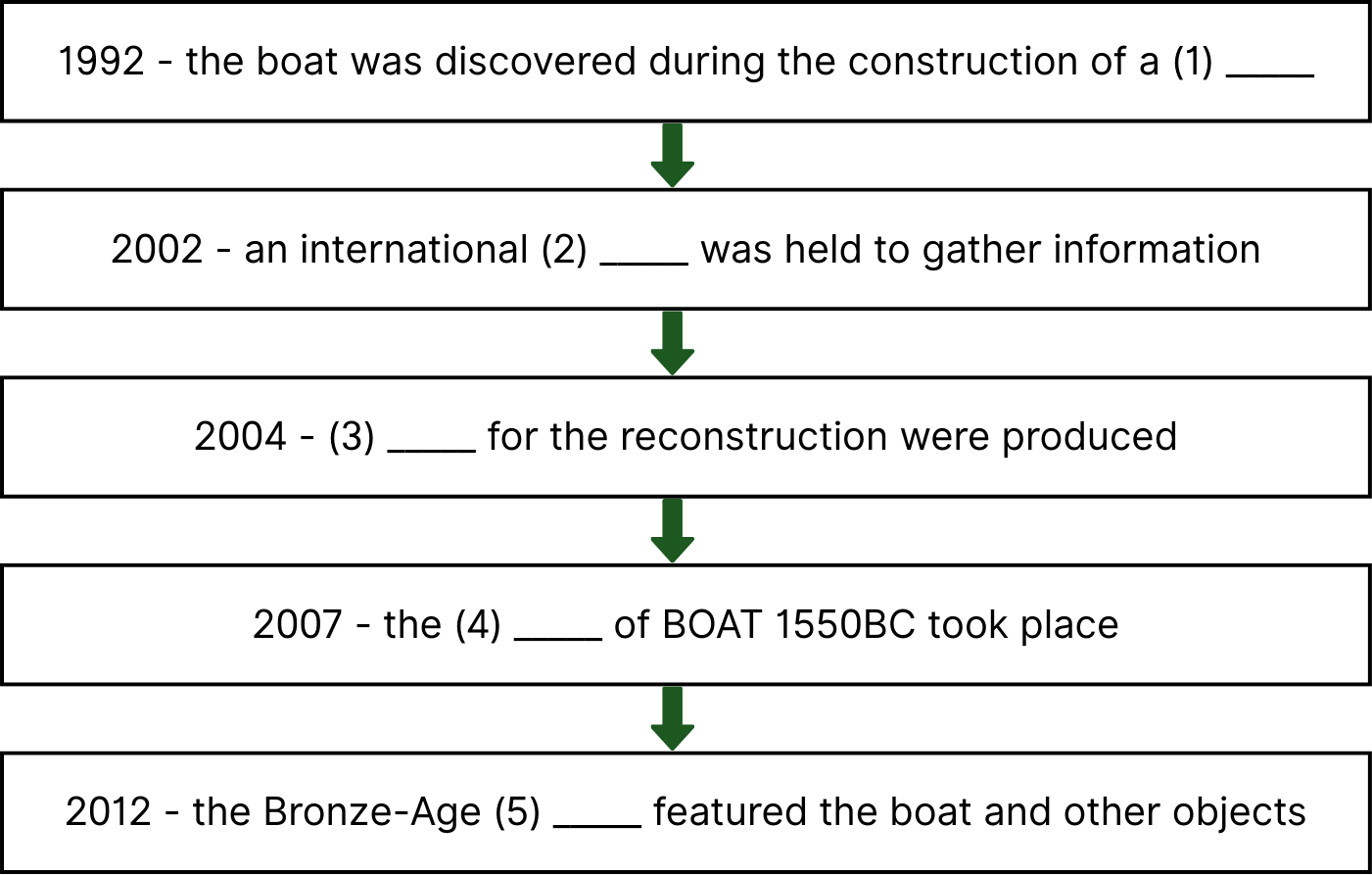
1992 - the boat was discovered during the construction of a .
2002 - an international was held to gather information.
2004 - for the reconstruction were produced.
2007 - the of BOAT 1550BC took place.
2012 - the Bronze-Age featured the boat and the other objects.
Choose NO MORE THAN THREE WORDS AND/OR A NUMBER from the text for each answer.
1. How far under the ground was the boat found? -
2. What natural material had been secured to the boat to prevent water entering? -
3. What aspect of the boat was the focus of the 2012 reconstruction? -
Complete the second sentence, using the word given so that it has a similar meaning to the first sentence. Do NOT change the word given in brackets in any way.
Addicts of computer games struggle to distinguish the virtual world from the real world. (DRAW)
=> Those obsessed ...........
Complete the second sentence, using the word given so that it has a similar meaning to the first sentence. Do NOT change the word given in brackets in any way.
Martine cannot go any higher in his career. (PINNACLE)
=> Martine ............
Complete the second sentence, using the word given so that it has a similar meaning to the first sentence. Do NOT change the word given in brackets in any way.
They remain close friends despite having had many arguments. (FALL)
=> Frequently as ..........
Complete the second sentence, using the word given so that it has a similar meaning to the first sentence. Do NOT change the word given in brackets in any way.
Every student will try very hard to get good marks to express their gratitude towards teachers. (LENGTHS)
=> Every student ..........
Complete the second sentence, using the word given so that it has a similar meaning to the first sentence. Do NOT change the word given in brackets in any way.
A great many people will congratulate her if she wins. (SHOWERED)
=> She will ..........
Complete the second sentence, using the word given so that it has a similar meaning to the first sentence. Do NOT change the word given in brackets in any way.
Looking at Joan's holiday snaps made Rita want to travel abroad. (WHETTED)
=> Joan's holiday snaps travel.
Complete the second sentence, using the word given so that it has a similar meaning to the first sentence. Do NOT change the word given in brackets in any way.
If you need her to, she can prepare a delicious meal in about half an hour. (RUSTLE)
=> Should the a delicious meal in about half an hour.
Complete the second sentence, using the word given so that it has a similar meaning to the first sentence. Do NOT change the word given in brackets in any way.
There are so many different styles of ethnic cuisine to choose from these days. (SPOILT)
=> These days, we to ethnic cuisine.
Complete the second sentence, using the word given so that it has a similar meaning to the first sentence. Do NOT change the word given in brackets in any way.
It's unlikely that this government will win the next general election. (ODDS)
=> the next general election.
Complete the second sentence, using the word given so that it has a similar meaning to the first sentence. Do NOT change the word given in brackets in any way.
She was unable to understand anything about what the teacher was explaining in class. (HEAD)
=> She could what the teacher was explaining in class.