Đề số 10 luyện thi vào 6 môn Tiếng Anh trường THCS Năng Khiếu ĐHSP
8/1/2026 7:00:00 AMRead the following passage and choose the correct answer to each of the questions.
Animal Intelligence: The Minds of Crows and Dolphins
For many years, scientists believed that only humans had the ability to think logically and use tools. However, recent studies on animal intelligence have shown that both crows and dolphins possess remarkable cognitive skills that challenge this traditional view.
Crows, in particular, have surprised researchers with their advanced problem-solving abilities. In one famous experiment, a crow named Betty was placed in a room with a straight piece of wire and a small bucket of food inside a glass tube. The food was too deep to reach with her beak. Betty independently bent the wire into a hook shape and used it to pull the food out. This demonstrated an understanding of cause and effect, as well as the ability to create tools without prior training.
Similarly, dolphins are widely known for their large brains and complex social structures. Marine biologists have discovered that dolphins use a sophisticated system of clicks and whistles to communicate with one another. These sounds are not just random noises; they function much like a language. Each dolphin even has a unique "signature whistle," which acts like a personal name to identify themselves to others in their pod. Furthermore, dolphins have been frequently observed working together to catch fish, showing advanced teamwork and planning.
While crows and dolphins live in completely different environments, their intelligence shares common traits. Both species can adapt to new situations, communicate effectively, and solve complex problems. These discoveries suggest that high levels of intelligence can evolve in various forms across the animal kingdom.
According to paragraph 1, what did scientists traditionally believe about intelligence?
- Both humans and certain animals could use tools.
- Only humans possessed logical thinking and tool-making skills.
- Crows and dolphins were the smartest animals on Earth.
- Animal intelligence was completely impossible to measure.
What did the crow named Betty do to solve her problem in the experiment?
She broke the glass tube and used her beak to get the food.
- She used a pre-made hook provided by the researchers.
- She changed the shape of a straight wire to reach the food.
- She waited for the researchers to remove the bucket.
What is the primary purpose of a dolphin's "signature whistle"?
- To confuse the schools of fish they are trying to catch.
- To warn other dolphins about approaching predators.
- To copy the sounds made by different marine species.
- To introduce and identify themselves to their group.
What is the main conclusion drawn at the end of the passage?
- Crows and dolphins are fundamentally more intelligent than humans.
- Intelligence is exclusively found in animals with very large brains.
- Crows and dolphins share a similar environment that makes them smart.
- High intelligence can develop in different ways among various animals.
Choose the sentence that is CLOSEST in meaning to the sentence given.
Looking at the painting, I couldn't help feeling amazed by the artist's talent.
- I found it impossible not to be impressed by the creator's skill when viewing the artwork.
- I couldn't offer any help to the artist despite being amazed by the painting.
- The artist was completely amazed by the painting because it showed a lot of talent.
- I decided to look at the painting in order to feel amazed by the artist's talent.
Choose the sentence that is CLOSEST in meaning to the sentence given.
On his first day, Tom told a funny story to break the ice with his new colleagues.
It was his colleagues who told Tom a funny story to welcome him.
Tom's funny story made his new colleagues feel less awkward with him.
Tom's funny story confused his new colleagues on his first day.
Tom avoided talking to his colleagues about his stories on his first day.
Choose the sentence that is CLOSEST in meaning to the sentence given.
He only meant to sketch for a few minutes but ended up spending the whole afternoon drawing.
- He spent the whole afternoon trying to sketch something in just a few minutes.
- Although his intention was to draw for just a short while, he spent the entire afternoon doing it.
- He only sketched for a few minutes before spending the rest of the afternoon doing something else.
- He had to spend the whole afternoon drawing because he was told to sketch for a few minutes.
What does the notice say?

- You may upgrade your seats for an additional fee.
- Seat changes are allowed up to 24 hours before the show.
- Customers can't ask for different seats after they've paid.
- You can pick new seats at the city theater.
What does the notice say?

- You can order this meal at any time.
- This café serves only healthy food.
- It's cheaper to eat here at less busy times.
- The prices change depending on the time of day.
Everything stored in the freezer stays frozen. Every ice cream container is stored in the freezer. Therefore, _____.
everything frozen is ice cream
every freezer contains ice cream
everything that stays frozen is in freezers
every ice cream container stays frozen
Choose the shape that completes the bottom pair so it shares the same relationship as the top pair.
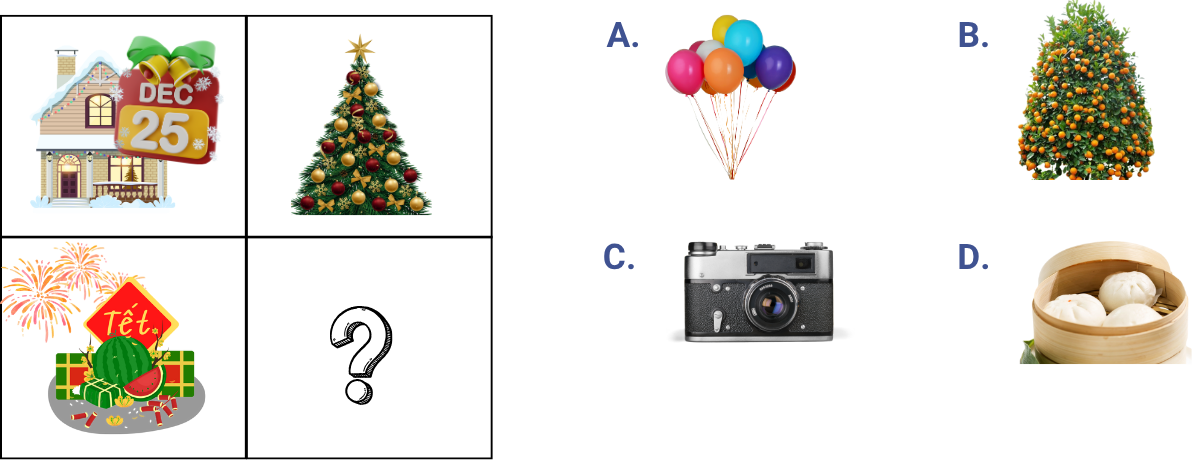
Shape A
Shape B
Shape C
Shape D
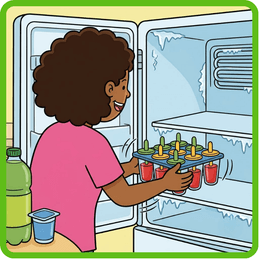
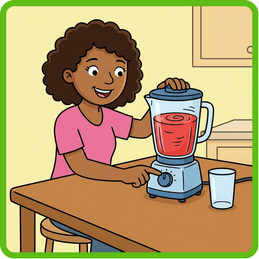
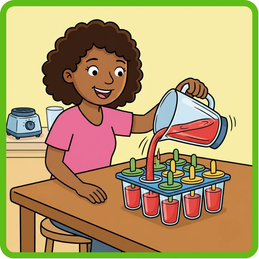
Mom removed the stems of fresh strawberries, blended them until smooth in a blender, and poured the blended mixture into an ice cream mold. Which photo is the missing step?

Read the text and choose the best answer to fill in the blanks.
Some people think teenagers are too young to run a class while still being students, but that is not true. In a new government scheme, sixteen-year-olds are already helping to teach lessons to primary school children, since the scheme allows school leavers to as teaching assistants in local primary schools. Head teachers say the extra support is welcomed. New rules were recently introduced allowing primary school teachers more time during the school day to focus on their lessons properly before each class begins, even though this sometimes leaves less time for actual teaching. To fill this gap, teenagers now step in instead of the missing teachers. They complete a two-year course starting at age fourteen, which gives them a valuable in their careers. Supporters call this a fair opportunity for young people. The government believes that about 18,000 teenagers could get jobs in this , although many people still doubt whether such young teenagers can really manage a full class of children.
Read the passage below. Are the following sentences 'Right' or 'Wrong'? If there is not enough information to answer 'Right' or 'Wrong', choose 'Doesn't say'.
The invention of the modern microwave oven occurred completely by accident during a routine scientific experiment. In 1945, a talented American engineer named Percy Spencer was working on complex radar equipment for a large military organization. While he was carefully testing a new vacuum tube, he suddenly noticed that a solid chocolate bar in his pocket had completely melted. Because he was incredibly curious about this strange phenomenon, Spencer decided to run several more experiments using different types of food. First, he successfully popped dry popcorn kernels, and then he managed to cook a raw egg until it suddenly exploded. Spencer quickly realized that the invisible radio waves were generating heat directly inside the food itself without any fire. Shortly after these successful initial tests, his engineering company finally built the world's first commercial microwave oven in 1947. This original machine was nearly two meters tall, and it weighed over three hundred kilograms, making it entirely unsuitable for regular home kitchens. However, as electronic technology gradually improved over the next two decades, engineers managed to design much smaller and significantly cheaper versions. By the late 1970s, the modern microwave had successfully become an extremely popular appliance in millions of households worldwide. Today, this incredibly convenient device allows busy families to easily prepare hot meals in just a few short minutes.
Spencer wanted to invent a new machine for cooking food in 1945.
Right
- Wrong
Doesn't say
The military organization rewarded Spencer for his surprising accidental discovery.
- Right
- Wrong
- Doesn't say
The first commercial microwave was too large for normal houses.
- Right
Wrong
Doesn't say
Engineers needed fifty years to create smaller versions of the microwave.
- Right
- Wrong
- Doesn't say