Đề số 12 luyện thi vào 6 môn Tiếng Anh trường THCS Năng Khiếu ĐHSP
8/1/2026 7:00:00 AMRead the following passage and choose the correct answer to each of the questions.
In 2009, British engineer Laurence Kemball-Cook invented Pavegen, a special floor tile that turns footsteps into electricity. The idea came from a simple question: every day, millions of people walk over train stations, streets, and shopping malls, but all that movement is wasted. Kemball-Cook wanted to capture it.
Here's how it works. Each tile has a small generator inside. When someone steps on the tile, it presses down by about ten millimetres. This movement spins the generator, which produces electricity — usually between three and eight watts for each single step. That's not a lot of power from one person. But Pavegen tiles are often placed in very busy locations, so the numbers add up fast. In one case, a train station used tiles across a small area, and thousands of daily footsteps produced enough electricity to help power the station's lighting.
Pavegen tiles have now been installed in more than forty countries, in airports, schools, and shopping streets. They have also appeared at music festivals and concerts, where dancing crowds generate electricity for light displays. During the Coldplay World Tour, for example, fans powered part of a light show just by moving to the music.
However, Kemball-Cook is honest about the limits of his invention. He has said clearly that kinetic tiles will never power an entire city by themselves. Instead, he believes they can teach people about clean energy in a fun, visible way — because most of us never think about the energy in our own footsteps.
- By combining energy from thousands of footsteps.
- By generating huge power from single steps.
- By absorbing natural heat from busy streets.
- By using internal batteries to store power.
What happened during the Coldplay World Tour?
- The band played their instruments much louder.
The dancing crowd helped power the light show.
- The organizers powered the whole music venue.
- The fans bought special shoes for dancing.
What can be inferred about Kemball-Cook's invention?
- It is considered completely useless for modern cities.
- It will eventually provide enough energy for major cities.
- It is more useful for education than for creating power.
- It is much too expensive for use in public areas.
What is the author's primary purpose?
- To present the future prospects of using kinetic tiles in tourism.
- To explain how this new technology can actively promote public health.
- To encourage people to participate in producing local renewable power.
- To introduce technology converting movement into electricity.
Choose the sentence that is CLOSEST in meaning to the sentence given.
Although she had fully recovered from her knee injury, Emily hesitated to join the marathon.
- Emily will join the marathon as soon as she has fully recovered from her recent knee injury.
- Emily hesitated to join the marathon because she had not completely healed from her knee injury.
- Emily joined the marathon without hesitation even though she hadn't fully recovered from her knee injury.
- Despite having completely healed from her knee injury, Emily was reluctant to participate in the marathon.
Choose the sentence that is CLOSEST in meaning to the sentence given.
This project has been put on ice until the school has enough resources.
- Doing this project is like skating on thin ice due to the school's lack of resources.
- As soon as the school has the needed resources, this project will see the light of day.
- Until the school has all the necessary resources, this project is being put on hold.
The school decided to put this project on ice because of the students' poor academic performance.
Choose the sentence that is CLOSEST in meaning to the sentence given.
After living abroad for a year, she got used to checking messages in a different time zone.
- Living overseas for a year made her accustomed to checking messages in another time zone.
- She used to check messages in a different time zone during the year she lived in another country.
She decided to live abroad for a year so that she could get used to checking messages in a different time zone.
It will take her exactly a year of living abroad to get used to checking messages in a different time zone.
What does the notice say?
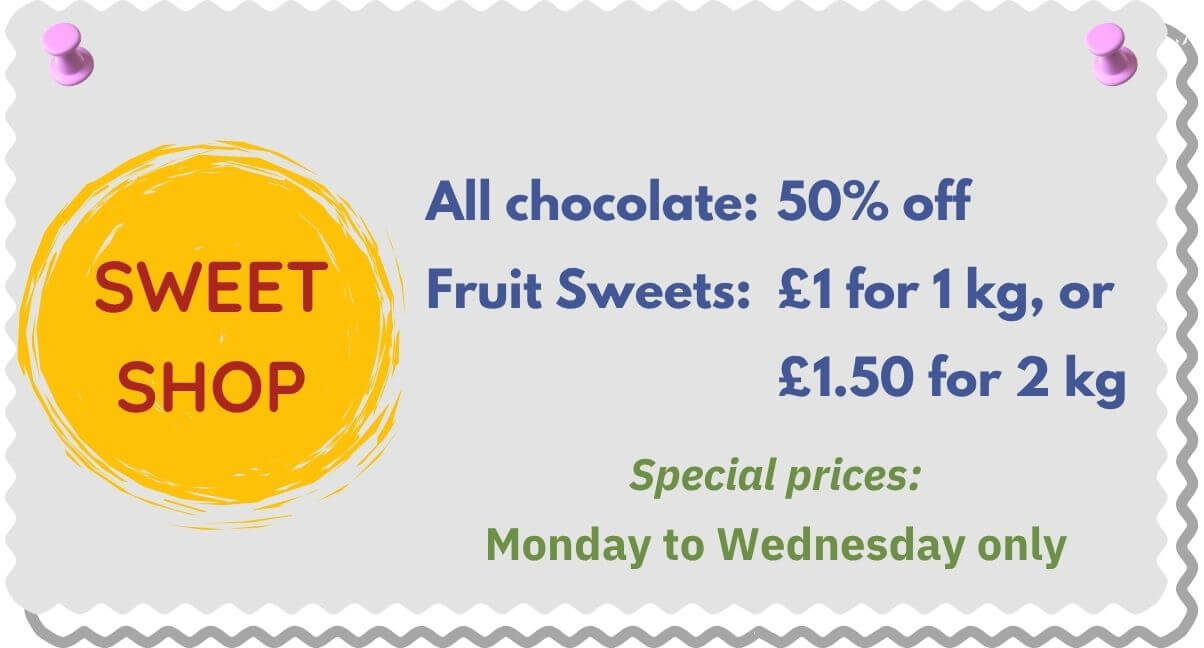
- The offer is available all week.
- 2 kilograms of sweets cost £1.50 more than 1 kilogram.
- Chocolate and sweets are sold at half price 2 days a week.
- You can buy chocolate at half its usual price.
What does the note say?
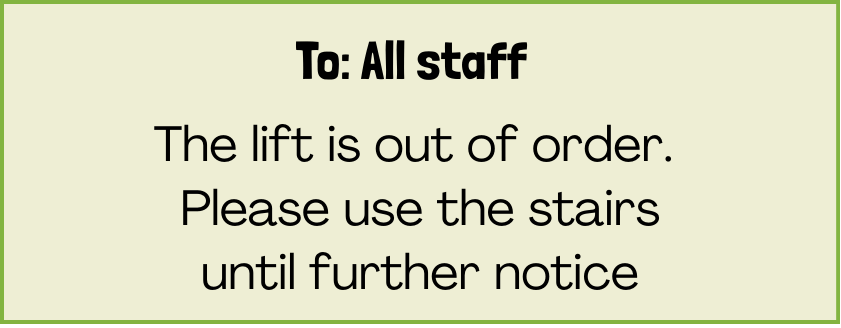
- The lift will be repaired at a specific time tomorrow.
- Staff should wait for a notice before using the stairs.
- You cannot use the lift to move between floors for now.
- The stairs are closed while the lift is being fixed.
All healthy snacks contain nutrients. All fruits are healthy snacks. Therefore, _____.
all healthy snacks are fruits
all fruits contain nutrients
all things with nutrients are healthy snacks
all nutrients come from fruits
Choose the shape that completes the bottom pair so it shares the same relationship as the top pair.
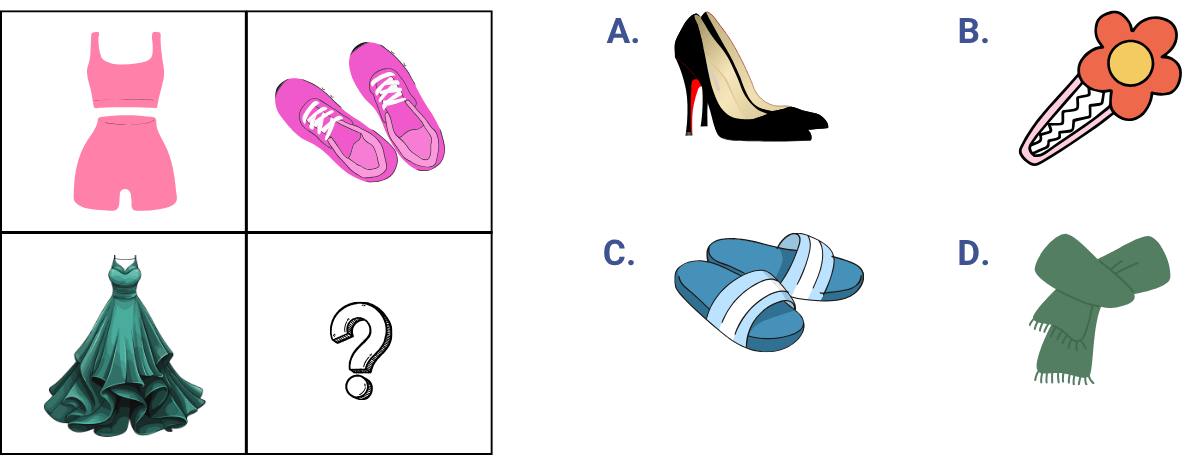
Shape A
Shape B
Shape C
Shape D
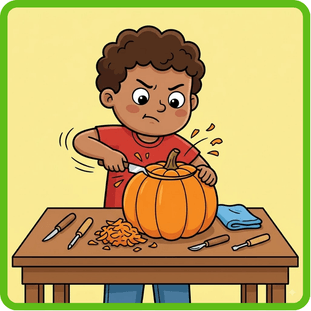
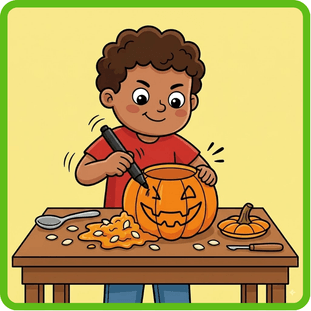
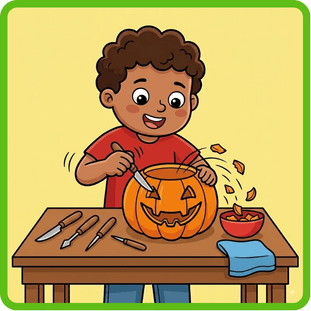
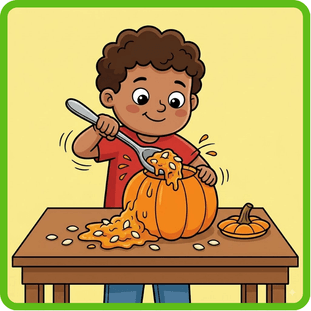
David is making a spooky Jack-o'-lantern for Halloween. He has carefully cut off the top of the pumpkin to make a lid, scooped out all the seeds from the inside, and carved out the eyes and mouth to finish the face. Which photo shows the missing step?
Read the text below and decide which answer best fits each space.
Honey is a natural sweet liquid produced by honeybees. It mainly of water and natural sugars. To produce just half a kilogram of honey, bees must fly thousands of kilometers and visit millions of flowers. The flavor and color of honey depend heavily on the flowers visited. In , there are more than three hundred of honey worldwide, ranging from mild and light to rich and dark.
In ancient times, honey was the primary sweetener because sugar was extremely rare. It was highly valued by ancient Egyptians, who even used it as money.
Today, honey is consumed across the globe. Research shows that it helps fatigue and boosts physical performance. Beyond its taste, honey is also used to soothe sore throats and enrich beauty products.
Read the passage below. Are the following sentences 'Right' or 'Wrong'? If there is not enough information to answer 'Right' or 'Wrong', choose 'Doesn't say'.
Have you ever wondered why it is incredibly difficult to stop watching short-form videos on popular applications like TikTok or YouTube Shorts? The answer actually lies deep inside your head, where a special chemical called dopamine controls how you experience pleasure and happiness. Every time you swipe up to reveal a funny video, your excited brain instantly releases a small burst of dopamine. Because this natural chemical makes you feel wonderful, your mind constantly demands more screen time, which creates a powerful scrolling habit. Furthermore, these modern digital platforms use complex computer programs, known as algorithms, to track your personal viewing preferences. If you watch an entire clip about cute animals, the algorithm will quickly find and display similar content to keep your attention. While these entertaining applications are perfectly safe in moderation, scientists warn that continuous scrolling can negatively affect a person's natural attention span. When young viewers become completely accustomed to fast-paced entertainment, they often struggle to concentrate on slower activities like reading books or finishing homework. By understanding exactly how these applications trick the human brain, teenagers can easily create healthier digital habits and set better daily limits. Finally, taking regular breaks from glowing screens allows your busy mind to rest and recover from constant digital stimulation.
Dopamine is a chemical released in the brain when people feel scared.
- Right
- Wrong
- Doesn't say
Computer programs track what you watch to show you similar videos.
- Right
- Wrong
- Doesn't say
Nighttime screen use can cause serious sleep problems for young teenagers.
- Right
- Wrong
- Doesn't say
Watching fast-paced videos makes it more difficult to focus on reading.
- Right
- Wrong
- Doesn't say