B1 PET Test #12 - Reading
5/26/2020 5:17:00 PMChoose the correct answer that goes with this text.
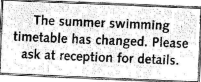
- You can get information about new time from the receptionist.
- Tell the receptionist about any change in your details.
- The swimming pool is open at the usual times.
Choose the correct answer that goes with this text.
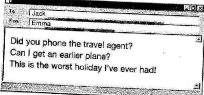
What does Emma want Jack to do?
- arrange another holiday
- fly out to meet her
- find out about flight time
Choose the correct answer that goes with this text.

- The store is closed, including delivery.
- Delivery is available despite the store closure.
- Customers can order on the website on July 24.
Choose the correct answer that goes with this text.
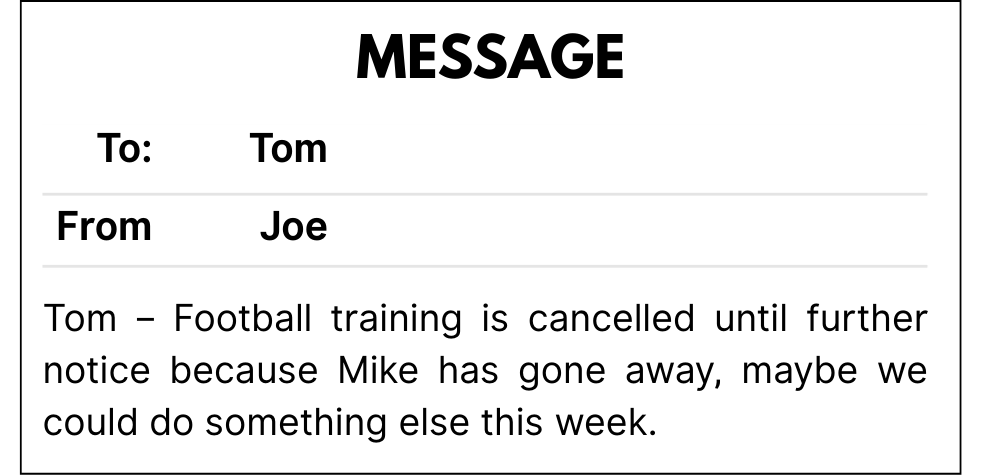
Tom and Joe aren't playing football because
- They're going away for a week.
- Mike will let them do something else.
- Training is on another day.
Choose the correct answer that goes with this text.
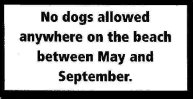
- Dog owners must avoid certain areas of the beach.
- You can never take your dog to this beach.
- Dogs are welcome at certain times of the year.
Read the following descriptions of eight videos.
BEST OF THE VIDEOS
|
A. Going Home B. The Lost Gold C. Wont Wishes D. Lonely Lives E. Perfect Couple F. My Father G. The Search H. Arrival Of A Stranger |
These people are choosing a video to hire for the evening. Decide which video would be the most suitable for each person.
Sarah enjoys watching films that scare her if they are well-made. She doesn't like to be able to guess what's going to happen.
Maria prefers serious films that are about people and relationships. She likes watching stories that take place in the past.
Simon has a job and relaxes by watching fun films that entertain him and are easy to understand. He likes to laugh and he likes to guess going to happen!
Juan likes films that make him think, but doesn't like to be scared. He's also keen on history and sport.
Sally enjoys well made and serious crime stories. She likes films that surprise her but isn't keen on love stories.
Read the passage and answer the questions.
First Time in the Air
When John Mills was going to fly in an aeroplane for the first time, he was frightened. He did not like the idea of being thousands of feet up in the air. "I also didn't like the fact that I wouldn't be in control," says John. "I am a terrible passenger in the car. When somebody else is driving, I tell them what to do. It drives everybody crazy."
However, John couldn't avoid flying any longer. It was the only way he could visit his grandchildren in Canada. "I had made up my mind that I was going to do it. I couldn't let my son, his wife and their three children travel all the way here to visit me. It would be so expensive for them and I know Tom's business isn't doing so well at the moment. It would also be tiring for the children - it's a nine-hour flight!" he says.
To get ready for the flight John did lots of reading about aeroplanes. When he booked his seat, he was told that he would be flying on a Boeing 747, which is better known as a jumbo jet. "I needed to know as much as possible before getting on that plane. I suppose it was a way of making myself feel better. The Boeing 747 is the largest passenger aircraft in the world at the moment. The first one flew on 9th February 1969 in the USA. It can carry up to 524 passengers and 3,400 pieces of luggage. The fuel for aeroplanes is kept in the wings and the 747's wings are so big that they can carry enough fuel for an average car to be able to travel 16,000 kilometres a year for 70 years. Isn’t that unbelievable? Even though I had discovered all this very interesting information about the jumbo, when I saw it for the first time, just before I was going to travel to Canada, I still couldn’t believe that something so enormous was going to get up in the air and fly. I was even more impressed when I saw how big it was inside with hundreds of people!"
The biggest surprise of all for John was the flight itself. "The take-off itself was much smoother than I expected, although I was still quite scared until we were in the air. In the end, I managed to relax, enjoy the food and watch one of the movies and the view from the window was spectacular. I even managed to sleep for a while! Of course," continues John, "the best reward of all was when I arrived in Canada and saw my son and his family, particularly my beautiful grandchildren. Suddenly, I felt so silly about all the years when I couldn’t even think of getting on a plane. I had let my fear of flying stop me from seeing the people I love most in the world. I can visit my son and his family as often as I like now!"
- He wanted to try it.
- He wanted to go on holiday.
- He wanted to see his family.
- He had to travel on business.
- He wanted to know how they work.
- It made him feel safer.
- It was his hobby.
- He had found a book on them.
What happened when John saw the jumbo jet for the first time?
- He felt much safer.
- He couldn’t believe how big it was.
- He liked the shape of it.
- He thought the wings were very small.
What surprised John about the flight?
- that he liked the food
- that there was a movie being shown
- that he was able to sleep
- that the view was good
- He thought he had wasted time being afraid.
- He realised that it was okay to be afraid.
- He hoped his grandchildren weren't afraid of flying.
- He realised that being afraid kept him safe.
Complete the passage. Write a letter from A-G in each blank. You don't have to write all the letters.
A. Often, they are worried about their children trying to do too much.
B. It's quite new and requires a lot of careful attention to keep it running smoothly.
C. Many students also take summer classes, usually to make up for bad grades during the year.
D. Perhaps they have to help out their families, or maybe they want to learn a particular skill or trade.
E. Night school is an educational option that exists in many countries of the world.
F. Some people don't think there's enough time in one day for both school and work and prefer to find another solution.
G. Students have the same facilities and the same requirements as their fellow students during the day.
Night School
Night school offers the same classes as regular secondary school except during evening hours. This evening programme allows students to continue working during the day and study at night. In most of them, formal schooling is compulsory until the age of 16 or 18, so young people who find themselves in need of work or have other important daytime obligations can finish their studies. For many people, it's the right choice.
Courses at night school are usually the same as those taught during the day. They are generally held in the same buildings, too. The only difference is that night school students go to school later!
Michael is a 17-year-old boy who works during the day on his family's organic farm. Michael's father runs the farm now, but one day it will be Michael's responsibility, which is why he needs to learn as, much as he can about the business. Since he didn't want to stop his schooling in order to work, he enrolled in night school. "It was a bit strange at first," he says, "working all day then going to school in the evening, but I soon got used to it."
Not everyone, of course, thinks that night school is the answer. Take David for example. He's a teenager who tried going to night school for a while so he could train as a carpenter with his uncle during the day. "I was so tired after working all day that I didn't have the energy to go to school!" David decided to work part-time on weekends and finish school during the day.
Parents might also object to night school. Meg is a teenager who wanted to leave school to take up a career in modeling. "Mum and Dad thought I would never finish school that way. My parents think working and going to night school is too difficult for someone at my age." For most of the students who do enroll, however, night school is the answer they've been looking for. It is a challenge to balance work and school, and it's definitely not for everyone. But those who go to night school are really making the most of their time - day and night!
Read and choose the best answer for each space.
Lights! Camera! Action!
Which country has the largest film industry in the world? If you think it’s the USA, you're wrong. The answer is, in fact, India. Nearly 3,000 films were in India in 2009, around 1,300 of which were full-length feature films.
The most popular films are action, comedy and romantic musicals. The musicals are productions full of colourful costumes and scenery with huge casts, including many dancers and singers. lmagine, one Indian film had seventy-one songs in it! That's a lot of to remember!
Film critics say that most of these films tend to be predictable they have very similar situations, but it seems that the public doesn’t mind at all. In fact, millions of people both in India and the rest of the world are huge fans and can't wait for new films to be .
Indian cinema is often referred to as ‘Bollywood’, but it turns that the term is only correct for Hindi-language films; there are many other languages spoken in India. The name ‘Bollywood’ is a combination of Bombay (the city now called Mumbai) and Hollywood, but Bollywood isn’t a real place.
So if you're ever in India, don’t try to find it!
(Adapted from Close-up B1 Workbook)
Read the text and write the missing words. Write one word on each blank.
Losing
The aim of most games is (0) win, and we'd all win than lose. Winning is fine, of course, but whenever there's a winner there's always a loser, and losing is not usually very pleasant.
It's important to deal losing in the right way. It's not very helpful just to think "They have been very lucky to win," as this removes all responsibility from us. Similarly, if we just say, "I wish I a better player," we're not focusing on how to become that better player.
Losing can be helpful, though, if we into the causes of why we lost. It can help us improve. It's useful to think about your performance in terms of what you have done differently. We can avoid the same mistakes if we say to ourselves things like: "I ought to have attacked earlier," or "I would have scored that goal if I'd run a little bit faster."