B1 PET Test #31 - Reading
5/17/2021 5:14:00 PMChoose the correct answer that goes with this text.

- The stamps are all very old.
- Some of the stamps are very unusual.
- You can buy just a few of the stamps.
Choose the correct answer that goes with this text.
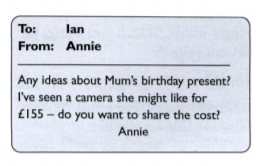
- Annie suggests that she and Ian give Mum one birthday present between them.
- The present Annie saw for Mum was too expensive, so she needs other ideas.
- Annie has already bought Mum's present but has seen something Ian could buy.
Choose the correct answer that goes with this text.
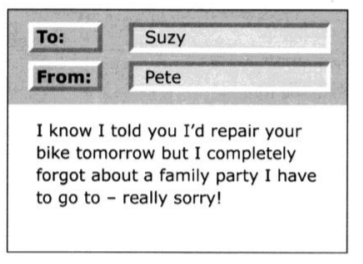
Why is Pete apologizing to Suzy?
- He can't go to the party with her.
- He can't do the favor he had promised.
- He hasn't had time to repair her bike.
Choose the correct answer that goes with this text.
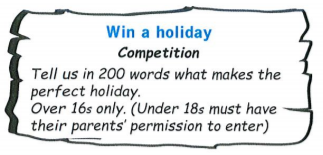
- The competition is open for families with teenagers only.
- People of all ages can participate in the competition if they wish.
- Your parents must approve of your entering the competition if you are not eighteen.
Choose the correct answer that goes with this text.

Mel is texting to _____.
- accept Sam's invitation to the cinema
- admit to Sam that she found the film scary
- ask when Sam can see another film with her
Read the following descriptions of eight programs.
|
A. Around the world B. Mickey Valdone C. A Lost World D. Young Dennis E. Ticket to Africa F. Where and when G. Sammy H. The House on the Hill |
The people below all want to watch a TV program. Decide which program would be the most suitable for each person.
Mitsuki likes reading and enjoys watching historical dramas which are based on novels. She would like to watch one which has some famous actors in it.
Callum wants to watch a comedy program. He would like to see something new which hasn't been on TV before. He prefers to watch short programs of about 30 minutes.
Keiko loves listening to music and reading about famous stars. She wants to watch some stars being interviewed and she'd like to see some live music in the same program.
Yann is interested in history and wants to watch a documentary which will tell him how people used to live in the past.
Ellen is looking for a program which she can watch with her children. Ellen is interested in current affairs and what's going on around the world. Her children like music.
Read the passage then choose the best answer to each question.
The price of a perfect holiday?
Cruises are becoming more and more popular, with around 20 million passengers per year now enjoying holidays onboard luxury ships. Many people see a cruise as the perfect way to sit back and do nothing and enjoy time off work. Everything you could possibly need is within easy reach. Onboard, there are shops, theatres, cinemas, swimming pools and leisure centers. There are more facilities, in fact, than most towns offer their residents. It’s therefore easy to see why they are so popular. But what is the effect on the environment of this trend?
Although it usually takes less energy for a vehicle to move through water than over land, cruise ships are often huge, with the biggest ones carrying up to 6,000 passengers. Moving such large vehicles requires enormous engines, which burn as much as 300,000 liters of fuel a day. One scientist has calculated that cruise ships create as much pollution as 5 million cars going over the same distance. Because they are out at sea, they also burn dirtier fuel that isn't allowed on land. Unfortunately, no government has control over the amount of air pollution out at sea.
Cruises also produce huge amounts of rubbish, and cruise ships aren’t usually good at recycling. Wastewater from showers and toilets is usually poured directly into the sea - as much per day as from a small town. Waste food from restaurants isn't put into the sea, but still causes problems when brought back to the land.
Cruise ships also cause difficulties in the cities where they stop. Popular destinations can get five or six ships per day, with thousands of tourists at a time. Good for restaurants? No. Restaurant owners complain that the visitors look around for a few hours and then return to their ship to eat. What’s more, the crowds can put off other tourists, who complain that the streets are too busy. Some towns have banned cruise ships or put a limit on the number that can stop at the same time. People who care about the environment worry that as the cruise industry continues to grow, so will the issues for our planet.
(Adapted from B1 EXAM BOOSTER)
- To persuade people to go on cruise ships
- To explain why cruise ships have become so popular
- To compare cruise ships with a typical holiday resort
- To describe how the services cruise ships offer have changed
One reason cruise ships cause a lot of air pollution is because _____.
- they carry large numbers of cars as well as passengers
- their engines are not as efficient as those of other ships
- it takes more energy to move through water than overland
- they use types of fuel that are not permitted on land
- All the waste products are carried back to shore.
- Waste food is often thrown away at sea.
- Most cruise ships recycle their waste products.
- An enormous amount of the wastewater isn't recycled.
- Surprised that they are rude to other tourists
- Annoyed that they don’t spend money on meals
- Happy that they fill up all the restaurants
- Pleased to see so many visitors to the city
- They seem to offer ideal relaxing holidays, but they aren't environmentally friendly.
- They are becoming very popular and they bring a lot of benefits, in spite of their problems.
- They used to cause a lot of pollution, but things are improving now.
- They cause pollution in the sea and on land, so cities are planning to ban them in the future.
Five sentences have been removed from the text below.
For each question, choose the correct answer from A-H. There are three extra sentences that you do not need to use.
A. Paper flashcards work just as well but electronic flashcard programmes provide some great benefits.
B. But in reality, having goals doesn't help you achieve much.
C. If you don't set goals, how can you know what you want to achieve?
D. At this time, there is no point even trying to remember the word.
E. Luckily, you don't need to learn anywhere near that many words to be good at a language.
F. You should aim to learn about 5,000 words in a couple of weeks.
G. To get around this, simply use the word in a sentence in your native language.
H. Yet the idea of learning a language seems anything but fast.
Learning a language
Whatever your reason for learning a new language, you can probably agree it'd be ideal to learn it fast. You'll have to learn a new grammar, memorize vocabulary words, practice speaking, etc. But learning a new language does not need to be a slow or boring process if you follow the right strategy.
The first step to learning a new language fast is to set goals. When you think about it, this makes a lot of sense. When faced with the idea of learning a new language, most of us feel nervous. Setting goals helps you to focus.
Languages are made up of a shocking number of words. English, for example, has between 600,000 and 1 million words. Consider this: the top 100 words make up about 50 percent of English language texts, and the top 1,000 words make up about 90 percent! By focusing on learning these words first, you can increase the amount of information you understand very quickly.
One of the best ways to learn vocabulary words is to use flashcards. Flashcards allow you to test yourself, which helps you memorize new information. Try out electronic flashcards. You can easily carry large amounts of words on your smartphone or tablet, and you can take advantage of flashcards that other people have created and made public.
When you're learning a new language, it can be hard to practice words in context because you haven't mastered yet enough vocabulary to make complex sentences. For example, if you're learning the Spanish word "casa" (house), you could say, "I'm going to go to my casa now." You can also make up a sentence with the new word you're learning, the meaning of the word and a word in your own language that sounds similar.
(Adapted from Simply PET Preliminary for School)
Read the text and choose the best answer to fill in the blanks.
Filming Everest
Film-maker David Breashears (0) had already climbed Mount Everest three times when he to make a film so that audiences could share his .
He set off on this nine-week adventure the following spring, with his photographic equipment and with six climbers from around the world. the conditions were hard and dangerous, with temperatures of -40oC, the climbers made good . Then, when they were just one thousand meters from their goal, there was a terrible storm. The team didn't give , however. They hid in a tent on the mountainside until it passed. Thirteen days later they reached the top.
"I was so tired that it was impossible to enjoy our success at first," said David. "Climbing Everest is difficult enough but filming made it harder. I am really proud we did it in the end!"
(Adapted from EXAM EXTRA PET)
Read the text and write ONE word to fill in each gap.
KEEP CALM!
If you get really nervous when you have to perform in front of an audience, you're not alone. It's a very common fear. Even some very experienced actors and musicians get extremely anxious before performing. Some people say that feeling anxious makes give a better performance, but other people can feel nervous that they can't perform at all. This is a very serious problem it affects their confidence and can destroy their career.
The useful thing to do if you feel worried about a performance is to try to relax. Don't think about all the things that could go wrong. Instead, keep calm and think positively. Before the performance, imagine the audience clapping and laughing. Think about good you'll feel after a successful performance. And remember, if you make a mistakes, the audience probably won't even notice.