B1 PET Test #39 - Reading
8/24/2021 8:58:07 PMChoose the correct answer that goes with this text.
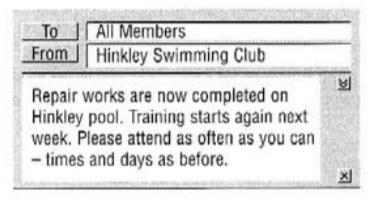
- You should inform the club if you cannot train at the arranged time.
- There are changes to the training times because of pool repairs.
- Training is at the same time as it was before the pool closed.
Choose the correct answer that goes with this text.

- Our staff can let you know about what we've used to make our dishes.
- Read the information on our menu if you need to avoid eating certain ingredients.
- Tell your waiter if you’d prefer something different from what's on the menu.
Choose the correct answer that goes with this text.
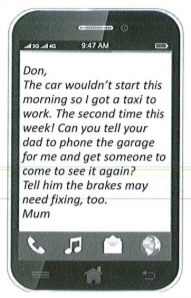
- Don's mum wants Don to contact his father and let him know about her car trouble.
- Don is expected to call the garage in order to arrange an appointment.
- Don's mum is checking whether Don has remembered to contact the garage.
Choose the correct answer that goes with this text.

- Students can get their ID cards in the canteen.
- Staff must bring their ID cards if they want to eat at the canteen.
- Students need to show staff their ID cards.
Choose the correct answer that goes with this text.
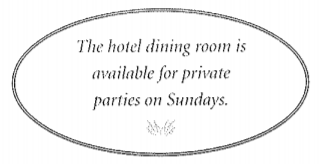
- You cannot eat here at weekends.
- Hotel guests can have parties in their rooms.
- It is possible to hire the dining room.
Read the following descriptions of eight magazines.
This Month's Pick of the Magazines
|
A. World of Sport B. History is Beautiful C. Footloose D. Green World E. Sport Business F. Plan for Success G. How We Live H. Pictures in Your Living Room |
The people below are all looking for a magazine to read. Decide which magazine would be the most suitable for each person.
Omar is interested in architecture and wants to know more about it. He would like to meet people with the same interest and to visit special buildings locally.
Cecile is very keen on sport and keeping fit and particularly enjoys long-distance running. She would like to improve her technique and perhaps find other people to run with.
Duncan enjoys spending his free time in the countryside, exploring different areas on foot, and by bike. He wants to know more about what he sees when he is exploring.
Heidi likes going to watch her favorite football team, although she usually has to work at weekends, organizing jazz concerts and festivals. She's keen to learn about the history of football.
Piotr is studying IT and Business at university, but he's very interested in modern art, although he's usually too busy to visit galleries and museums.
Read the text and questions below. For each question, choose the correct answer.
Night Work
Can you imagine what it would be like working at night? You'd start your day when everyone else was going to bed, and you'd go to bed when everyone else was getting up. Is that really a natural way to live?
These days, more and more jobs need to be done at night. Most big hotels offer 24-hour service, and need staff at reception and working in the bars. Many companies have 24-hour call centres to deal with emergency enquiries. There are 24-hour supermarkets, and of course, there are the workers for the emergency services such as fire-fighters, the police and hospital workers.
However, people can work well at night. This is partly because we cannot easily change our sleeping habits. Some people can manage on as little as three hours' sleep while others need as many as eleven hours, you're either a 'short sleeper' or a 'long sleeper'. If working at night stops you from getting the amount of sleep you need, you will damage your health.
The best part of the day for everyone is around lunchtime, and the worst point is between 2 a.m. and 4 am. So if you're driving home at this time or doing something important at work, things are far more likely to go wrong!
Humans are used to sleeping at night and being awake during the day, and they'll never be able to do things the other way round. The problem is that today's 24-hour society isn't going to slow down which means that night-workers will remain.
(Adapted from PET Practice Test 5 tests)
- To describe the importance of work
- To say how working at night can be bad for you
- To suggest how people can change their way of life
- To recommend people spend more time sleeping
- Many people refuse to work at night.
- It is easier than working during the day.
- It is easier to demand better working conditions.
- There is a variety of them.
- Everybody needs the same amount.
- It's difficult to change your sleeping needs.
- People sleep better in the early morning.
- Many people need more than 11 hours' sleep.
- Fewer people will work during the day.
- Some jobs will always be done at night.
- People will demand fewer services.
- People will work longer hours.
- A good night's sleep can change your life!
- A worker that sleeps more, works more!
- Society is changing but our bodies are not!
- The loneliest jobs in the world!
Five sentences have been removed from the text below.
For each question, choose the correct answer from A-H. There are three extra sentences that you do not need to use.
A. The police called the Kerry Mountain Rescue Team.
B. The hikers were huddled together in a small tent between two large rocks.
C. They said it's extremely dangerous to go hiking in bad weather.
D. Nobody answered back so we began to lose hope.
E. We didn't know they had already found their way home.
F. Suddenly, I heard the sound of a whistle.
G. We were just about to start eating when my phone rang.
H. After searching all night, we gave up and went back home.
Lost in the mountains
When you're a mountain rescue volunteer, you never know when you're going to be called to work. We go out in all weather and at any time of the day or night. If someone is in danger, there's no time to lose. On New Year's Day last year, I was sitting down to breakfast with my family. Two hikers had decided to celebrate the new year by walking along a mountain ridge in Country Kerry, Ireland, just a few miles from my home. They were staying in a small guest house and had set off early on New Year's Eve. When they didn't return by the following morning, their host became worried and called the police.
I was just one of 12 volunteers who left our breakfast tables and set out to look for the missing hikers. We pushed through strong winds and thick clouds, calling and listening over and over again. It was too cold to survive for long out on the mountains, and the hikers had been missing for a whole day and night. I shouted out and was relieved to hear a voice shout back. They were so happy to see us. They explained that they'd got lost, and the winds had been too strong for them to keep walking. Luckily, they had warm clothes, food, and the tent.
We led them back down the mountain and returned them to their guest house, where a delicious hot meal was waiting for them and for the rescue volunteer team. They said that they'll never forget that New Year's Day when they were rescued by local people who became heroes.
(Adapted from B1 Preliminary EXAM TRAINER)
Read the text and choose the best answer to fill in the blanks.
"Ask your pharmacist first"
When you have so many to do at school and even some homework back at home, the last thing you want is a(n) throat or a headache to drag you down.
"Prevention is better than cure" is what most people say, meaning that it is always best to try no to get sick than to find ways to get better when you do. But what happens when you haven't yourself for the winter? At some point in autumn, you'll start feeling down and that's when you should remember that a visit to your pharmacy can be a real bonus in helping you get well soon.
But it's not just the medicine that assists the cure - only at a pharmacy will you find expert from a highly trained health professional. Your pharmacist will gladly what he believes is the best for you. So, by working together, you can be sure that your medications are taken safely and effectively to maintain your good health.
(Adapted from Succeed in Cambridge English B1)
For each question, write the correct answer in the gap. Write ONE word or a number, a date, a time.
The Koala
We're leaving Australia soon and we've just met that well-known symbol of Australian wildlife, the koala. I've always called them koala bears, but they are a member the marsupial family.
They are only two centimeters long when first come into the world and spend the first six months living in their mother's pouch before moving on to her back for a further six months.
They live on eucalyptus leaves, which they eat huge amounts of, up to 1 kilogram day. One benefit of this diet is that they rarely need to drink water as they get from these leaves. They can live for up to 15 years in the wild and as long as 20 years when cared for in zoos or nature reserves.
Unfortunately, as more of these eucalyptus trees cut down, we are seeing a fall in number of koalas.
(Adapted from PET Collins 8 TESTS)