B1 PET Test #46 - Reading
10/11/2021 8:19:08 AMChoose the correct answer that goes with this text.

- Details of student's new timetables are available from the collage office.
- You should let the college office know if you get a new phone number.
- All requests for course changes must be made through the college office.
Choose the correct answer that goes with this text.
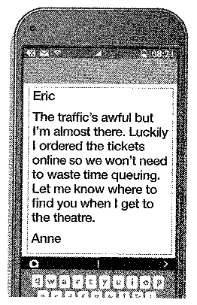
Why is Anne texting?
- To ask Eric if he can do her a favor
- To remind Eric about what they have agreed
- To give Eric an update regarding their arrangement
Choose the correct answer that goes with this text.
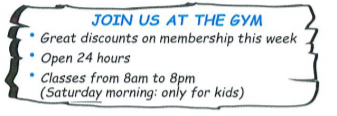
- Classes are offered 24 hours daily.
- It is cheaper to join the gym if you do so this week.
- Weekend classes at the gym are offered for everyone.
Choose the correct answer that goes with this text.

- We need to change the training time because it's full at 2 p.m. this week.
- We may have to train with a different team this week.
- We must go training at a later time this week.
Choose the correct answer that goes with this text.
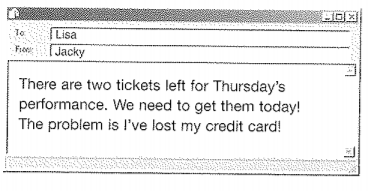
What does Jacky want Lisa to do?
- Cancel an arrangement
- Find her credit card
- Buy some tickets
Read the following descriptions of eight free-time activities for people wanting to find.
Activity clubs
|
A. Think! B. Games and chat C. Party Plus: D. Come dine with me E. Nature lovers F. Action! G. A world of food H. City explorers |
The people below all want to find a new free-time activity. Decide which free-time activity would be the most suitable for each person.
Emma loves using her imagination in a creative way. She loves working on projects with other people, and she would like to visit places and see creative people at work.
Marco loves making things, and he enjoys meeting people from other cultures. He would like to learn a skill that he can use outside the class.
Amina is interested in serious issues. She enjoys listening to talks and learning about life in other countries. She would also like to discuss her ideas and opinions with other people.
Niko enjoys going to different places and meeting people from different backgrounds. He's also keen to find out about the place where he lives. He's especially interested in history.
Erica is keen to help other people. She enjoys events where there are crowds of people. She wants to learn skills she can use in a job when she finishes her studies.
Read the text and questions below. For each question, choose the correct answer.
Tom Avery is the youngest Briton to have reached both poles. He and his team recently followed the route taken by Robert Peary in his 1909 expedition to the North Pole.
Both men left from Cape Columbia in Canada but Peary's team was larger. Peary also had four support groups and every 160 kilometres a group would leave food behind and turn back. This meant the team decreased in size as he went north. Avery's team didn't have the extra men, but they had food dropped by plane at four locations.
Although Avery's team had the benefit of modern technology, Avery thinks this did not make much difference. "Your speed depends on the dogs and how quickly you can get a sledge through the ice. We also had to deal with the same dangers. At the end of winter, some ice is only 7 centimetres thick and it can break easily under your weight. Peary was also more experienced than us and had been on several expeditions to the Arctic.
Avery believes they owe their success to the 16 Inuit dogs that pulled the sledges. "Our dogs worked in teams of 8. They kept us going. In the evenings, I would thank every one of them."
"Travelling with dogs is the best form of Arctic transport. You cannot do the journey in that time by any other method".
Some historians say that Peary could not have reached the North Pole in 39 days. But Avery's team actually beat this time, becoming the fastest to reach the North Pole on foot. Avery says, "We told everyone it could be done so it was important not to fail. But it was hard, especially towards the end when the ice was melting quickly."
(Adapted from PET Practice Test Plus 2)
- To explain why people travel to the North Pole
- To suggest possible ways of reaching the North Pole
- To describe two challenging journeys to the North Pole
- To compare the characters of people who went to the North Pole
How was Avery's North Pole expedition different from Peary's?
- Avery's team was larger.
- Avery's team was supplied by air.
- They did not take the same route.
- They did not leave from the same place.
Avery believes that having modern technology _____.
- was of limited importance
- helped them to travel faster
- improved the safety of the whole team
- prevented them experiencing the real North Pole
- He regretted not taking more dogs.
- He thought they were well trained.
- He was very grateful to the dogs.
- He was surprised by their speed.
- How to lead a team
- An accident in the Arctic
- Discovering new routes
- Proving it's possible
Five sentences have been removed from the text below.
For each question, choose the correct answer from A-H. There are three extra sentences that you do not need to use.
A. I'm the only woman in this group.
B. That was a very long time to live in space.
C. People often ask what food tastes like in space.
D. This stops everything floating away while we eat!
E. On the other hand, the ISS is a perfect environment to do scientific experiments.
F. That's the meeting where we discuss what needs to be done during the day.
G. They like my desserts, and they have a dark bread that I love.
H. I'll never forget looking through the window and seeing it for the first time.
A day in the life of an astronaut
Italian astronaut Samantha Cristoforetti talks about daily life on the International Space Station (ISS).
For the last few months, my home has been the International Space Station, orbiting 400 km above the surface of the earth, at 25,000 km per hour. We took off in a Russian Soyuz spaceship from Kazakhstan, and the flight to the Space Station took six hours. I felt incredibly excited.
There are two Americans, three Russians, and me. Fortunately, we all get on well. The day starts for everyone at 7 a.m. There's no gravity up here, so every morning I float through the cabin to attend our daily planning conference or DPC. It usually lasts a few minutes. After it's finished, we speak to space centers around the world, including Houston (USA), Munich (Germany), and Tsukuba (Japan).
Then we have breakfast: oatmeal, eggs, and coffee. In the past, astronauts had to suck food out of tubes. Nowadays, astronauts' food is served in special individual boxes with covers. Life has become much easier for astronauts over the years.
Our dinner is at around 7.30 p.m. My meals were prepared by an Italian chef on Earth before I left, and they're delicious. However, I do exchange a lot of food with my three colleagues from Russia. Their lentil and vegetable soup is also really good. Of course, I miss fresh food, but a cargo spaceship comes once a month with fresh fruit. When I get back down to Earth, I know I'll miss this place.
Read the text and choose the best answer to fill in the blanks.
Most people live in flats or houses, but right now biologist Emilia Ruiz is waking up somewhere in the Pacific Ocean because her home is a 20-meter boat. She has the last two years sailing with her colleagues Ryan and Charlie, who are also scientists.
Emilia's work of studying large sea creatures such as whales and dolphins as they cross the oceans, so she often travels very long distances and has friends all over the world. She is doing a Master's degree online and her studies are going well.
Her way of life, though, is sometimes uncomfortable. Space on her board is limited and bad that lasts days is common, in winter. Storms at sea can be frightening, although modern boat equipment usually helps sailors them and Emilia nearly always feels safe. She contacts friends by social media and whenever they get together they have great fun in the places they visit.
For each blank, write the correct answer. Write ONE word or a number, a date, a time.
Sir David Attenborough - Blue Planet
Probably most famous nowadays for the series Blue Planet, Attenborough has made viewers wake up not only to the beauty of our planet but to the danger we have put it in. After being delighted the wonderful photography and Attenborough's well-known way of keeping us fixed to our TV screens, the final episode showed us the reality. We saw the pollution of our seas and the damage that is doing to the sea creatures affected by the rubbish, which is now everywhere. It caused a shock that promises of change were quickly made by the government.
Attenborough has an amazing ability to influence public opinion. He argues that with fifty percent of the total population living in cities, people to be shown nature, even on TV, as they are not connected to it anymore. Only , in his opinion, can we persuade people to take care of it.
(Adapted from Simply PET Preliminary for School)